Bosque Stars
by Keith Bauer
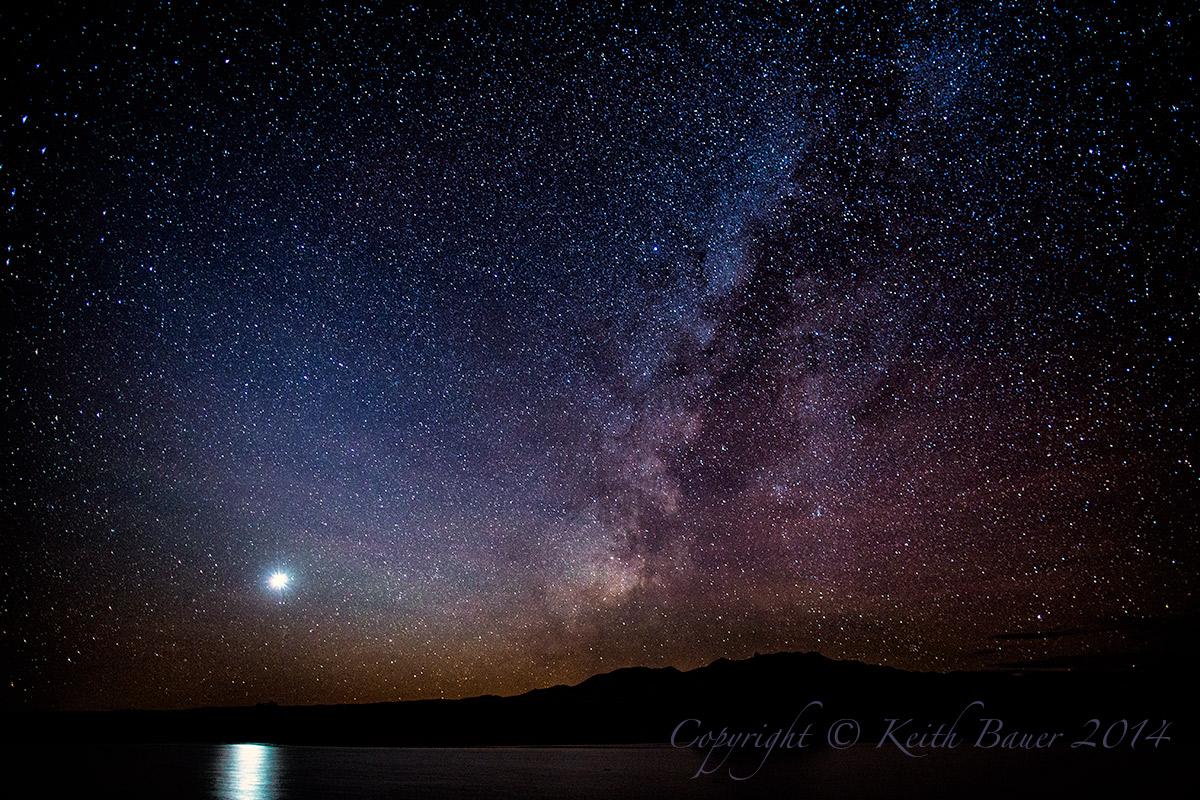
Yep, there's a lot more to Bosque Del Apache than birds. During our workshop last December we stayed out a bit later one evening to work with the group on taking some night images. I had a blast, and I think the workshop participants did as well. This is one of the images.
The bright star is Venus, and I was very surprised to see the bright reflection in the water that it generated.
Canon 5D Mark III
24mm f/1.4 L II
20 seconds @ f/2.0, ISO 1600
Larger version included.

Comments
12 commentsI think star photos need some foreground detail to really hold interest.
At iso1600 you should be able to lighten it a bit.
Venus is nice and the 1.4 gives you a ton of stars.
You might want ot look at Topaz or another NR plug in for star photos.
They work pretty well reducing the noise that is inherent in these.
Ed
What a grand view of the night sky, just wonderful Keith
I'm new here, but I'd like to make some comments. I hope you don't take them too negatively. The 24 f/1.4 at f/2 is a wonderful lens (I use one for night photography too). It seems extremely popular these days to make night photos blue. But that is very unnatural. There are NO blue stars. The night sky these days (we are near solar max) is not blue. Even at solar minimum it is rarely blue except in twilight or when a bright Moon is out.
It looks like (from the position of Venus) you took the image in very early December, 2013. I did a nightscape at Bosque on December 3, 2013. I congratulate you on getting 20 seconds without car lights from I25 in the scene. I had to do many tries before I had a 60 second period with no lights (I was doing 60 seconds and f/1.4 on the land, 30 seconds tracked on the stars).
The night sky in your scene shows red banded airglow above the mountains. But in your image, that airglow is magenta. Higher up the sky and stars are blue. The southern latitude of Bosque will show green of red airglow, not blue sky at that time of night. The Milky Way in that region is full of beautiful colors, including reds and pinks from emission nebulae, blue reflection nebulae, brown from dust, and many colors of stars from blue white through red. Also in your scene is the Zodiacal light, which is gray with a slight blue tint. Your scene is two-tone: magenta and blue, which are not found in such a night scene. Try a sunny white balance and let the colors show.
For more info on colors in the night sky, see my web site articles. The nightscape articles are near the top. In my nightscapes gallery is an image from December 2012 that shows red banded airglow, the Zodiacal light and the Milky Way. I have yet to process my December 2013 scene, which goes much fainter.
Roger
Welcome to NPN. Thanks for your comments on my Bosque Night image. You are correct, taken in early December.
I know you are a real scientific kind of guy and realize that is the basis for your comments. The fatal flaw in your comments is you don't take into account photographic intent, or what is visually pleasing to me as the photographic artist. I don't think there is a reason that night images MUST conform to NO blue stars. I read your comments on another image pointing to this one for reference. I took a look at your website. You certainly have plenty of scientific detail. Gee, I wonder why many photographers are rendering their night images in the blue tones that you have said aren't real? Maybe it because they like them that way, not because they don't know the difference. I processed this image with a wide variety of options and settled on this one as the one I liked the best. Sure, I could go back and work it again, and again, but that's not really the point.
Hope you'll continue to comment on images. I also hope you'll expand your thoughts to more than the scientific realities of any situation and realize that for many of us, photography is much more than trying to render a scene as an exact duplicate of what was "real".