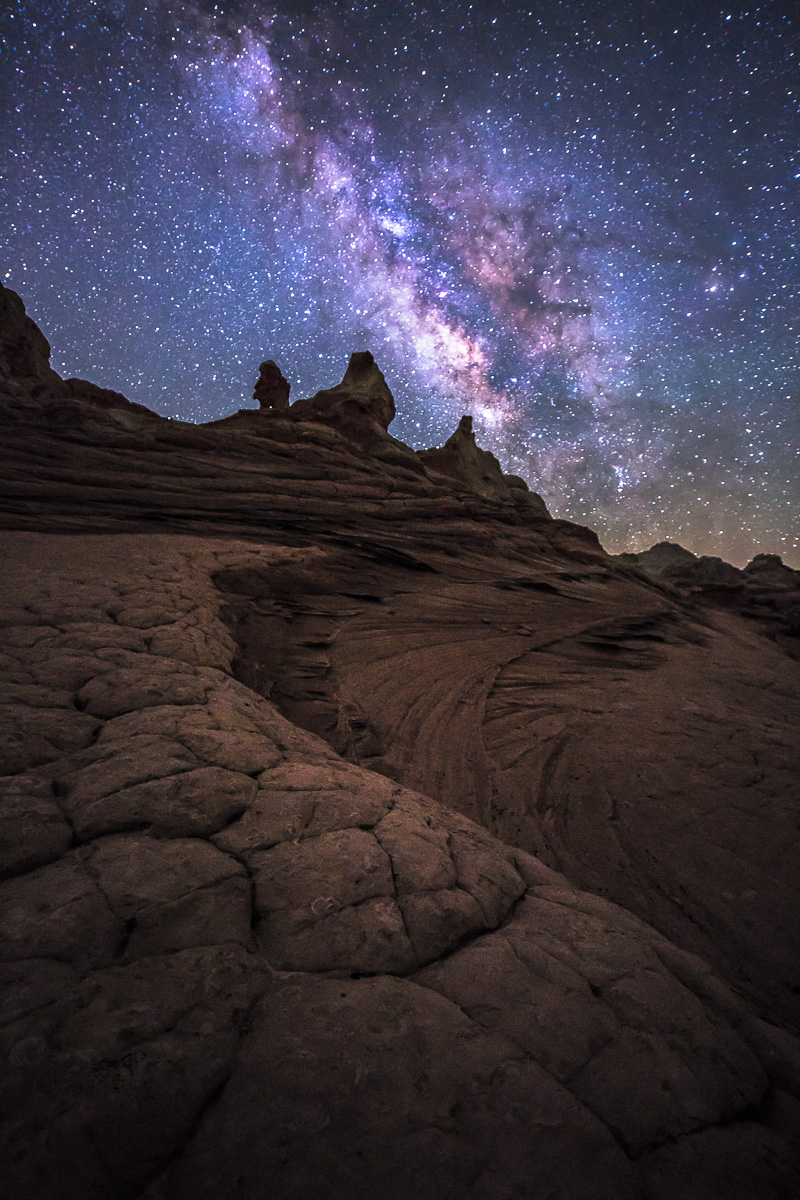
Stan Rose commented recently that Milky Way images are a dime a dozen, but I think this one's worth at least 50 cents.

I really like the terrain at White Pocket for night photos; the patterns in the white "brain rock" sandstone show up particularly well. I pushed the contrast and saturation in this image more than I'm normally comfortable doing, but I felt it fit the "otherworldly" vibe to the scene.
Single exposure, ~20mm, f/2.8, 30 sec, ISO 6400
Frank opinions and unfiltered C&C always appreciated.

Comments
24 commentsAlmost no noise, what NR did you use?
I love these kind of photos, getting light on the FG with the night sky in a single shot is really tough to do.
Very well done.
Please see my other comments on other recent nightscapes. Your repost is improved, but still too blue for natural colors. The dust in the Milky Way shows a strong magenta cast, but it is a red-brown. There are no blue stars, though I do understand this is the popular presentation these days.
The use of ISO 6400 works against you here, as it saturates many stars thus losing color in the stars. Better is to work at a lower ISO, like 1600 and boost the low signal with curves in post processing (but not changing the upper right point in curves). Remember, ISO does not change actual sensitivity. Use no slider tools that would clip high or low signals.
A strong nightscape, worth a lot more than a "dime a dozen" includes a strong foreground, and your image has those components. Beautifully composed. The foreground color seems off, probably in part due to the color balance in the sky. With a warmer color balance, you could bring the sky and land back to natural color (the night sky is not blue). See my articles on nightscape photography and color of the night sky on my web site if you are interested.
You have some halos from processing artifacts at the sky-land interface.
Again, I think this is a great nightscape, just needing some different post processing.
Roger
Roger: See my comment that I responded to on my night image from the Bosque. You seem to be fixated on what "natural" is. I'm far more concerned about photographic intent and photographic vision.
Roger, if you read this, thanks for your feedback. I spent some time on your website and read your other recent comments on nightscapes. I learn a lot from others' perspectives, including yours. My current approach may differ somewhat from yours regarding the importance of presenting a scene exactly the way it is in nature. I resonate with what Guy Tal has written regarding the value of a photographer's vision and creativity in crafting a scene for the viewer, which includes the value of exercising a measure of artistic license. Styles and preferences differ among photographers of course, but rigid adherence to presenting the scene as captured (for example, by saying a night sky cannot be blue) seems to consign the photographer to the role of mere technician and a "transporter" of a camera to various scenic locations. At any rate, it was helpful reading your feedback, and I'll keep those thoughts in mind as I continue to experiment with this image and as I refine my own style.
The night sky may not have been blue for this shot, but for Roger to say that the night sky is not blue is not accurate. It is blue during Astronomical twilight and when the moon is out. Also, the rods in our eyes, which we use for night vision, can't see reds at night and can make out blues much more easily. So a slight blue cast may be closer to what we see. If you want to mimic how we would see if our cones were ultra-light sensitive and we could see perfectly well at night with them, you'd use a warmer white balance. But the daylight white balance will, in my opinion, be much too warm. The cones of our eyes naturally adjust to make white appear white in different color light. The color of light when the moon is out is about 4150K. With no moon out and minimal airglow, you can use a white balance of about 3800 to get neutral colors and a grey/black sky. So I believe the daylight white balance of around 5100K that Roger suggests will create an unnatural yellow color cast.
The reality is that cameras "see" much differently at night than we do. All images are therefore subject to artistic interpretation. So I definitely agree with you about following your own artistic vision. There is no one "right" way to process night images.
Also, ISO 6400 works fine, as long as you're not blowing out any highlights. ISO does change light sensitivity. Extended ISOs like H1 don't, but native ISOs do. At ISO 1600, your image would be underexposed and when you try to bring out detail in dark areas later, especially the foreground, it will bring out more noise than if you got the exposure right in the first place.
That's just my long-winded way of saying I have no problem with the way you rendered your initial post.
Your new repost is excellent! The sharpness in the foreground rocks is much improved, the browns in the Milky Way look good, and the star colors are nice.
Now to other comments. In one of my responses (not sure which nightscape), I said IF one wants to present the scene in its natural light, not that it must, then a blue sky on a dark moonless night away from twilight is not blue. I certainly agree with the photographer's artistic license to color such a scene any way they want, including doing things like making a sunset blue.
Grant, I do agree that if a bright moon is out, the night sky can be blue, but none of the images in recent days presented here had the moon out and that is what I was referring to. I also agree that twilight is blue, actually a deeper blue than during the day, but that is not night and also does not apply to the images I was referring to.
But your comments about seeing blue and red at night are incorrect. See the plot of rod and cone sensitivity here:
http://www.clarkvision.com/articles/night.observing.lights/
The rods (night vision, no color, for others reading) are more sensitive at all wavelengths, from blue to red than the cones (color vision). The cones are relatively insensitive to blue, so one does not really see blue at night. Blue, in fact, is the hardest color to see in the dark night, moonless sky. Many photographers these days use bright red lights and that skews one's color perception. On a dark night, one can actually see color in the sky as well as on land. For example, I was hiking trails a week ago in Canyonlands, Utah without lights and no moon in the middle of the night. I could see the grass and bushes as green and the rocks and soil as red. Many stars show color in the sky. As airglow increases in intensity, one can see reds and greens. The colors are quite pastel at those low light levels but are there.
Grant, you said "So I believe the daylight white balance of around 5100K that Roger suggests will create an unnatural yellow color cast." But that is exactly the color of the light on the landscape. Sunsets too are yellow and red. Does one say that is unnatural? Does one set the white balance to make those sunset yellows turn white (or blue)? Of course one could for artistic license, but it is not natural. Airglow is usually dominated by specific emission lines of oxygen and hydroxyl in the upper atmosphere, and those wavelengths are green and red, which in combination give yellows and oranges. So to say it is an "unnatural yellow cast" is completely wrong. The dominant light on a dark moonless night sky is a combination of airglow with its neon-like red and green emissions and stars, and most stars are redder than our sun.
I have only been trying to communicate the true nature of the night sky. If every photographer wants to color their nightscapes an unnatural blue, that is fine. To me the reds, yellows, and greens in the night sky make it all the more wonderful and mysterious than every night scene is blue.
Roger
I definitely appreciate your enthusiasm for night photography and trying to explain the colors. I'm always trying to learn, and I would be glad to be proven wrong if it means learning something new. But I do still disagree with much of what your wrote.
You wrote "then a blue sky on a dark moonless night away from twilight is not blue."
While skies on a moonless night are almost never as blue as presented in some photographs, air glow produced by molecular oxygen at ~95 km is blue. So you can definitely still capture blues on a moonless night after twilight.
You wrote "if a bright moon is out, the night sky can be blue"
I've found that even a sliver of a moon will cause the night sky to be blue, as the light from the moon is still much more powerful than any other light source.
You wrote "I also agree that twilight is blue, actually a deeper blue than during the day, but that is not night."
I was referring to Astronomical twilight, which I would definitely consider to be night. At this time, it is dark enough that we can't see the colors and we can see a very large number of stars and the Milky Way. The camera, however, can still pick up blues in the sky, which gradually fade to purple and then die away.
You wrote "The rods (night vision, no color, for others reading) are more sensitive at all wavelengths, from blue to red than the cones."
This may be true but they are far more sensitive in the blue spectrum than the red. So much more sensitive that you will barely be able to see anything with red colors in the low light of night. So the blue colors that are in the sky from air glow, etc. will be much more visible to us (though we will still basically see the sky as gray since rods don't process color). From the below link "The light response of the rods peaks sharply in the blue; they respond very little to red light." http://hyperphysics.phy-astr.gsu.edu/hbase/vision/rodcone.html
You wrote "The cones are relatively insensitive to blue, so one does not really see blue at night."
We do have far fewer "blue" cones but these cones are far more sensitive than other cones. Ultimately, the sensitivity to red, green, and blue is about the same.
You wrote "Sunsets too are yellow and red. Does one say that is unnatural? Does one set the white balance to make those sunset yellows turn white (or blue)?"
The reason we see sunsets as yellow and red is because the color cast only extends across the clouds in the sky, not on the dark land that is in shade. Our eyes / brain have something relative to compare the colors to and use white colors on the land as a reference point. Compared to the whites on the land, the clouds look yellow or red. If, however, we are in a room lit by yellow light and have no other frame of reference, our eyes / brain will adjust to make whites look white instead of yellow. This is why you would need to change the white balance to Incandescent in order for the camera to "see" the world the same as we do. In some of your photos, I personally see a yellow color cast across the entire image. If our cones were able to see perfectly well at night, I believe our eyes/brain would adjust to this color cast so that we could see the whites as white. This is why I think 3800K is about the right white balance to avoid color cast. If you're studying things from a scientific standpoint then you'd want to keep all of the variables unchanged. But from an artistic standpoint, our eyes don't work this way and our perception of colors changes depending on the color temperature of the light.
One thing that strongly convinced me of this was when I shot the northern lights and could easily see the colors. They mostly appear neon green. But if you process them with a daylight white balance, they will look yellow. I have to lower the white balance to 3600-4000K to get it close to looking like the neon green that I actually saw.
I started out using daylight white balance on my night shots, thinking that would make the colors more "real." But then I found that it almost always gave a yellow color cast, even with minimal air glow. Also, I found that when shooting the same scene in the same light with film, it rendered the colors blue / purple rather than yellow. The difference in color seemed to be how film handled colors in extreme low light vs. digital. It wasn't that one was real and one wasn't.
Most of my shots with a blue sky were taken with a moon or during astronomical twilight. With others, I did push the white balance down to about 3000K, though I haven't done that with more recent shots. I may eventually rework a few that I will admit are a little too blue. I think I prefer to mimic how our eyes would see if our cones could see perfectly well at night rather than if our rods were color sensitive (which would skew things very much to the blue side).
I would like to respond to some of your points.
Regarding the spectral sensitivity of color vision, please see the excellent paper by John Werner:
http://redwood.berkeley.edu/bruno/npb261b/werner-reading/Werner1.pdf
and examine Figure 7 right panel. Blue sensitivity is about a factor of 2 lower than green in young people, and decreases as one ages due to yellowing of the lens in the eye. The data show that green is the most sensitive color in color vision.
While there is blue airglow emission from oxygen, it is many many times weaker than the green and red emissions. See the spectrum of airglow and the explanation at:
http://www.atoptics.co.uk/highsky/airglow2.htm
Regarding film showing the night sky is blue, the color of long exposure night images is highly dependent on the film's reciprocity failure. Some film come out green, some magenta, some red, some blue, regardless of the real night sky color. I have a lot of night sky images on film, and I see all these colors, varying between film types. A google search for reciprocity failure color correction will show the problem. If a yellow filter is recommended, that means lower the incoming blue light because red and green drop sensitivity too fast compared to blue, making long exposures overly blue.
Finally, regarding color perception in strongly colored light environments, the "auto white balance" effect is limited. Try observing a red sunset through a tube and see if when you only see red if the scene turns white or not. It doesn't. Similarly, Try taking a red flashlight into a dark room and illuminate white paper. It still looks red. I too have been in colored aurora, like green, and the camera records it as green. Similarly with red aurora. There are other examples, at night in my living room with incandescent lights, the light still looks yellow to me.
If you have been in visually green aurora and the camera recorded yellow, were you using red flashlights? I see many people using red flashlights that are too bright. Strongly colored lights skew color perception. The most famous of this effect was early observers viewing Mars saw a spring greening in the dark areas on Mars. It turned out the bright red Mars iron-oxide rich soil skewed the color vision so the gray basalt lava flows looked green.
When I'm out at night observing the night sky, I work with minimal or no lights, even walking a trail (when safe enough) with no lights except that from the sky. When fully dark adapted, one can see the true nature of the night sky. But that can only be done by using lights that are not above a threshold and being dark adapted for at least 45 minutes. I give those thresholds at: http://www.clarkvision.com/articles/night.observing.lights/
and that is a very dim light when trying to illuminate something.
Roger