The Time Machine
by Sairam Sundaresan
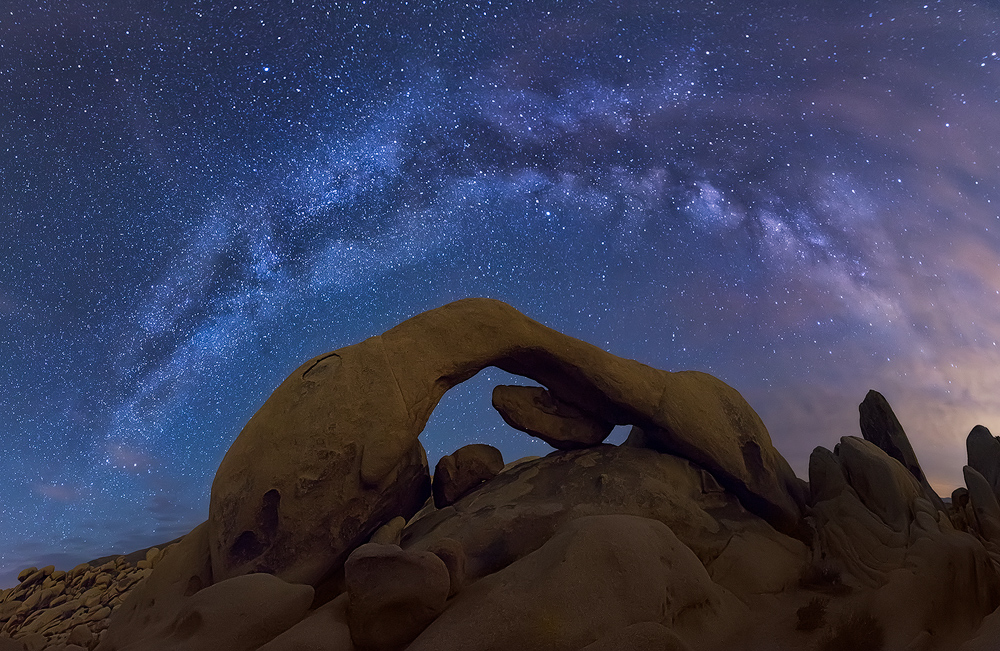
Probably one of my favorite images that I have ever taken. Right from the planning to the sudden upsets along the way to the final processing part, I have enjoyed making this image as much as my first ever picture with a DSLR.
It took a lot of planning to figure out when the Milky way would be over the arch. It was a small window of time, and when I got there, the whole sky was blocked out by clouds. The weather forecast had said clear skies, but nature never gives you a moment's rest. Praying earnestly that the clouds would clear up, I waited for nearly 2 hours, setting up my composition, testing light painting strength in the hope that something would give. Lo and behold, 2 hours later, the clouds parted revealing the milky way in all its glory.
I had to work fast, since this would be a panoramic view, and I took about 14 vertical shots stitched horizontally. The challenge here was that the light painting had to be consistent across individual frames, and the exposure time had to be as little as possible to ensure a proper stitch of the stars. Once I had the shots in the bag, I thanked the heavens for the stroke of luck I had. You can see some of the clouds on the right side of the frame.
In post, it took a lot of work to warp, and stitch the frames together, and then blend in some detail for dynamic range.
I took up photography 3 years back, and I never could have imagined that one day, I'd be able to pull something like this off. That's why I call this image "The Time Machine"
Please see the LARGER Version
As always, your comments and critiques are much appreciated!
Sairam

Comments
22 commentsGary.
Nice processing.
Best,
Carol
I might add just a touch more contrast to the Milky Way?
Well done!
--P
Very good planning and execution. What planning tool do you use for nightscapes? I use Stellarium.
Regarding your color balance, please see my comments on other images and the recent nightscapes I have posted. Your blue color balance is certainly popular these days with digital photographers, but the Milky Way is not blue and there are no blue stars. Hot stars are bluish-white, but the majority of stars are yellow, orange and red. The milky way is full of reddish dust. You can certainly use a color balance to make a blue image for mood, but be aware that it is not natural. The night sky is usually much warmer. Note too that images like this submitted to some photo contests would get rejected as being too unnatural.
The night sky is filled with wonderful colors, and I wonder what your scene would look like with a natural color balance (e.g. sun). See my green river overlook nightscape for an example and explanation of the colors.
Roger
Thanks Marylynne