Black Chinned Hummer
by Keith Bauer
I have finally had a bit of time to get out in the back yard and photograph the hummers this summer.
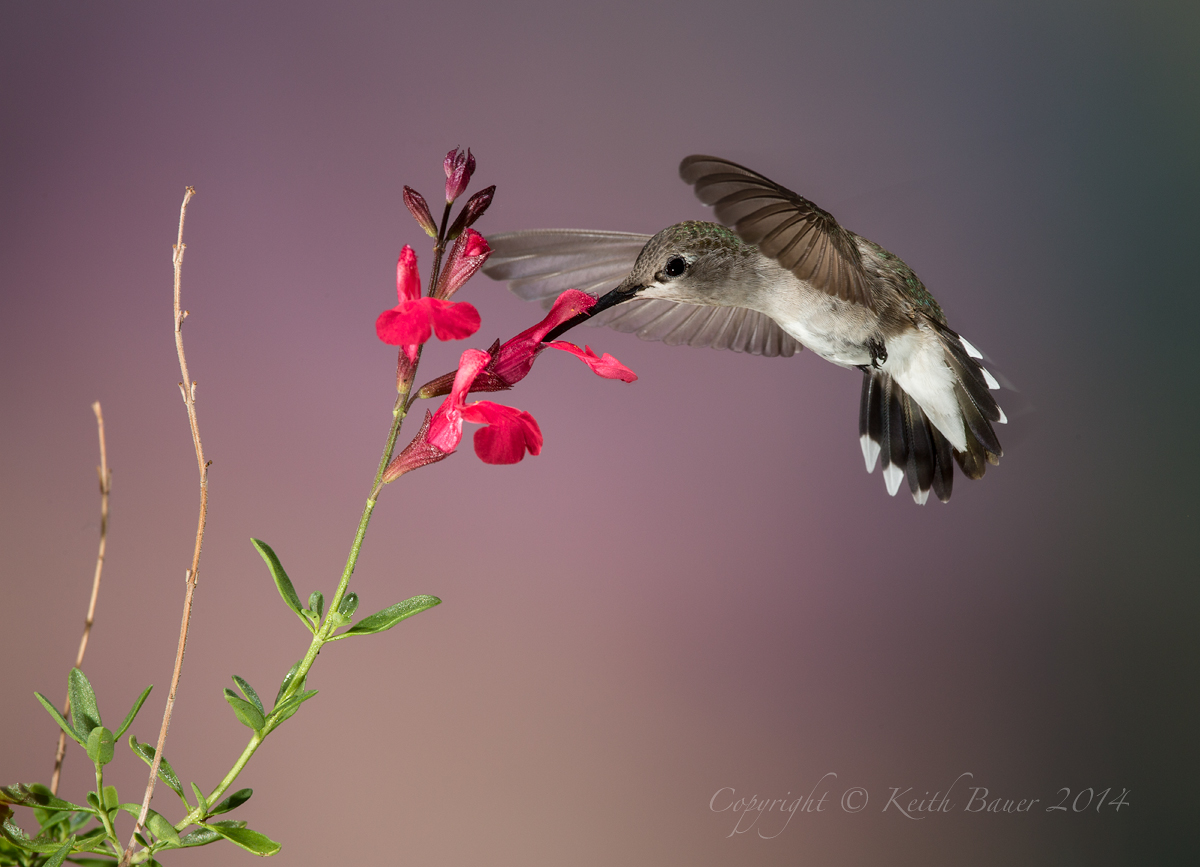
This is one from this morning. Female Black Chinned Hummer.
Techs:
Canon 5D Mark III
100-400 @ 400mm
1/125 @ f/16, ISO 320
Four Canon 430EX II Flashes, 3 on the hummer, and one for the background.
Larger version really helps see the details.
Thx for taking a look

Comments
22 commentsI was wondering how you got such detail in the wings at 1/125 SS ?
Thanks,
Mike
Mike. The camera settings for this image are amost meaningless except that they are setup to create a black frame. The exposure is all from the multi-flash settings. The flashes are set in manual at either 1/16 or 1/32. That produces a flash duration of around 1/10000. That is really the effective shutter speed, hence the ability to stop the hummingbird wings.
Thanks,
Mike
P.S. Having this conversation with you is not only educational but, I get to look at this sweet image again, Win - Winn !
When using flash, whether multi, or single, the exposure is really made up of two parts. The two parts are the ambient light, and the light provided by the flash(es). If the flash(es) provides all the light it is typically called "flash as main light". If the light is largely ambient with just a bit of flash it is typically called "fill flash". There is clearly a gradual scale between fill flash and flash as main light. If the shutter speed is fast enough that the resulting ambient exposure would be black (or greatly underexposed), then the flash duration becomes the effective shutter speed. If the shutter speed is slow, then the flash pulse can become a small fraction of the overall exposure time. For example, shooting some moving subject with a 1 second exposure with a flash, the flash is a very small component of the overall exposure time. The effective shutter speed in this case is the shutter speed the camera set.
Hope that helps answer your question. Flash is a magnificent tool to master in the field to solve a huge array of problems.
That is caused by the ambient light adding enough light to cause "ghosting" from the movement of the tail. I should have had slightly better settings so that the ambient light added absolutely nothing to the overall exposure to avoid the ghosting. There was no cloning done. A small crop, pretty much out of the camera.
Here is a link to the image that I posted on my personal website. This version has the ghosting cloned from around the tail.
Hummingbird with Ghosting Removed
Beautiful composition, great wings position.
Hi Kurt: I did not use any gels on the flashes. The background gradient is largely from then position / angle of the background flash.
Reading the various comments here, it sounds like your approach is much less artificial. And there's no question the photo (other than the ghosting) is superb. But at what point do photos like Glenn's cross NPN rules?