Isolating a buck
by Lon Sharp
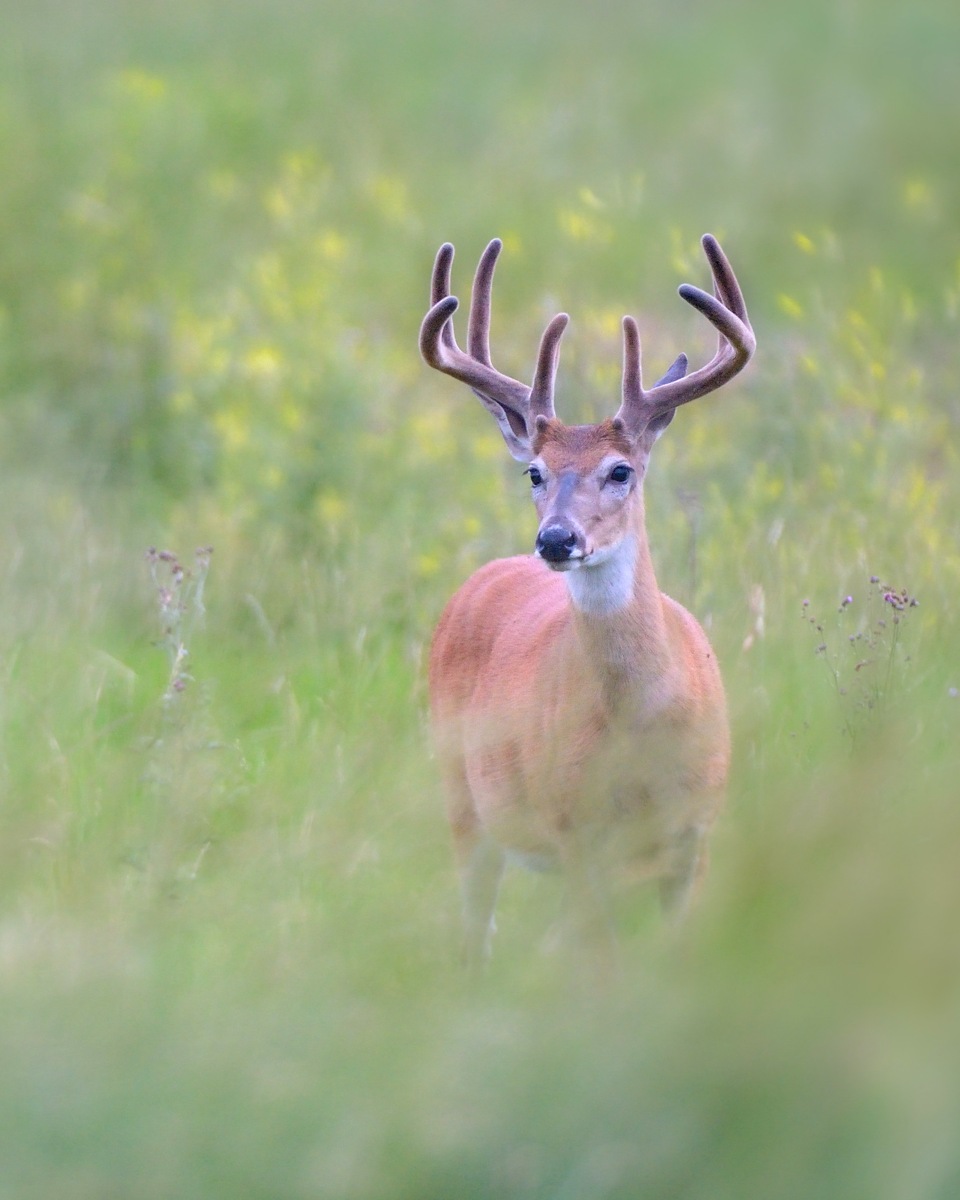
This is a whitetail buck taken in a situation with lots of intervening junk (grass, weeds, a wire, etc.) overlaying the scene, but with his head isolated in a "hole." I decided to work with it a bit in processing, and maybe this is going into the realm of pop photo, I am not sure!
Shot wide open, f4, 400 mm, 1/1600, iso 3200, handheld, -0.3ev, d610
I processed with CaptureNX2 by removing all sharpening and viewing the raw image as totally neutral tones. Then I cropped strongly (this is about 3000 pixels long as shown)and began to re-apply contrast and color saturation and added sharpening and high pass to just the deer, and applied a blur filter to the rest of the background. I thought the end result was at least interesting. Your thoughts are welcomed.

Comments
9 commentsInteresting approach you've taken here. I like simple images and gravitate towards those with some form of what I term "visual contrast" - could be standard light/dark contrast, can be colour contrast, and often it's focus-contrast (sharply contrasting in-focus and out-of-focus) elements. So obviously this image pushes some of the right buttons for me. On the "standard" compositional issues of the positioning of subject, frame orientation, etc., all looks good here. Techs (exposure, etc.) look mostly solid too. I do find the weeds (almost looks like invasive knapweed) a bit off-putting - not that they're major distractions, but when I imagine the scene "clean" (without the weeds), the extra simplicity is a bonus.
In terms of the soft/hard contrast in the image - I almost wish that the buck was a little MORE solidly obscured by OOF grass in the chest region and that the facial region (and antlers) was a little sharper to make it pop a little more. I know that lens (assuming it was the 200-400) isn't maximally sharp at 400mm at f4, so guessing that the lack of softness is a function of that - and stopping down slightly wasn't an option for you (bringing more foreground and/or background into focus wouldn't have helped at ALL!).
Final note: I've never found blurring in post to be nearly as effective as blurring-by-good-bokeh in the field - somehow digital blurring isn't quite there yet. And, for some illogical reason, to me (applying ONLY to my own photography) it feels that blurring in post is going a little too far in image manipulation...just thinking out loud...
Thanks for posting this - interesting image, interesting technique, and good food for thought...
Cheers...
Brad