Gallery: Weekly ChallengePosted November 11, 201464 views12 comments
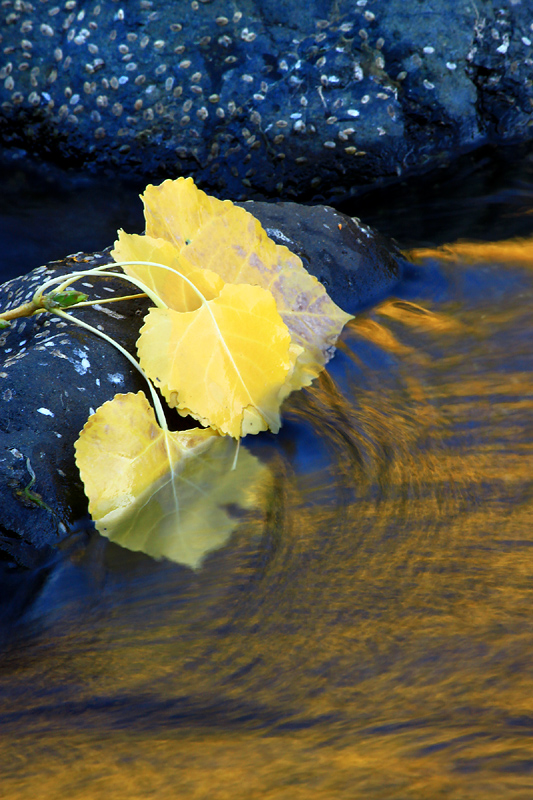
Along Cache Creek, late afternoon.
Canon T1i, f/22, 1/3 sec, ISO-100, 200mm, tripod.
Comments
12 comments
Comment posted by Chet Dowell on November 11, 2014 at 9:30 AM
This has a nice quality of passing time, flowing, seasonal and more permanent in the rocks. I really like your comp as well. Nice work. Chet
Registered on December 3, 2012, 237 Posts, 1171 Comments
Comment posted by Mark Seaver on November 11, 2014 at 9:58 AM
Wow, two of my favorites combined, Dave...a fine set of leaves and some neat reflections in moving water. The rocks are a good addition also. (I don't think your larger photo is larger. Is it 1200 pixels on the long axis?)
Registered on January 23, 2011, 1103 Posts, 17270 Comments
Comment posted by Philip Hodgkins on November 11, 2014 at 1:21 PM
I will echo Mark. What are the dots on the rocks?
Registered on July 24, 2006, 2741 Posts, 12349 Comments
Comment posted by Paul Breitkreuz on November 11, 2014 at 1:56 PM
I really like the composition here, Dave. The rocks, water flow, all add nicely to the small cluster of leaves. There are two things I might change here. I would lower the brightness of the yellow slightly. Secondly I'm not sure about the blue in the rocks and water. I think I would bring down the saturation there for sure. The image works very nicely and I like the comp very much, just needs a tad more post processing.
Registered on February 25, 2006, 525 Posts, 8448 Comments
Comment posted by D.A. Edwards on November 11, 2014 at 2:26 PM
Mark, you are correct the larger photo is just slightly larger. Back before I joined NPN last month, 800px high was my standard size for processed vertical images and this photo dates from last fall. Guess I'll have to start making them larger.
Paul, I'll make a stab at some add'l PP per your feedback.
Phil, the dots on the rocks are some sort of aquatic life, I would guess a larval stage that gets left behind. Nearly every rock in the creek is covered with them. They are odd and this is the only place I've ever seen them. Maybe a resident entomologist can identify?
Cache Creek flows out of Clear Lake, which is dammed otherwise it would probably be dry most summers and falls due to its location in the inland coastal ranges. Eventually it flows into the Central Valley and by late summer down low in the valley it gets pretty much stagnant then disappears altogether.
Registered on October 8, 2014, 226 Posts, 1187 Comments
Comment posted by D.A. Edwards on November 11, 2014 at 3:03 PM
Here's a revised image with the blues reduced significantly on the rocks, not as much in the water since I believe that is a sky reflection that shows up bluer than the rocks on the original.
Registered on October 8, 2014, 226 Posts, 1187 Comments
Comment posted by D.A. Edwards on November 11, 2014 at 3:10 PM
Here's a close up of the rocks with the white spots from another photo. It's very considerate of this life form to stay so equally spaced from its brethren
Registered on October 8, 2014, 226 Posts, 1187 Comments
Comment posted by Paul Breitkreuz on November 11, 2014 at 3:40 PM
Dave, I think that reduction in blue is much better here overall. Those are interesting little bits of life on those rocks.
I wonder if those are related to all the mussels they're trying to keep out of all the California freshwater areas? I'm not a boater but I've seen the signs about washing down boats before being allowed in certain areas.
Thanks for the research Dave, I just read your post listed below mine here. Interesting stuff overall. Glad they're not part of the mussel issues CA. is confronted with.
Registered on February 25, 2006, 525 Posts, 8448 Comments
Comment posted by D.A. Edwards on November 11, 2014 at 5:52 PM
Hi again Paul, those are not the NZ mussels that they are so concerned with but apparently, with a little help from Teh Google, they are microcaddis cases, made by larvae of the caddisfly family Hydroptilidae. These are made by larvae of the subfamily Leucotrichiinae, most likely the genus Leucotrichia. They spin little flat oval cases of silk tight and immobile against the rocks. It figures trout fishermen would be all over this:
Larvae of the caddisfly Leucotrichia live in silk cases attached to hard surfaces in streams. They construct cases in summer, overwinter as larvae, and emerge as adults the following June or July. Leucotrichia larvae are very territorial. Territory size is determined by the availability of benthic algae, which serves as food for the larvae. Larvae spend about half their time reaching out of their case to graze on the algae surrounding their case.
Mystery solved!
Registered on October 8, 2014, 226 Posts, 1187 Comments
Comment posted by Mark Seaver on November 11, 2014 at 7:43 PM
Dave, many thanks for the info on the caddisfly larvae. The colors (especially the blues) in the repost do seem more realistic.
Registered on January 23, 2011, 1103 Posts, 17270 Comments
Comment posted by Albert Darmo on November 11, 2014 at 9:56 PM
Hi Dave This being a leaf theme. i would have croped out the top spotted section. to make a stronger image.. agree with Mark that the repost has more naturel color. the leaves by the water make a delightful presentation
Albert Darmo
Canada
Registered on November 25, 2008, 1386 Posts, 11978 Comments
Comment posted by Angela Classen on November 11, 2014 at 10:58 PM
I think the suggestion to desaturate the blue in the rocks is a good one. Other than that, not much in the way of suggestions from me. Love the texture and pattern of the water, and the comp is great.
Registered on June 13, 2007, 434 Posts, 2742 Comments

Comments
12 commentsPaul, I'll make a stab at some add'l PP per your feedback.
Phil, the dots on the rocks are some sort of aquatic life, I would guess a larval stage that gets left behind. Nearly every rock in the creek is covered with them. They are odd and this is the only place I've ever seen them. Maybe a resident entomologist can identify?
Cache Creek flows out of Clear Lake, which is dammed otherwise it would probably be dry most summers and falls due to its location in the inland coastal ranges. Eventually it flows into the Central Valley and by late summer down low in the valley it gets pretty much stagnant then disappears altogether.
I wonder if those are related to all the mussels they're trying to keep out of all the California freshwater areas? I'm not a boater but I've seen the signs about washing down boats before being allowed in certain areas.
Thanks for the research Dave, I just read your post listed below mine here. Interesting stuff overall. Glad they're not part of the mussel issues CA. is confronted with.
http://www.troutnut.com/hatch/1718/Caddisfly-Hydroptilidae-Microcaddisflies
An explanation for the spacing regularity:
Larvae of the caddisfly Leucotrichia live in silk cases attached to hard surfaces in streams. They construct cases in summer, overwinter as larvae, and emerge as adults the following June or July. Leucotrichia larvae are very territorial. Territory size is determined by the availability of benthic algae, which serves as food for the larvae. Larvae spend about half their time reaching out of their case to graze on the algae surrounding their case.
Mystery solved!
Albert Darmo
Canada