Another Rarity
by Ken Watkins
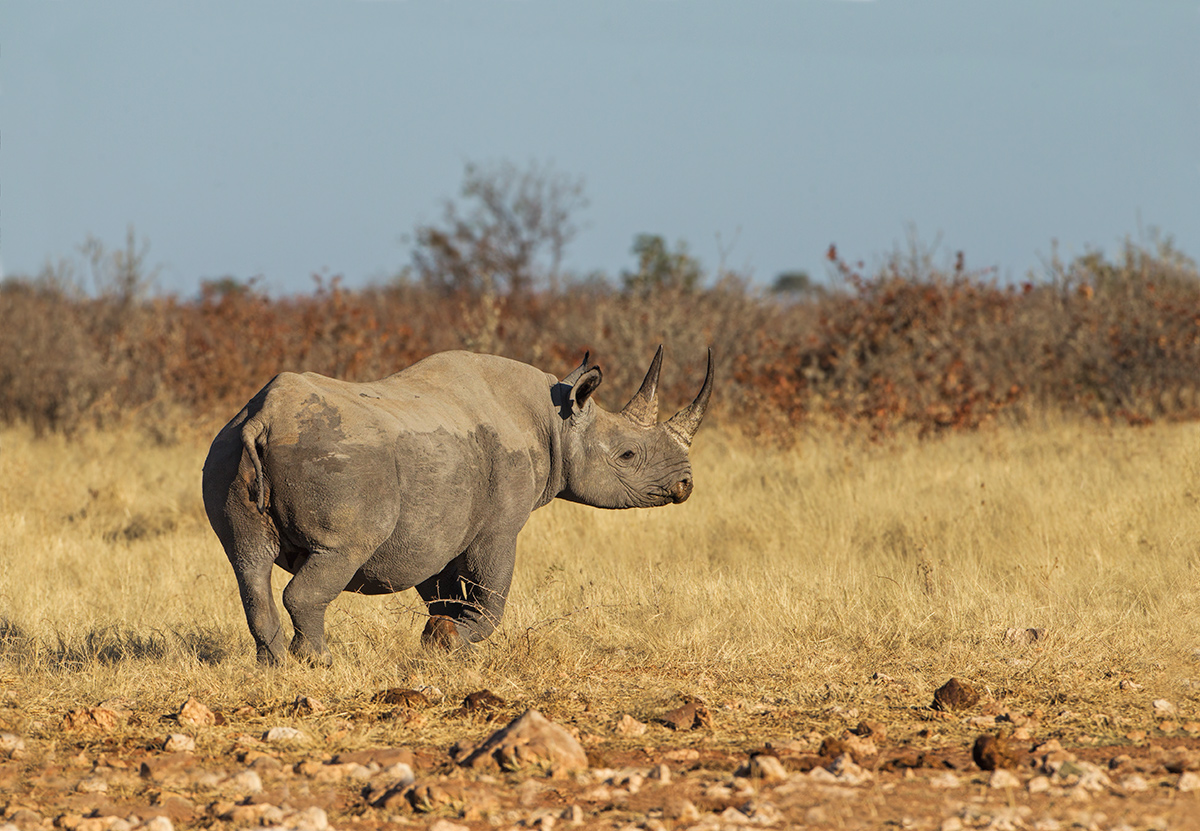
Yes it is a Black Rhino, there are some left in the world, not that you would know from the "rage" on the web. I deliberately left the little sticks in place, virtually full frame.
Etosha National Park, Namibia
EOS 1DX MkIV
500mm F4
F8
ISO 400
1/1600
Taken from my vehicle through open window

Comments
10 commentsOnce again a totally unnecessary, provocative, and argumentative commentary. Your comment can only be taken to mean you don't support rage about critically endangered species. I don't share your view - if you ask me the declared extinction of the Western Black Rhino sub-species (Diceros bicornis longipes) in 2011 by the IUCN, and the crash of the entire Black Rhino population from over 70,000 in the early 1960's to around 5,055 today, is cause for both concern and well-targeted rage.
Brad
Whilst your figures maybe correctly quoted from the various sources available, there is no reliable data relating to the estimates from 1970, and the conclusions that follow this assumption.
Black Rhino were considered to be vermin and were largely shot by farmers, whether the horn went to China is unclear as there is no reliable data.
The simple facts are that South Africa saved the White Rhino (see Project Rhino) and the only substantial populations of Black Rhino in the wild other than Namibia have resulted from translocation from South African sources.
The following is from the IUCN website
"Between 1960 and 1995, large-scale poaching caused a dramatic 98% collapse in numbers. Over this period numbers only increased in South Africa and Namibia from an estimated 630 + 300 in 1980 (Emslie and Brooks 1999) to 1,915 + 1,750, respectively by the end of 2010 (AfRSG data 2011). Continentally numbers bottomed out at only 2,410 in 1995 (Emslie and Brooks 1999). From 1992–1995 total numbers remained relatively stable with increases in some countries (those with the best-protected and managed populations) being cancelled out by declines in others. However, since the low of 1995, Black Rhino numbers at a continental level have increased every time continental population estimates have been revised by the AfRSG reaching 4,880 by December 2010 (Emslie 2006; Emslie et al. 2007; AfRSG data 2008, 2011).
Given the continual increases in population I just wonder why the "rage" is continuing. I have my own opinions as to the increase in rage but will keep them to myself.
I certainly do not support "rage" based on self promotion and incorrect conclusions.
The fact that South Africa is suffering the most poaching is simply explained by the simple fact that it has far more Rhinos, and they are easily reachable.
RIP Dr. Ian Player
You say: "Given the continual increases in population I just wonder why the "rage" is continuing."
Because several sub-species are on the brink of extinction, with one sub-species down to one known individual. Population sizes are only beginning to rebound in isolated areas, and remain precariously low. "Continual increases" is not an accurate representation of a very short-term trend in isolated areas. It requires many decades, verging on centuries, of positive population growth before - in a long-term evolutionary sense - the phrase "continual increases" makes any biological sense.
I have no problem at all with you accurately conveying information that conforms to credible scientific knowledge, but beginning an image post by flinging out an opinionated comment about "rage" on the web is a non-starter. Did you even think of how many NPN members may, in fact, be very concerned - and even in a rage - about the Black Rhino situation? Did you even think - or care - if you might have offended them? But I have to admit you're getting better - this go 'round you refrained from calling people names like "tree-huggers" and "know-nothings" as you have in the past.
Please limit your comments in this gallery to the photographic aspects of your posts - non-opinionated natural history tidbits accompanying your image posts are acceptable as well.
Brad
I am sure I posted a further response but it is not here.
Oh well
Feel free to post it again...
Brad
I really see little point, I think it was a thank you for publishing extracts from my private emails to you.
Plus an invitation for anybody that was offended by my comment to contact me?
Nothing from personal emails published - you have referred to both "tree-huggers" and "know-nothings" in your own commentaries and/or comments on images (your own and/or images of others). You have managed that all by yourself.
You say: "Plus an invitation for anybody that was offended by my comment to contact me?"
OK - you offended me - consider yourself contacted. I care tremendously about species extinctions, and find your comments about those who choose to voice their concerns as "rage" offensive.
As I have told you many times - please limit your comments in this gallery to the photographic aspects of your posts - non-opinionated natural history tidbits accompanying your image posts are acceptable as well.
And, to be more specific - please refrain from the use of name-calling, excessive rhetoric, and bullying in your posts. No one else in this gallery ever seems to find the need to do it.
Brad
I will transfer to email as this is clearly going nowhere and does not in my opoinion belong in the public domain
In making my response I am assuming you are indirectly referring to my comments in my recent Tiger post.
John Tobias asked to elaborate on my statement that this Tiger was “now in a zoo”
I provided further details as follows
“John,
Bandhavgargh has little prey for Tigers and so the Tigers go into the surrounding areas to kill "holy cows" for the want of anything else. This is made easier by the failure to maintain fences and letting people move into the reserve.
These two brothers killed some cows and were moved to a zoo, India should not really be trusted with Tiger conservation!”
You then posted the following
“Wow... Your comments about India should not be trusted with Tiger conservation is little too shallow. You should be more worrying about African Elephants which doesn't have good track records over there.”
I took this to mean that we should clean up our own yard before criticising others
You provided no substantiation of your assertion about African Elephants.
I would ask you to refer to the current project
http://www.greatelephantcensus.com/coverage/
This is not yet complete but the initial reports are more encouraging than most would have believed.
I was in Kidepo (Uganda) when WCS undertook their count (as part of this census), and was informed that Elephant numbers were up and that no sign of poaching had been observed, and the population had increased since the last count which was around 10 years ago and involved my friend Dr. Mike Koch who was then the chief vet in Africa for WCS (Wildlife Conservation Society) who are in my opinion the foremost conservation “charity” in the world. My own sightings in this park indicate that the Elephant population is slowly increasing, following the devastation caused by Somalian poachers. This probably results from the fact that there is a Ugandan Army base on the border.
Turning back to my comments regarding Tiger conservation in India, in response to a comment by Upjeet Singh, I explained the source of my opinion as follows
“Just for your information I was in India just after the results of the last count were published, many people were concerned at the conclusions in particular the differing methods used between the counts and the inclusion of areas not previously counted.”
If you believe this is a false assumption then you have to date not disagreed with it to date, and nor has anybody else. If you have any info to contradict my current belief then I would be pleased if you could share it.
I understand you are a regular visitor to India and presume you may have read the intense debate that took place at the time of the release of the results of the last count.
Finally your comment
“Maybe here India could teach something on conservation of Rhinos”
I could certainly agree with this, it is my understanding that the population of one-horned Rhino has dramatically from a low point of 200 to around 2,500.
I have visited two Indian Parks that contain One Horned Rhino.
I visited Dudwha in 2005 which at that time had a small population in a fenced enclosure. I understand that the population has now risen to around 30, so this has clearly been a great success. These Rhino are however not free roaming a decision I would fully support.
Kaziranga is an entirely different proposition, the success here can only be described as phenomenal, the place is literally crawling with Rhino.
Given the fact that this park is quite close to China makes this success all the more remarkable.
I am told that the largest cause of Rhino death is the annual flooding of the Bramaphutra.
The fact that this park is patrolled intensively is I believe the reason for this success, the dedication of the rangers is immense (something not necessarily seen elsewhere).
When I was last there a ranger gave his life to the cause, having been gored by a Rhino.