Tentative...
Just a few days ago I picked up a new desktop computer (replacing my reliable but getting long-in-the-tooth Mac Pro from 2009). To begin evaluating the computer I decided to see how it performed when processing images from raw - so I returned to some of my "flagged but not processed yet" shots from 2014. This one is from that batch of newly processed images...
Those who know me know that while I love all wildlife, I have a particular interest and even fondness for carnivores. This predilection is based not so much on the "romance" or "machoism" of carnivorous animals, but more on their fascinating behavioral diversity and individualism. Any organism that has to actively hunt for a living has to be behaviorally flexible and possess the ability to learn a lot. And - in many cases - they also have the need to be able to function within a social system - at least part of the time. Lump these characteristics together and you get animals that we think of as highly intelligent. And, if you spend some serious time watching them, you realize that - like humans - they have individual personalities and clearly express and communicate their emotions.
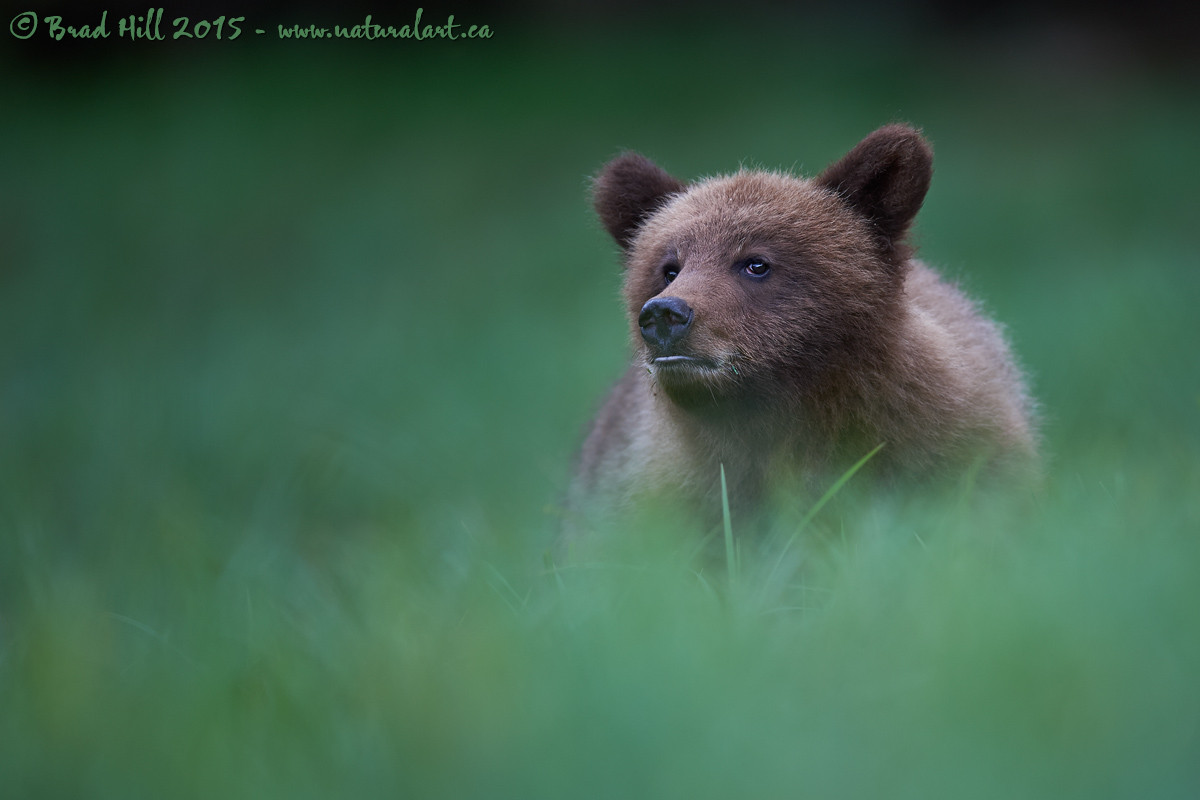
This grizzly cub offered up one of my most memorable photographic experiences of 2014. Not only was did it give me a scene and image that I had been waiting to capture for years, but in about a one minute period it delivered up an absolute gamut of emotions - from curiosity about us through to a little fear and tentativeness and, finally, complete acceptance and comfort with our presence. At the exact instant I clicked the shutter on this one the cub seemed drawn to us by curiosity but still just a tad hesitant or tentative about approaching any closer. When the cub was giving me this look it had stopped moving forward and froze for a good 30 seconds - and you could just feel it evaluating the situation. Shortly after this shot the cub completely relaxed and went back to feeding (on grasses) as though we didn't exist (and were no threat to its safety).
In the last year or two I've noticed a trend on my photo tours where clients are bringing fewer super-telephoto primes and more zoom lenses. Really popular lenses on my trips have been the "new" Nikkor AF-S 80-400mm f4.5-5.6 VR and the Canon 200-400mm f4 VR. And, with the recent introduction (at the time of this writing) of the new Tamron 150-600mm and the Sigma 150-600mm "ultra-zooms" I suspect this trend towards more zooms being used on my trips will continue. And there's good reason to bring such lenses along - most of them tend to be smaller and lighter than the "big primes" and thus are both easier to travel with AND easier to carry and hand-hold in a field setting. But...there are times when the wider apertures and incredible bokeh (quality of out-of-focus zones) of the big primes absolutely MAKE the shot. And this shot was one of those instances - this shot couldn't have been captured with any zoom I'm aware of and come out like this (everything you're looking at here was done optically...there were almost no adjustments made during post-processing - and NO creative blurring done in post-processing).
Subject: Young grizzly (
Ursus arctos) cub checking out a strange creature...
Location: Khutzeymateen Inlet, northern Great Bear Rainforest, BC, Canada
Camera: Nikon D4s
Lens: Nikkor 400mm f2.8 VR - hand-held from floating zodiac. VR on and in "Normal" mode.
Exposure: 1/500s @ f3.2; ISO 220. -0.67 compensation compensation from matrix-metered exposure setting.
Crop: Very minor- this is about 95% of full frame
A lot more details about this image - including including a much higher resolution version (2400 pixel) - can be found here on my website:
http://www.naturalart.ca/galleries/latest/.
Comments and critiques welcomed - probably best to view the larger version prior to doing so!
Cheers...
Brad
PS: Like all wildlife images on my website and that I post on NPN, the subject is fully wild and completely unconstrained. Besides the potential impact of my presence, nothing has been done to intentionally alter or affect the ongoing behavior of the subject and, of course, there has been no use of any form of bait or other form of wildlife attractants (including vocalizations)

Comments
3 commentsA wonderful image.
In a perfect world, I would have preferred to place the left grass blade, slightly on the left side, so that instead of pointing to the chin, it should have been left of the mouth. In other words, your POV should have been on the right side a touch.
Jagdeep Rajput