Down the Hatch!
Watching the spectacle of bubble-netting Humpback Whales is a mind-boggling experience. This coordinated behaviour is learned and passed on from one individual - and one generation - to another through cultural transmission. You'll find this complex feeding behaviour in some specific populations of humpbacks but not in some others. Even if you're just watching them do it you become aware of their amazing intelligence. But once you find out the details of the practice, including the fact that the whales divide up the labour needed to make their bubble-nets and that each whale has a specific task to perform, their intelligence becomes even more impressive.
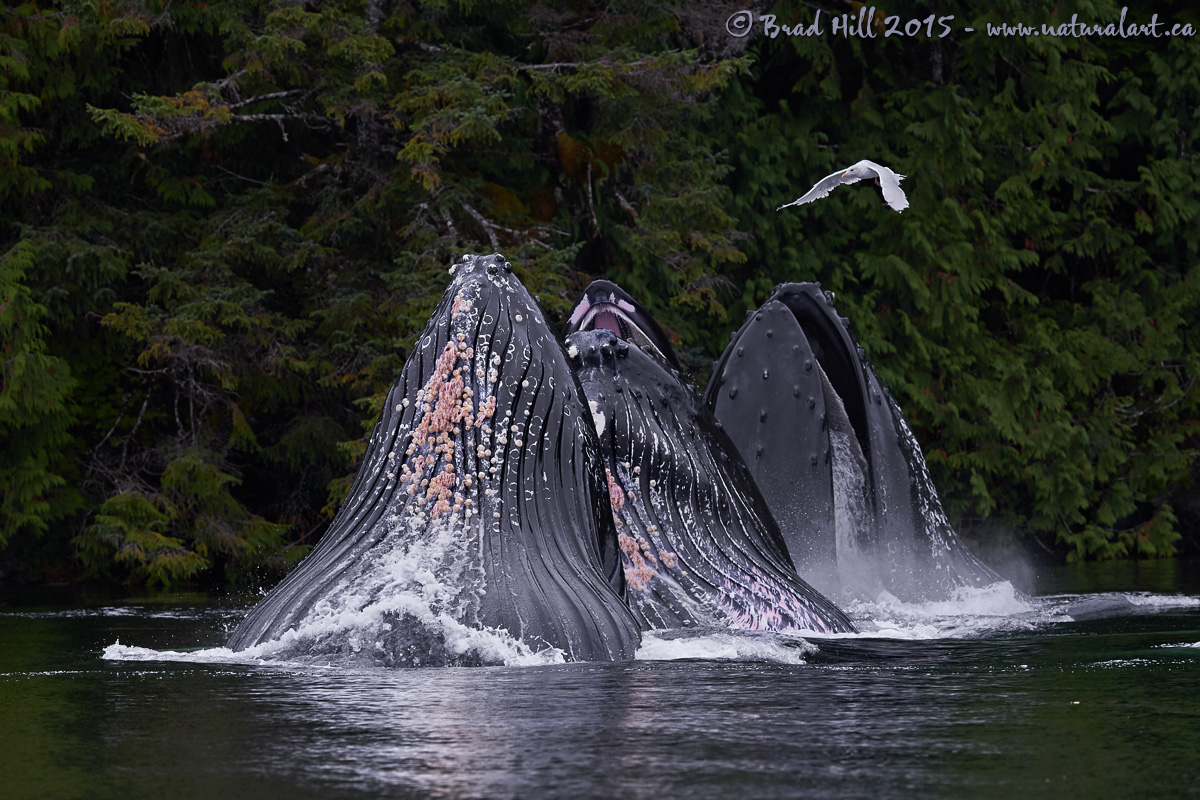
I captured this shot of 3 humpbacks breaking the surface during an extended bout of bubble-netting. Because there's lots of "spillage" of the small bait-fish that the whales are capturing out of the sides of their mouths, gulls are never far away. Despite how some may interpret this image, these whales aren't leaping out of the water in an effort to capture the gull!

Here you are seeing the distended lower jaws of the two closest whales and their "pleated" skin that allow the expansion of the throat that's needed to enclose tons of water (quite literally) is clearly visible. The pink circular objects all over the whale's throat are hitch-hiking barnacles that, like the gull, take advantage of the whales' sloppy eating habits for their own nourishment. The back-most whale is reversed in its orientation - you're seeing its upper jaw - and those bumps on it are called tubercules - and they're actually enlarged hair follicles. This whale has just begun expelling water through its baleen plates - straining out fish and other things (hopefully edible things!) in the process.
Subject: Humpback Whales (
Megaptera novaeagnliae) bubble-netting along a narrow coastal inlet
Location: Great Bear Rainforest, BC, Canada
Camera: Nikon D4s
Lens: Nikkor AF-S 400mm f2.8E VR - hand-held from sailboat. VR on and in Sport mode.
Exposure: 1/1250s @ f5.6; ISO 450. -1.0 stop compensation from "recommended" matrix-metered exposure setting.
Crop: Moderate - this is about 85% of full frame
More about this image (including processing details and a 2400 pixel version of this shot) can be found here...
http://www.naturalart.ca/galleries/latest/
Comments and critiques welcomed - probably best to view the larger version prior to doing so!
Cheers...
Brad

Comments
13 commentsBTW the barnacles are perhaps more interesting than you might suspect. There are two kinds of barnacles in this picture. The white ones with the typical barnacle shell are probably Coronula diadema and are specific to humpback whales. Meanwhile there is a species of gooseneck barnacle Conchoderma auritum which grows on the regular barnacles rather than on the whale itself. Which is pretty cool, unless you're a whale.
Yes, I knew about there being both goosenecks and "standard" barnacles on many of their body parts, including on the edges of their tail flukes. But I had no clue about the species - so thanks a bunch for that!! They also tend to have a lot of lice (don't know the species!!) on their snout as well (we've had a few "friendlies" stick their nose up beside the boat - so close that you can touch them!). Next time that happens I'll try to pick off one of the lice and send it to you for ID'ing!
Thanks a bunch!
Brad
What are the odds on seeing this, let alone being able to capture it so well. Marvelous
Jagdeep Rajput
Very Cool ! Great explanation of the developing scene.
Bill
Ray
Max
Supreme Work Brad