Focus
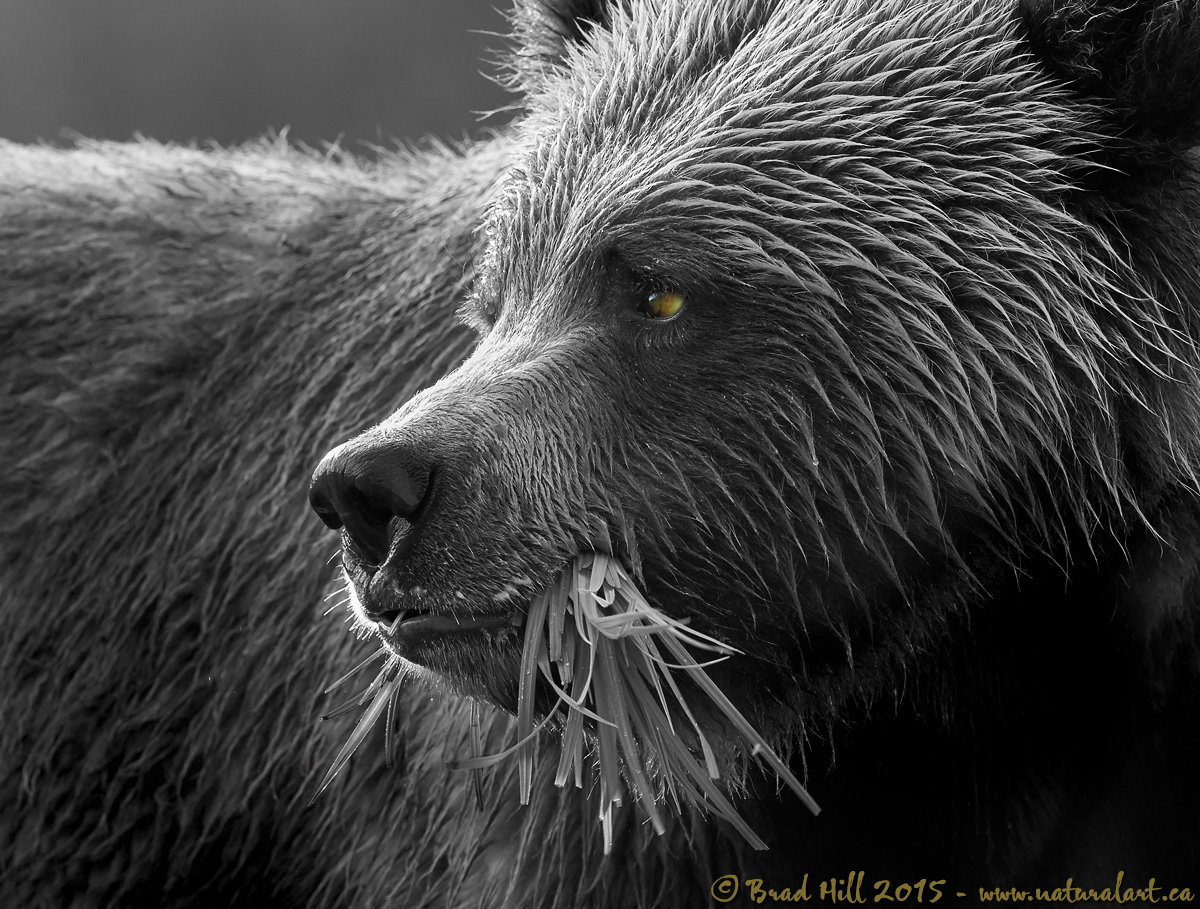
I shot this tight, intimate portrait of a foraging grizzly a few years ago while visiting the Khutzeymateen Grizzly Sanctuary. My primary motivation in shooting it was to juxtapose the almost fearsome reputation of grizzlies with their much more gentle true nature. The keen observer will notice that the material hanging out of the bear's mouth is grass - not tripod parts and not the fingers of an overzealous photographer! The bears in the Khutzeymateen - including this bear - are completely wild, but because its been years since these bears have been harassed or mis-managed by humans, they tend to be quite tolerant of small groups of humans that know to stay in places that don't threaten the bears. And, at times, while the bears are going about their normal activities, their chosen route brings them quite close to the Zodiacs that contain guests to the sanctuary. Which is exactly what happened here. And when this does happen, the key to minimizing disturbance on the bears is for everyone in the Zodiac to move as slowly and gently as possible - which usually translates into NOT fiddling with cameras - so you don't change lenses or cameras and you just shoot with WHATEVER you have in your hands. In this case I had my favorite wildlife lens in my hands - my 400mm f2.8 VR. Ergo - tight portrait!

This shot sat in raw form until February 2015. Then, when looking through my collection for some shots for a specific project, I decided to process this one. As soon as I finished the colour master file, I knew I HAD to try a B&W conversion on this one. My taste in B&W photos is quite straight-forward - I like them tonally simple, yet with some true blacks, some true whites, and with a nice but discrete range of grays in between. In other words - simple but with contrast. Interestingly, this tends to mean that images I like in colour are the same ones I like in B&W. I can't recall a time when I decided to try a B&W conversion because the image "didn't work" in colour...
What about the full colour eye? Tacky? Cliche? Perhaps. THAT aspect of the shot is little more than an experiment on my part and I kind of like it. It clearly draws attention to the eye region almost instantly, and I THINK after that most viewers will explore the rich detail of the head region (possibly more slowly than if the eye was in B&W). For those who are on the fence - full B&W versions (with no retention of colour in the eye) and full colour versions are available for comparison below...
Subject: Male grizzly (
Ursus arctos) NOT eating a tripod!
Location: Khutzeymateen Grizzly Sanctuary, northern BC Coast, Canada
Camera: Nikon D4
Lens: Nikkor 400mm f2.8G VR - hand-held from floating zodiac. VR on and in "Normal" mode.
Exposure: 1/400s @ f11; ISO 2000. -0.33 stop compensation compensation from matrix-metered exposure setting.
Crop: Very minor - cropped slightly from right side
A lot more info about this image - including including much higher resolution versions (2400 pixel) - of it as above (with colour eye), in full B&W, and in full colour can be found here on my website:
http://www.naturalart.ca/galleries/latest/.
Comments and critiques welcomed - probably best to view the larger version prior to doing so! Real curious as to which (if any) version of it you prefer (and why)?
Cheers...
Brad
PS: Like all wildlife images on my website and that I post on NPN, the subject is fully wild and completely unconstrained. Besides the potential impact of my presence, nothing has been done to intentionally alter or affect the ongoing behavior of the subject and, of course, there has been no use of any form of bait or other form of wildlife attractants (including vocalizations)

Comments
12 commentsThe only two parts of the image I'm less enthused about is the somewhat abrupt transition to near/pure black in the LRC without any detail in the neck region for something of a fade to black feel, and I HATE myself for even mentioning this but the open mid-grey background in the ULC adds an element to the frame that I somehow wish wasn't there...I hate mentioning it because I really fear many of us wildlife photographers in 2015 have a tendency to want images so clean we get bothered by nature!
Anyway, straight B&W for me, with a touch of the neck fur brought back as showing in the colour version (the colour version is outstanding as well though).
Sweet shot. I prefer both the straight B&W version and the straight color to the as presented version. To me the one with only the eye colored draws attention to the processing rather than the bear. A for B&W vs color I think both have merit.I think the color version emphasizes the grass (and thus the more docile nature of the bear) whereas the texture of the fur has a lot more impact in the B&W version.
I think John makes a good point about the neck fur in the B&W conversion though I might not have noticed it unless he had mentioned it.
Great shot.
Clinton
Welcome to the world of B&W!
Since it is technically solid, I like both he frames, full color as well as full B&W.
But, I feel B&W is able to emphasise more on textures n patterns by simplifying it.
The B&W with colored eye, somehow never appealed me, as many photographers in India tried on tiger pictures.
Jagdeep Rajput
PS. Looking at the small thumbnail, I thought Bear had whiskers.
Thanks for the feedback on this - always appreciated. Overall - when I total up the feedback I got above and directly by email from my website - the version that came in "first" in preference was the B&W conversion with the full-colour eye (tho' not by much over the full B&W) version. The full colour version came in a distant third...
Some specific feedback:
1. John: On the dark lower right corner with no shadow detail: Photographer's preference!
On the strip in the upper left corner: As you suggest - only way to get rid of that would have been to crop tighter, and - at least in my opinion - that would have cut out far too much of the interesting and highly detailed hair on the upper forehead...(as well as the ears)...so I had to compromise and leave it in.
2. Clinton - you said: "To me the one with only the eye colored draws attention to the processing rather than the bear".
Interesting point. I guess my thought is that the moment I look at ANY B&W image I think they are so "derived" I'm instantly thinking of the processing (tho' normally AFTER just letting the image impact on me). It's not as tho' any day-time scene is ever B&W - when I look at Ansel Adams great B&W landscapes I'm impressed, but I do find myself thinking about how the scene would have looked in colour (and what filtering he did along the way to produce the final image).
All good food for thought, tho' - thanks again to everyone leaving their thoughts on this one...
Cheers...
Brad