
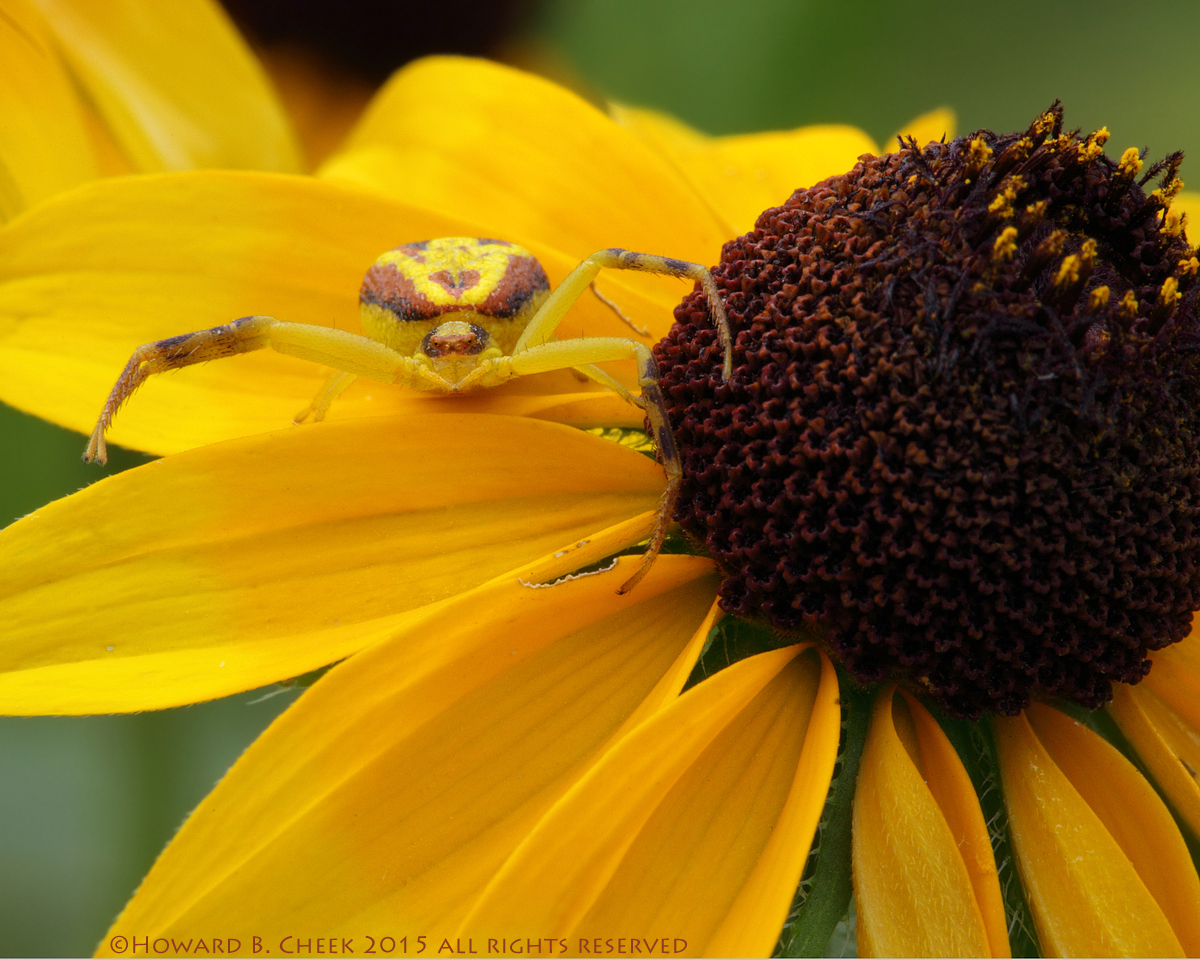
by Howard Cheek
Mimicry is used widely by arthropods to survive in a hostile environment. Often mimicry is associated with the production of chemical compounds such as pigments. In crab spiders, the change of color is based on a complex physiological process that still is not understood.
In order to actually ensnare its prey, the spider relies on this specialization. It has the ability to change colors and blend in with the flower it is hunting from. The spider remains still and unseen, waiting to ambush an unlucky insect that chooses the wrong flower to pollenate.
This color change may require several days before taking effect once the spider moves to another variety, so it prefers to hunt from a particular type of flower.
F/18, 1/8th second, ISO 640, 5DM2, Sigma 150mm f/2.8 with tripod & wire.
Comments
7 commentsHoward ..thats a beautiful spider ..and more beautiful flower ..Thats a whole lot of information you have provided, on the pigmentation. I think I now have a starting point...to understand the spiders and mantises.
Balan Vinod
Nice angle on the flower and the crab spider, Howard; and good job even finding this well-camouflaged spider! Technically and compositionally, this is also a pleasure to look at, as always for your work.
P.S.. A note on camouflage vs. mimicry. In biological terms, camouflage (rather than mimicry) is actually a better description of the spider's color and pattern, since camouflage means blending in with the environment. Loosely-speaking, camouflage could be considered a form of mimicry, since camouflage "mimics" the surroundings. However, in biological terms, (in English usage*) camouflage is sort of the opposite of mimicry, since biological mimicry means plainly standing out (not blending in) while looking like something else -- usually something to deter potential predators. Common examples of mimicry are harmless insects that copy the appearance of stinging wasps or bees; and butterflies that have spots that look like large bird eyes.
* After writing this, I looked up the paper you quoted. Don't blame the French authors for that small English semantic translation error. Biological terms may not translate precisely into English. For that paper, the distinction is not important, since it is about the chemistry of color change, rather than animal behavior.
A good photo and a great example of the Goldenrod's ability to change colors to match the flower it's on, Howard. Excellent photo of this amazing adaptation.
This is a fine look at this crab spider, Howard. It's colors match nicely with it's perch. I've seen these where their colors aren't matching and wondered about how that would work. Your last point provides a nice answer.
Wonderful shot, Howard.
Perfect details and POV.
D&L
This is wonderful Howard! Love that spider, Ray
Howard, The spider’s colors match really well with the flower. Beautiful colors, good DOF management and very interesting information. Thanks for sharing!