
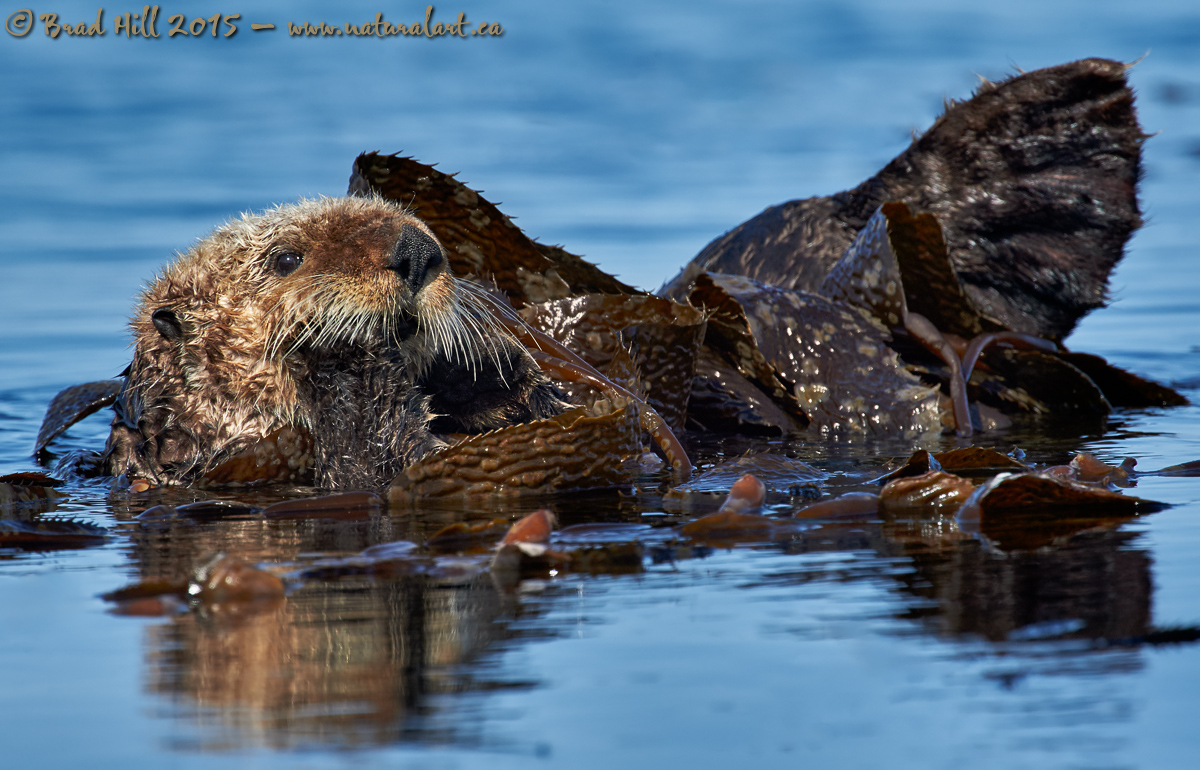
by Brad Hill
That's a Wrap!
After looking at all the thumbnails in this gallery I decided we needed an image up here that wasn't dominated by greens or browns...so here's one with a much bluer look to it. Kidding...just returned from leading my annual Marine Mammals photo tour and sea otter photo ops absolutely dominated the week. So it seemed appropriate that my post would be of one of those cute little beasts...
Few cross-kingdom relationships in nature are as intertwined as that between the Sea Otter (Kingdom Animalia) and Bull Kelp (Kingdom Chromalveolata). The two species have an extremely tight ecological relationship - the predation of shellfish (particularly sea urchins) by the otters allows the kelp to escape being over-harvested by the shellfish and, ultimately allows the kelp to prosper and form thick underwater forests. The otters, in turn, directly use (and are almost dependent upon) the kelp for a variety of reasons, including using them in an ingenious way to anchor themselves from drifting away when they decide to grab 40 winks! Here we were watching this male sea otter as he became increasingly drowsy. Just before nodding off, he swam over to a nearby thick kelp bed, grabbed onto the leafy blades, and rolled over and over in the water until he was fully wrapped up (and anchored in place)! Shortly after this shot was taken the otter fell into a peaceful slumber...with the knowledge he'd wake up in the same place he fell asleep!
Subject: Male Sea Otter (Enhydra lutris) lounging in a bed of bull kelp
Location: Northern Vancouver Island region, BC, Canada
Camera: Nikon D4s
Lens: Nikkor AF-S 400mm f2.8E VR paired with 2x (TC-20EIII) teleconverter (800mm total focal length) - hand-held from floating Zodiac
Exposure: 1/1250s @ f11; ISO 1100. No compensation compensation from matrix-metered exposure setting.
Crop: Very minor - this is about 90% of full frame...
A lot more info about this shot - including a 2400 pixel version of the shot - can be found here on my website. This go 'round the additional info includes a short discussion on teleconverters that may interest some Nikon shooters...
http://www.naturalart.ca/galleries/latest/.
Comments and critiques welcomed - probably best to view the larger version prior to doing so!
Cheers...
Brad
PS: Like all wildlife images on my website and that I post on NPN, the subject is fully wild and completely unconstrained. Besides the potential impact of my presence, nothing has been done to intentionally alter or affect the ongoing behavior of the subject and, of course, there has been no use of any form of bait or other form of wildlife attractants (including vocalizations)
Comments
8 commentsHello Brad , This guy was quite a distance from you and you did well from the Zodiac to nail the Focus, Sharp with excellent Detail ! Congrats.. Nice Eye capture & detailed whiskere too!
thanks for sharing,
Bill
PS... Hope the Fires are far away from your home!
Hey Bill,
Thanks! The otters in the region I run this tour were FAR more numerous this year - nice conservation success story after their re-introduction a few decades back. And...while each year they seem to be getting a LITTLE more approachable, they still tend to need a pretty LONG focal length to work effectively with. So I got a lot of practice hand-holding shots in the 800 to 1200mm focal length ranges while in rolling seas!
Biggest fires are quite a ways away, but a few small ones are within 10 km of our cabin (thanks for asking)...
Cheers...
Brad
Brad, this is very impressive, though I'm not sure everyone will understand. Having just spent some time with this species up north, I have a sense of how difficult it can be to get close photo ops like this.
I assume you cropped this way (otter centered vertically) in order to keep the reflection intact as part of the greater "shape," so to speak?
Max
Hey Max,
We had a banner year for otters this year, and were able to even shoot full-frame portraits of them (albeit with darned long lenses!). But lots of mums with pups, mating pairs, and other cool stuff. But really tough shooting as we were invariably in big swells. Good fun (if you weren't prone to seasickness!!), but super-challenging...
This one is almost full frame, with only slightly more cropped off the top than other sides (but those other sides were just slivers). So, the image here is representative (with a very slight aspect ratio change) of the full-frame shot. in both the original shot and this version I intentionally kept the reflection of the head and rear foot/flipper. I suppose some part of the otter is mid-line vertically, but my goal was to position head and nose 1/3 the way down from the top (good ol' rule of thirds).
Hope you had good luck with the coastal wolves - those guys can be really tough!
cheers...
Brad
PS: When I was in the field on this one (and from a compositional perspective) I liked the graphic "X" shape (or double diagonal?) provided by the otter and the reflections of its various appendages...
Love the colors in this one. Deep, rich tones. Also interesting symmetry across the vertical middline.
Hisham.
Hi Brad,
I very much like this image. It shows the behavior of wrapping in kelp very well. I like the eye contact, whiskers and the display of the big webbed foot. Getting a nice blue water color is great too. In the Monterey area most of the places where it's relatively easy to find otters have ugly green/grey water. I do find myself wishing you'd have come back after the otter had finished his nap so that you could get a dryer face. Wet otters look kind of like drowned rats but dry otters (or at least otters with dry faces) are off the charts cute. This one is in-between. Almost but not quite dry.
One other observation - I think this otter is wrapped in Macrocystis (Giant) kelp rather Neriocystis (Bull) kelp. You can tell by presence of small floats and the texture on the blades. Neriocystis has smooth blades coming off of a single very large float.
Clinton
Hey Clint,
Thanks for the feedback...I actually desaturated the blues (by 10 Photoshop "units") - as shot it was just electric blue and if I hadn't it would have looked super-saturated!
On the kelp - there were some large floats RIGHT behind (not visible in the image) the otter - perhaps both types of kelp were intermingled? I've noticed both genera of those kelp mixed together before. Thanks for pointing this out!
Cheers...
Brad
Hi Brad, yes it is very likely there were both kinds of kelp present. Neriocystis is actually much more common in BC than Macrocystis but what's in the picture is Macrocystis. The grow in similar areas though Neriocystis tends to be happier in places with lots of water movement and Macrocystis in calmer areas.
Clinton