
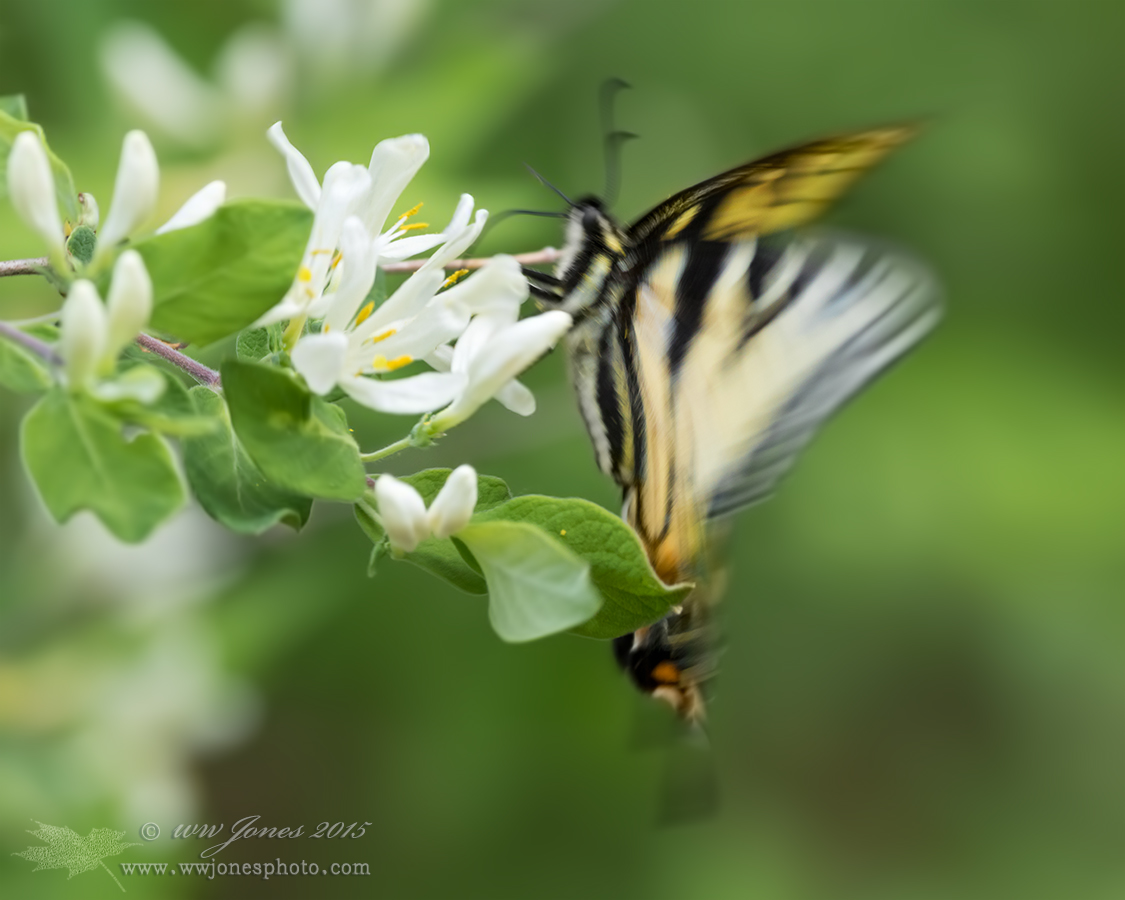
by Wayne Jones
And now for something completely different. This image came to mind a couple of days ago when we had a discussion about why Scott shot a tiger swallowtail at a shutter speed of 1/4000 sec. Basically, he was shooting in changing light conditions, and wanted to be ready for everything. I applauded the strategy, since my philosophy -- after decades of documentary photography -- is to do what it takes to "just get the shot." In the case of this shot, I decided to depart from my usual documentary style, especially since I already have more "mug shots" of tiger swallowtails than I will ever use. I was actually looking for shallower depth of field than my typical f/16 insect shots, but kept the ISO at a level where noise is not a problem. For subjects in the shade, I expected motion blur in a few shots, and figured I would just delete them, but this "accident" was my favorite shot of the series.
This one was an accident, but I have often tried to illustrate (rather than freeze) motion on purpose, with living subjects from plants and animals to people. Although I enjoy these images, many people -- from editors to family members -- have reacted with comments like "We need something just like this, but not blurry" or "Too bad it didn't come out" or even "Dude, I think your camera moved!" Unlike the blur in a long-exposure waterfall image which seems universally accepted, reactions to the blur of moving people and animals is quite variable. Just thought I would post this to see how fellow photographers react, so please tell me what you think -- positive of negative.
Comments
5 commentsI like the natural, soft look with the soft whites and greens, Wayne. The softness or blur looks natural in this setting. While wing blur or motion is fine with me, and can actually be very appealing, I think the body/head/eyes should be reasonably sharp. I am not sure why wings and waterfalls can be blurred but bodies and eyes should be reasonably sharp. I suspect this has more to do with my training as a photographer than anything innate with the image. There is artisitic interpretation and expression, of course, and exceptions to every rule, but in this particular image, my personal reaction is that the body/head needed to be fairly sharp. Thanks for posting, as I am curious to hear how others' react to the image.
The significant blur subject, (with the white flower in good focus) gives a strong sense of motion Wayne.
Actually, I think the level of blur's just about right for what you're trying to do here..
My take? Ideally, one would get the same level of blurred wing 'motion' everywhere.. except for the head.
Great post, great food for thought
Wynes for me this photo is beautiful: original, creative. You have luckly inverted the rules: the butterfly is soft, with a strong feeling of movement, and the flower is sharp. I love this image.
Wayne, this does a fine job of "catching the action". Yes, in photography, the expectation is a sharp image, even when the subject is a moving bullet...but that's not always the best answer. I think this works very well, with the movement of the bf set off well by the terrific sharpness of the honeysuckle blooms.
Wayne,
This how nature works. The swallowtail is keeping its wing muscles warm and the vibrations facilitate pollination. If you watch bumblees on tomato flowers, they stick their head and tongue into the flower and shake like crazy which causes the pollen to shake loose and stick to the static elictricity charged bee. So in effect, you make a case for justifying this type of image to illustrate the biology of these 2 living things............................Jim