
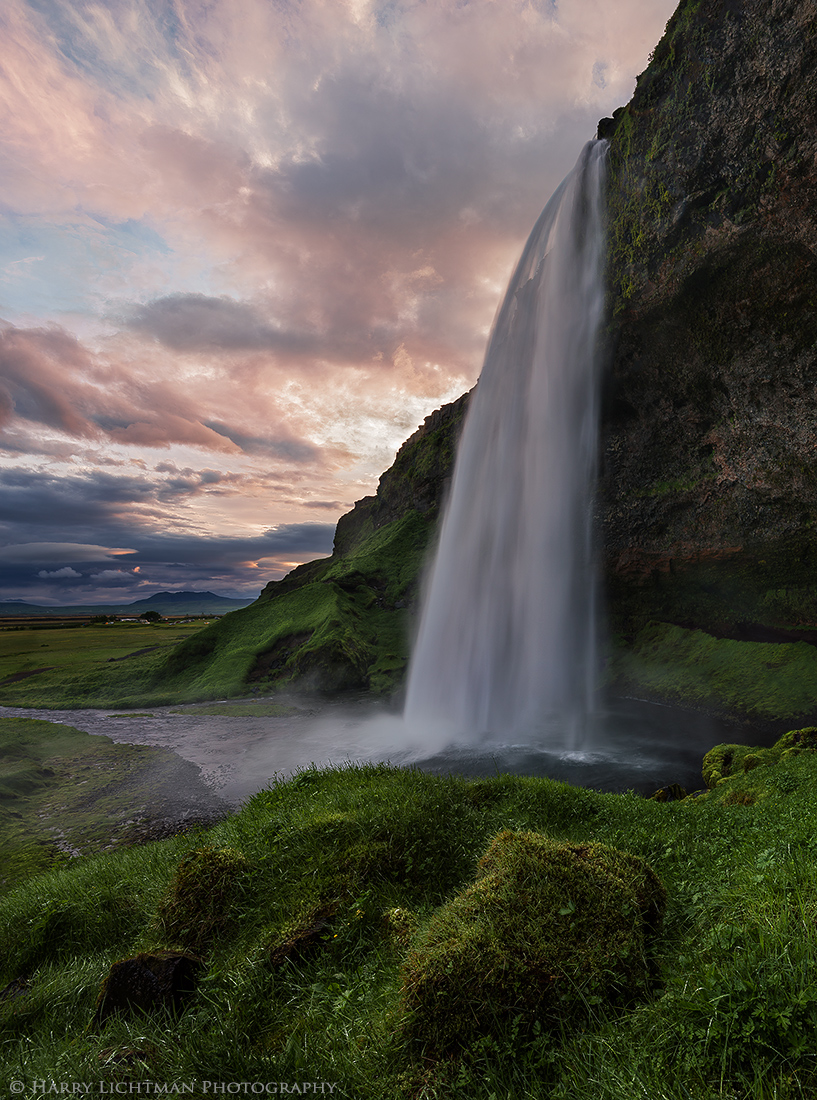
One of the most photographed waterfalls in Iceland is Seljalansdfoss on the southeast coast. It is very accessable which is great but also make getting unique shots or those without people difficult. I had no illusion of getting that one in a millon shot, just something good that would have a personal appeal and maybe commercial appeal down the road. I suppose it is like going to Yosemite and shooting falls there. I visited the falls during the day when I first arrived in Iceland, and then returned for better and varied lighting conditions on several occasions. This was taken a bit before midnight, though it never got totally dark. Few people were visiting the falls at this hour so I was able to photograph pretty much by myself. Staying dry from the mist of the falls was a major challenge as the wind seemed to blow the spray my way. I had taken this view as a vertical shot which came out fine, but I needed to move farther away from these grassy boulders to include the whole fall and ended up with less sky. For this one I moved very close to them so they would appear much larger and took 4 successive horizontal shots in a vertical direction to cover the view and stitched them. I was able to get more of the sky in this way and a little different perspective. There was a bit more of the rock wall to the right in the stich, but I cropped it off so the falls would not be too centered. While this fall has been shot from every angle, I liked the magestic profile this view gives and the ability to include the vibrant green grasses and moss that surround the falls. I was lying on my back for this one with the tripod centered over my chest and waited for wind shifts to uncover the camera and take the shots. Comments welcomed.
Nikon D810, 16-35mm, polarizing filter, ISO 40, all 4 shots at f16, 1/4 sec.
Comments
12 commentsBeautiful composition and mood. The sky definitely makes this special.
Effort well rewarded. I'm impressed with how well you handled the light in this dificult exposure. Lovely imaging.
Harry, This looks great! I like the comp you have here and think the foreground grass and moss add up to an excellent view of this falls. The falls itself looks wonderful and especially with that great looking sky backing it up. Really nice just as you have it here and I don't think I would want to change anything.
Nick Bristol Lone Rock,WI
The recent forums suggest that not enough technical questions are being asked or advice being given by members, so here goes.
Can you please explain why you stitched 4 horizontal images. Were the 4 images the same size or defined by the subject matter?
If you have the time, and that's a big if, could you post the 4 images taken to create the final image.
Thanks.
Igor - I try to work backward from the finished image I have in my head when deciding how to contruct a photo - whether it be stitching frames, focal stacking, processing RAW files multiple times, or taking a single shot. This allows me to identify potential challenges /problems and then ways to overcome them. As I mentioned in the original post, I took a single vertical, but it didn't give me the perspective I wanted - the large boulders in the FG. Even with a super wide angle lens, either the boulders or the top of the falls would be cut off. Stitching 2 vertical shots would not have included as much sky. Had I panned the camera side to side, holding the camera vertically, I would have had to point the camera downward to include all of the boulders and I thought I might have some issues putting the final stitch together where the waterfall overlapped the images, and distortion for the lens. Lighting was even enough so I only needed a single exposure for the entire dynamic range, though I did bracket each exposure. I could include wide areas of the sky which weren't possible with a single verticle image or if Ihad stitched vertical shots. I'm sure there were other ways to solve the issues I found in getting the view I wanted, but this seemed the simplest way of doing it. I am all for keeping it simple, and the fewer the shots the better for me, but this just seemed to work out for me with 4 horizontal shots stitched. I will try and get those slides posted when I get a chance. Hope this explanation was helpful.
This is excellent, Harry. Great color and tonality, and I like how you framed this. I do see a halo along the top edge of the cliff band. Other than that, I think this looks great.
Thanks also for your explanation as to your thinking how this image should be done.
--P
Thanks Preston for catching that.
So Igor, here are the slices that I used to create the final image. I can see some water spots that were taken care of by the stitching software of PS that I didn't even realize until now. Now that is cool!
Harry, what a very powerful and wonderful scene. Iceland seems to have enough freshwater for the entire world at times....
Your excellent field work and post processing has collectively come together to present this superb image......
Nice work Harry. What surprises me is that you were able to keep the dynamic range for sky and rock together in one exposure. Why ISO 40 instead of 64?
Doug - I used the built in ND filter (allows ISO settings below the native 64) of the 810 to allow a slower shutter speed for the water rendition. I did have a 3 stop ND filter with me but with the spray it seemed too big of a hassel with getting wet. The low ISO setting combined with f16 gave me an acceptable shutter speed for water detail. The brightness of the sky did create more light so I needed to get the slowest shutter speed I could without resorting to shooting at f22 and degrade quality. I am able to hold highlights and increase the shadows during RAW processing without significantly damaging the detail in the shadow area. I'm not sure if it is the camera or the Raw processing power of PS, but the combination really gives me confidence in holding it all in one image. I still did bracket in case it was needed but didn't think I needed them in this case. Maybe you have found the same with the D810 files, it looks like you shoot with it too.
Fascinating. As I understand it you went to the four shot image in order to generate a perspective that none of the lenses would give you. A wider lens would make the fg rock too big in relation to the upper falls and a longer lens would make the rock below not significant enough. I was always curious how images with moving objects such as the water are stitched together convincingly. The water path is slightly different in each shot. I guess there is some cloning that needs to be done to get that evened out.
Other than the halo which Preston pointed out, not much I could to suggest for improvement. Beautiful image Harry. I really appreciate you sharing your thought process in constructing this image. It is a great help to all who may find similar situations.