
by Brad Hill
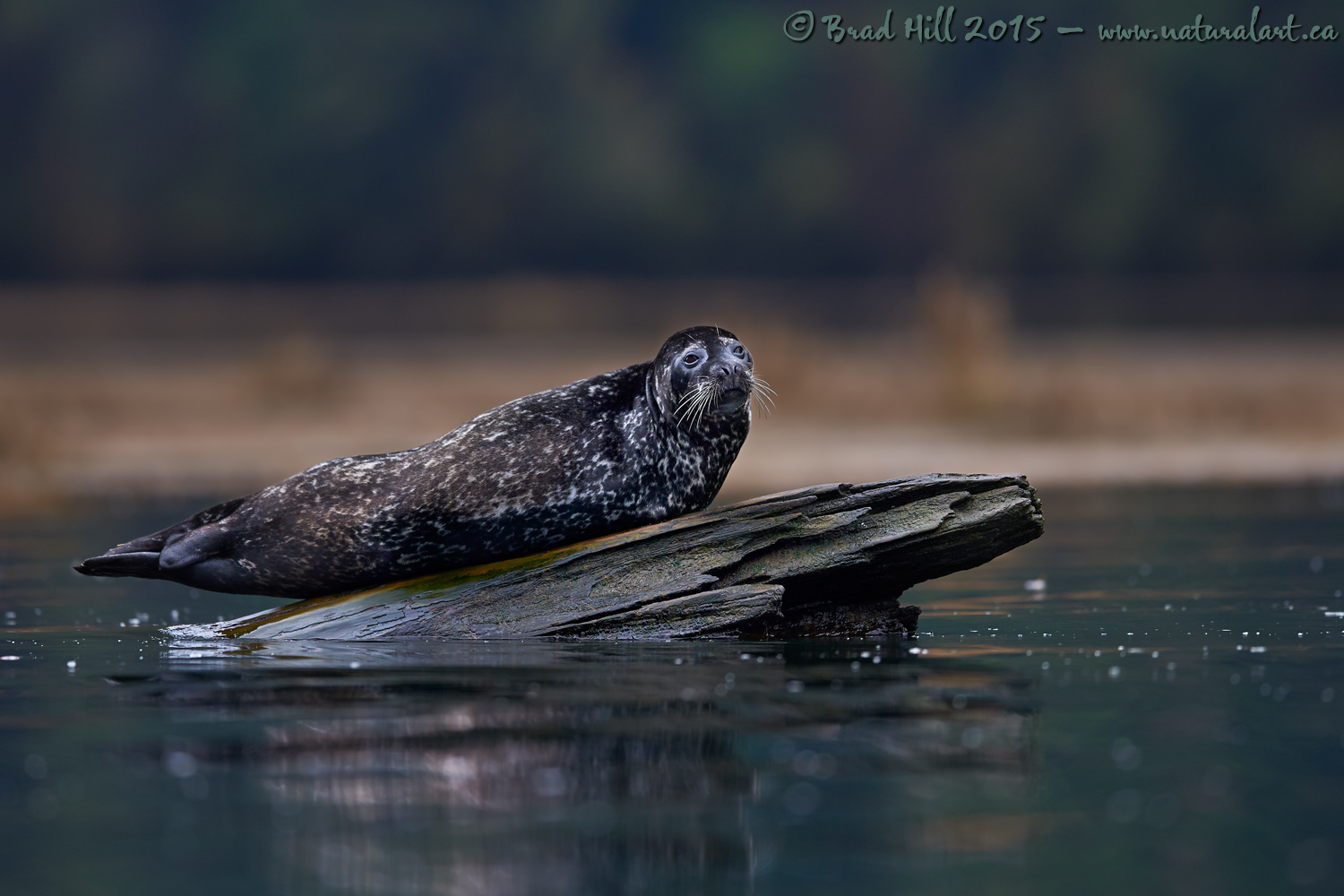
Seal on a Stick
Another "Hey, it's NOT a bear shot" from the Great Bear Rainforest!
I'm presenting this shot for a couple of reasons. First, I want to prove to the folks who shoot mostly birds that they don't have exclusivity to the "...on a stick" theme. 
Even though I'm a huge fan of Harbor Seals (in their own right, and as photographic subjects - I love their big eyes, whiskers, and almost human-like face), in this particular case I think I like the texture and colours of the "perch" this seal is on almost as much as I like the seal itself! Nice stick, eh?
The second reason I posted this image here (and on my website) is that it's a good shot to use in a discussion of subject isolation. I've been spending a lot of time lately field-testing a bunch of competing lenses (notably the new Nikkor 200-500mm, the Sigma Sport 150-600mm, and the Nikkor AF-S 80-400mm, with my own primary goal to really get a feel for the strengths and weaknesses of each lens in a field setting. I've been getting a lot of questions about the lenses via email, but probably the most-commonly asked question has been this:
"With having a maximum aperture of only f6.3 at the longer focal lengths, can you effectively isolate the subject from the background with the Sigma Sport 150-600?"
The short answer to the question is this: Yes, but only once you realize that subject isolation is MORE a matter of camera and background position (relative to the subject) than it is to having a lens with a large aperture and shooting "wide open".
I explain this issue more fully in the commentary associated with the image on my own website - so those who are curious can follow the link below for more info.
Subject: Dry Harbor Seal (Phoca vitulina) on a big stick
Location: Great Bear Rainforest (central BC coast), BC, Canada
Camera: Nikon D750
Lens: Nikkor 400mm f2.8E VR - hand-held from floating Zodiac.
Exposure: 1/400s @ f3.2; ISO 320. -0.67 stop compensation from matrix-metered exposure setting.
Crop: Limited - this is about 85% of full frame...
A lot more info about this shot - including the full discussion on subject isolation and a 2400 pixel version of the shot - can be found here on my website:
http://www.naturalart.ca/galleries/latest/.
Comments and critiques welcomed - probably best to view the larger version prior to doing so!
Cheers...
Brad
PS: Like all wildlife images on my website and that I post on NPN, the subject is fully wild and completely unconstrained. Besides the potential impact of my presence, nothing has been done to intentionally alter or affect the ongoing behavior of the subject and, of course, there has been no use of any form of bait or other form of wildlife attractants (including vocalizations)
Comments
7 commentsnice to see an mammal on a perch
I like this for its rich and deep color tones...which leads me to ask about you preferences for slightly darker color renditions. I have always found there is real difference in final product depending on if the end result is on a screen, with illumination coming through the image, or whether the image is printed and the illumination is all reflected light. For me, if it looked fine on screen, it would often not translate as well printed on paper unless I processed it differently to compensate. So my question is for print viewing, do you have to make a different file? I am betting others will find your expert experience helpful in this matter, as well.
Nice composition. I really love the point of view as well. There something about being down on eye-level with the animals that allows for a more intimate feeling. Great textures and love the deep colors. I'm not sure I would change anything about this. Well done! :)