
by Brad Hill
Whaleville, BC
If you take the time to really LOOK, it's hard not to find the natural world absolutely mind-boggling. This is a case where I thought the subject matter in this shot was kinda cool (even if it has a certain element of grossness to it) - but it got WAY more cool when I took the time to do some research...
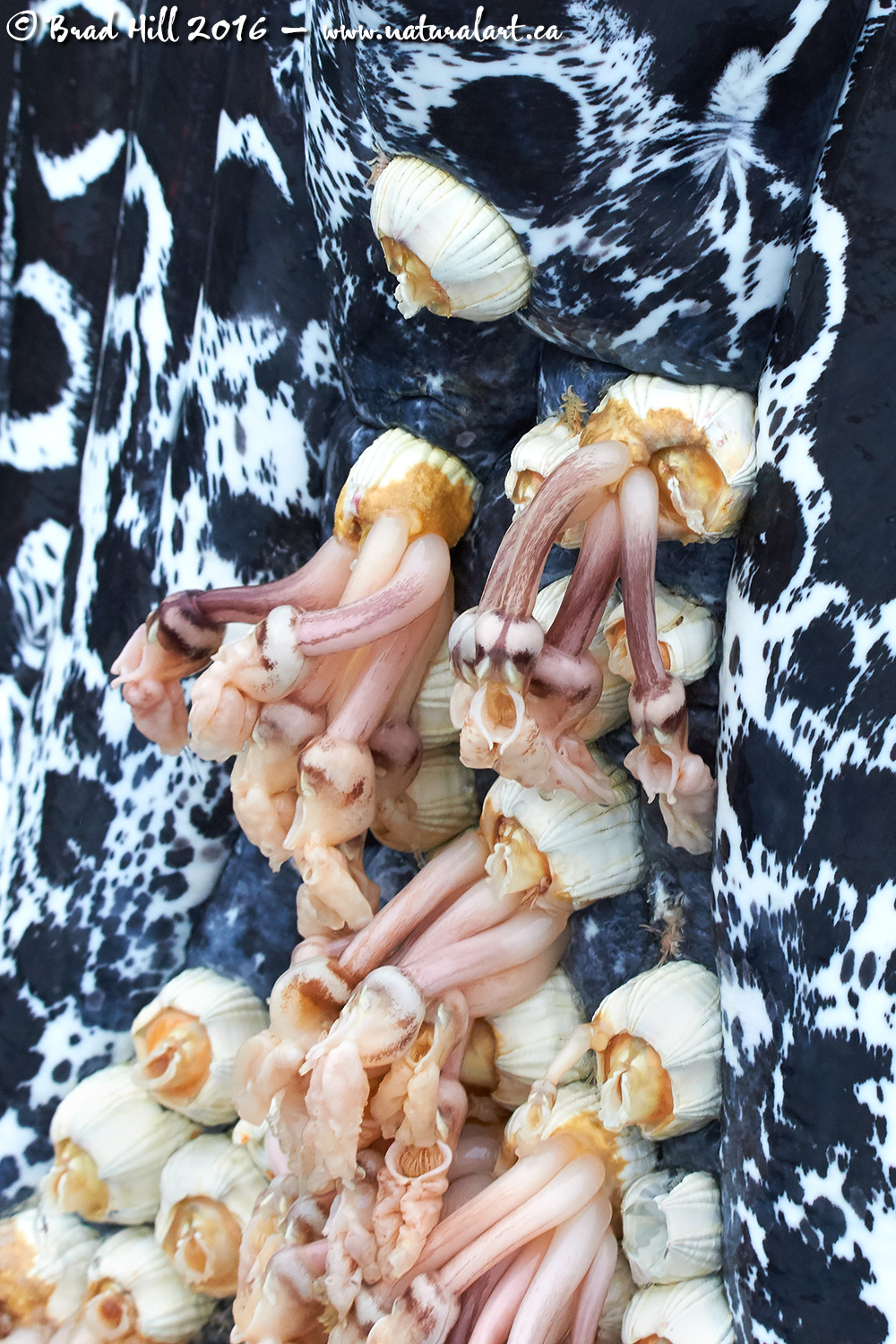
So...what the heck are we looking at here? Well...many people will recognize that we have some calciferous round barnacles in this shot. A smaller number will probably recognize that there are some Gooseneck barnacles in the image too (those are the long-fleshy things hanging down in the image - and they ARE attached to the round barnacles). But what the heck are the round barnacles attached to? Well that black-and-white substrate happens to be the pleated underside of the lower jaw of a humpback whale. And...when I took the shot the humpback was just a meter or so off to the side of our sailboat and sitting absolutely motionless (and vertical) doing what's called a spy-hop. Yep...it was a very friendly (and darned curious) humpback - it was REALLY checking us out. I could go on and on about how cool this friendly humpback was, but that's kinda another story...
Back to the barnacles. So...after I returned from the trip into the Great Bear Rainforest where I shot this image I did a little research. Turns out the round barnacles are called Humpback Barnacle (Coronula diadema) - and they grow ONLY on humpback whales (how's that for specificity?). The Gooseneck barnacles? They're called Humpback Gooseneck Barnacles (Conchoderma auritum). Where do they grow? ONLY on those round Humpback Barnacles. So...you're looking at both a barnacle that only grows on a humpback, and a barnacle that grows ONLY on a barnacle that grows ONLY on a humpback! Crazy, eh?
Subject: A humpback's (Megaptera novaeagnliae) personal community...
Location: Great Bear Rainforest, BC, Canada
Camera: Nikon D4s
Lens: Sigma Sport 150-600mm at 185mm. Hand-held from sailboat. OS on and in "OS1" mode.
Exposure: 1/400s @ f7.1; ISO 1800. -1.0 stop compensation compensation from matrix-metered exposure setting.
Crop: This is about 85% of full-framed image
A lot more info about this shot - including a 2400 pixel version of the shot - can be found here on my website...
http://www.naturalart.ca/galleries/latest/.
Comments and critiques welcomed - probably best to view the larger version (or, better yet, the new detail view) prior to doing so!
Cheers...
Brad
PS: Like all wildlife images on my website and that I post on NPN, the subject is fully wild and completely unconstrained. Besides the potential impact of my presence, nothing has been done to intentionally alter or affect the ongoing behavior of the subject and, of course, there has been no use of any form of bait or other form of wildlife attractants (including vocalizations)
Comments
12 commentsBTW, Years ago I was on a small ocean raft taking me from diving off the coast of Lanai back to the marina in Lahaina, Maui. We spotted a humpback with young. The captain of our raft shut off the motor (the law requires no running motors within a certain distance of a humpback) and positioned us in what he thought was her path. She swam right up to the raft and kept diving under us and coming back up on the other side giving us a show I will never forget. It lasted for several minutes. I was surprised and amazed at how gentle these huge creates are. She even let her youngster say hello very close to us. Your story reminded me of that day....it is still one of my favorite days I ever had in nature. Thanks for posting this and the story behind it.
a really crazy story that nicely shows dependencies in nature. Thanks for the image and the explanation.
1. Kurt: Well...there's probably some species-specific microbes growing on the gooseneck barnacle (that only grows on the humpback barnacle that only grows on the humpback), but beyond that...
The humpback encounter was amazing - we've been noticing an increase both in total humpback numbers and an increase in the number of "friendlies" (that like to visit and interact with boats) in the Great Bear. We had about 30 minutes with this one - she'd circle around and then come up and caress the boat with her pectoral flippers and regularly spy-hopped up to check us out. She must have done a good dozen laps. Just an amazing experience...and you can't come away from it without thinking that the whales are fully sentient beings...
2. Alberto: I'm not sure it's a symbiosis - probably more along the lines of commensalism (relationship between two organisms where one organism benefits from the other without affecting the second). Both species of barnacles benefit from being exposed to food sources but I doubt there's any benefit (and likely little or no harm) to the whale...
Cheers...
Brad
Bill
www.Billbickle.com
.
Wow. That is all.
Clinton