
by Brad Hill
Bedtime
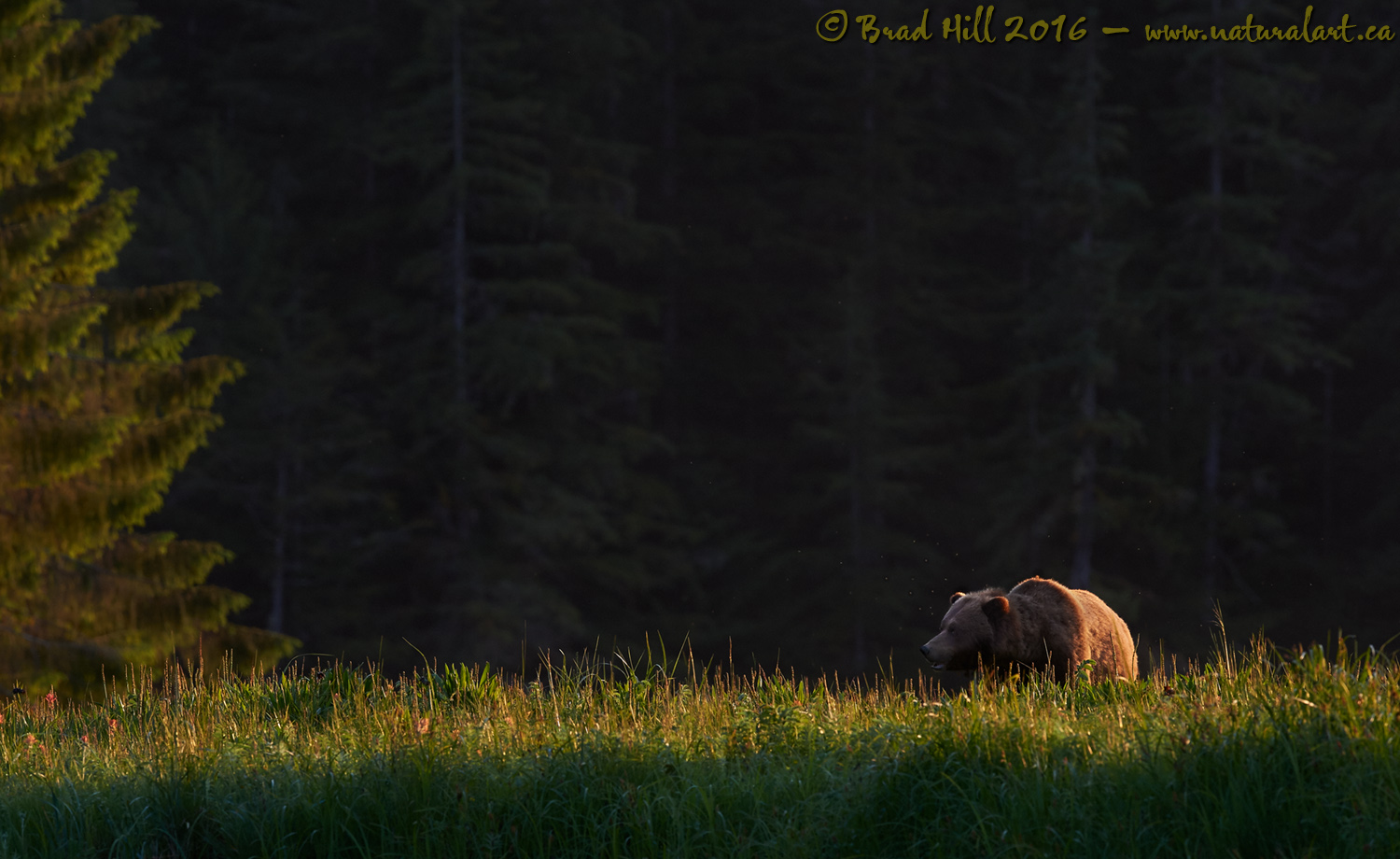
I captured this image late one evening in May of 2015. The sun was just going down, and so was the bear! We watched the bear quietly bed down only moments later. Dreamy light just before dream time. What could be better for a keen wildlife photographer? This opportunity was a good reminder that at the end of the day, it's ALWAYS about seeing and capturing the light...
I tend to like scenes and images that are on the very "edge" of what our cameras can capture and render. Commonly these scenes are outside of what the camera can capture "on its own" - meaning that the contrast or dynamic range is such that realistically rendering the scene requires a lot of post-processing work. This image - while really very simple and consisting of only 4 elements (the horizontal band of light, the softly illuminated tree, the bear, and the subtle background) - is a good case in point. While making the exposure in the field wasn't too tough (I only needed to under-expose the image by 0.3 stops less than the light meter "suggested" to retain all the highlights), I had to blend 5 different derivatives of the raw file (raw "clones" or "variants") that differed in exposure to get this one right (and note that here I'm using "right" in the sense of "in the way I remember the scene"). So not only was this scene outside where you could push a single raw file during processing, it is WAY outside what the camera could do on its own (which, of course, makes it WAY outside the in-camera "JPEG Zone").
Over the years I've noticed that a lot of neophyte and/or developing wildlife photographers put their cameras down just when things are getting interesting, like during strong side-lighting (as in this scene), strong backlighting, or whenever contrast is high. I'll grant that these situations often force the photographer to "take control" of their cameras (for instance, making exposure compensation decisions, and sometimes pretty extreme compensation decisions) and also demand that they understand what they can (and can't) do during post-processing. But if you want to capture compelling shots, you just gotta take those leaps at some stage! 
Note to Billy-Boy: This one was captured during your first day in the Khutz in 2015 - so you may have a similar shot!
Subject: Adult Grizzly (Ursus arctos) just about to hit the sack...
Location: Khutzeymateen Inlet, northern BC coast, Canada
Camera: Nikon D4s
Lens: Nikkor 400mm f2.8E VR. Hand-held from Zodiac boat. VR on and in "Sport" mode.
Exposure: 1/400s @ f8; ISO 2800. -0.3 stop compensation from matrix-metered exposure setting.
Crop: Full frame horizontally, small strip taken off of top and bottom of image
A lot more info about this shot - including a 2400 pixel version it - can be found on my website using the link immediately below.
http://www.naturalart.ca/galleries/latest/.
Comments and critiques welcomed - probably best to view the larger version (or, better yet, the new detail view) prior to doing so!
Cheers...
Brad
PS: Like all wildlife images on my website and that I post on NPN, the subject is fully wild and completely unconstrained. Besides the potential impact of my presence, nothing has been done to intentionally alter or affect the ongoing behavior of the subject and, of course, there has been no use of any form of bait or other form of wildlife attractants (including vocalizations)
Comments
4 commentsLove the shaft of light, the subtleties in the shadow detail and good to hear you also blend exposures in wildlife photography.
Thanks - your feedback is appreciated. While lighting like this isn't everyone's cup of tea, it's certainly something I enjoy!
Cheers...
Brad