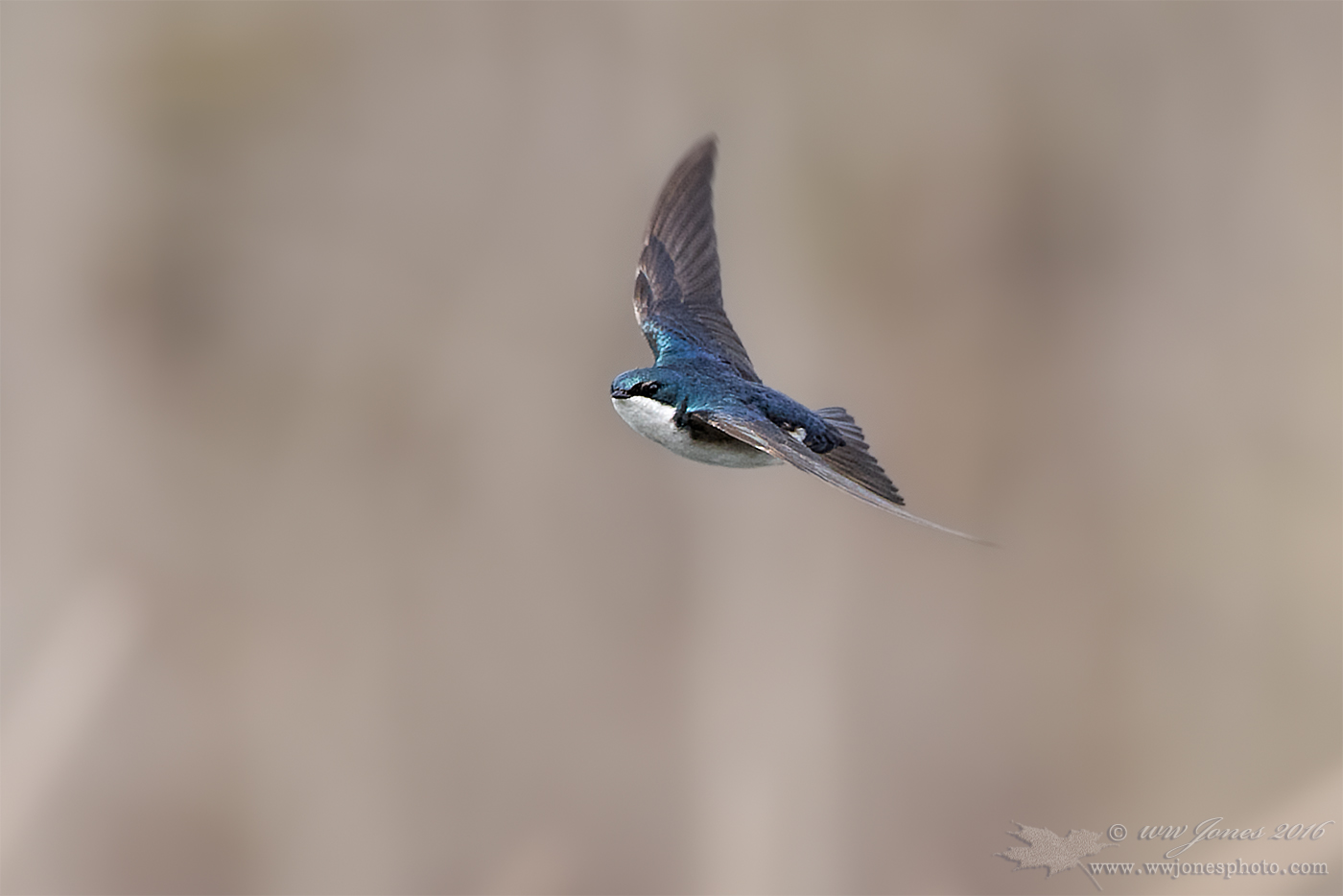
Tree Swallow BIF REPOST
by Wayne Jones
This is a repost of the male tree swallow BIF I posted yesterday.
Thanks to Dennis Plank and Steve Thompson for noticing a noise problem I caused in processing. I don't know if it's 43 years of working with film before I got a digital camera, or just my old eyes, but I am not very sensitive to noise in my images. I guess I'll have to get my nose closer to the screen with my trifocals now. I still have a hard time seeing the noise, even after they mentioned it. :-( -- Is there a significant improvement in this version?
With changing light conditions on a cloudy, breezy day, I ended up slightly underexposing the bird. The noise came from a small boost in exposure and in shadow detail in ACR, but mostly from oversharpening. To tried to compensate for a shutter speed that was not fast enough to keep up with the little speedster, I tried the Photoshop "Shake Reduction" sharpening tool without really knowing how to use it. After Dennis and Steve pointed out the noise, I used less exposure compensation, and then took some time with that Shake Reduction sharpening tool, experimenting with the "Smoothing" and "Artifact Suppression" sliders. To help make up for slightly less sharpness, I added just a touch of contrast with Topaz Clarity to bring back the sparkle of the irridescent feathers. I ended up with this image, which I think is a better compromise between sharpness and induced noise.
All that work really makes me appreciate the importance of getting it right in the field. In this case, I was totally engrossed in trying to track and focus on these impossibly fast and erratic fliers, while getting blown around in my little canoe.
Canon 7D Mark II; Sigma 150-600 C @ 435 mm.
1/800 sec. @ f/7.1; ISO 640
25% of frame
Hand-held from canoe

Comments
7 commentsI like this repost better than the first--but more than just the relative comparison, it is a very nice image. I think the darker background looks so much better than the original. Its tonal value compliments the bird a lot more and creates a really nice overall look. And I love the blurred tip of the rear wing; I think it creates a dynamic quality that would be missing if it were sharp. If sharp, the bird would become static.
Like you, noise escapes me sometimes. I shot Tri-X and developed it in HC-110 so much in the old days, that I'm oblivious to noise! LOL
DENNIS: Since you asked, here's a little shot of the original soft Raw file with only the default image settings in ACR, next to a small view of the finished second version. I think the original had both motion blur and soft focus.
Just too much extreme processing, but I wanted to have something to show after over 900 clicks in two hours.
May