
by Brad Hill
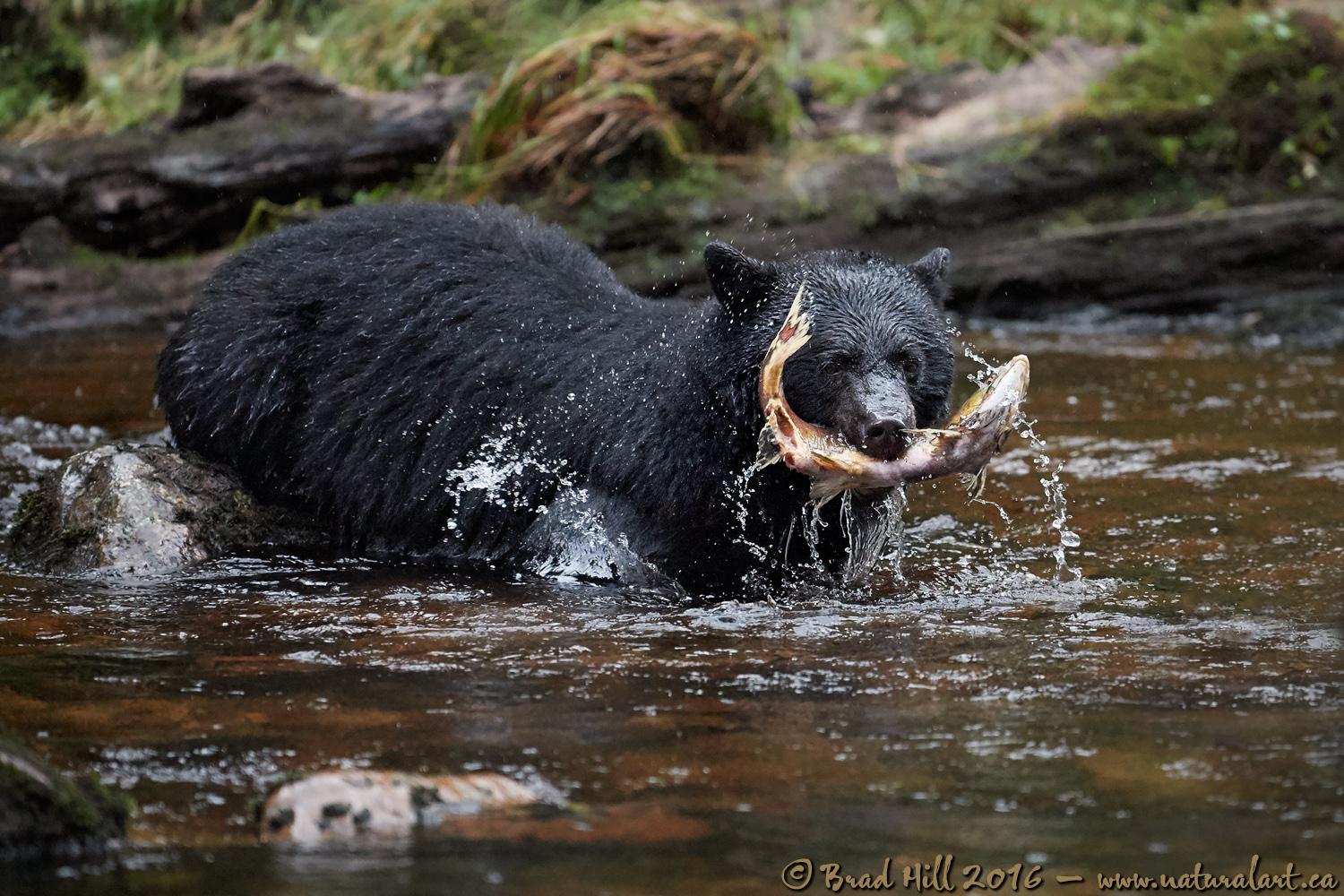
In our day-to-day existence most of us are removed from observing acts of predation and fully appreciating what a pervasive force it is in the natural world. And, while most of us likely don't empathize too closely with fish, when I processed this image of a black bear with a pink salmon wildly and fruitlessly flailing away in its mouth I actually felt for the fish. After avoiding all sorts of dangers as it went from egg to fry to full-grown spawning fish over a two-year period, this bear abruptly terminated its life. Yet in dying the salmon is helping to ensure that the bear will have sufficient energy stored to survive over the winter and re-emerge healthy next spring. Depending on your position on the food chain, predation can really suck or be a great thing! Life & Death...can't have one without the other!
Back to this image: I captured this shot at a pretty crazy ISO - ISO 14,400. Why? I had no choice - there was no other way to successfully freeze the action in this low-light environment. From past experience with the camera I used here I knew it was possible for me to work in this ISO stratosphere with a scene like this and still get usable shots.
I often get the question "I have a Nikon (or Canon) XYZ - how high of an ISO can I shoot it at and still get good images?" This is an incredibly tough question to answer for someone else. Of course the top end of usable ISO's varies with sensor size and generation (as the question implies). But the impact of visible noise on an image also varies with scene type, with images showing fine detail (which I've also heard called "micro-contrast") usually being LESS impacted (at least visually) by noise. And, it varies with the software you use to process your raw files, YOUR ability to selectively remove noise from an image, and more! Factor in variation in the perception of noise between (or among) users and my answer of "You tell me" becomes understandable! There are SOME reasonably objective ratings of image sensors (by ISO performance, like on dxomark.com), but it's my experience is that they are extremely poorly correlated with the actual ISO you can successfully use in the field.
Subject: Happy Black Bear (Ursus americanus) with very sad salmon
Location: Great Bear Rainforest, northern BC coast, Canada
Camera: Nikon D5
Lens: Nikkor 70-200mm f4 VR @ 200mm. Hand-held. VR on and in "Normal" mode.
Exposure: 1/1000s @ f4.5; ISO 14,400. -0.67 stop compensation from matrix-metered exposure setting.
Crop: Moderate - this is about 85% of the full-frame image
A whole lot more info about this shot - including a 2400 pixel version it - can be found on my website using the link immediately below.
http://www.naturalart.ca/galleries/latest/index.html
Comments and critiques welcomed - probably best to view the larger version prior to doing so!
Cheers...
Brad
PS: Like all wildlife images on my website and that I post on NPN, the subject is fully wild and completely unconstrained. Besides the potential impact of my presence, nothing has been done to intentionally alter or affect the ongoing behavior of the subject and, of course, there has been no use of any form of bait or other form of wildlife attractants (including vocalizations).
Comments
4 commentsGreat job on this image, and I can't believe it's at ISO 14,400. Wow. Excellent job on the blacks in this.
Well done.