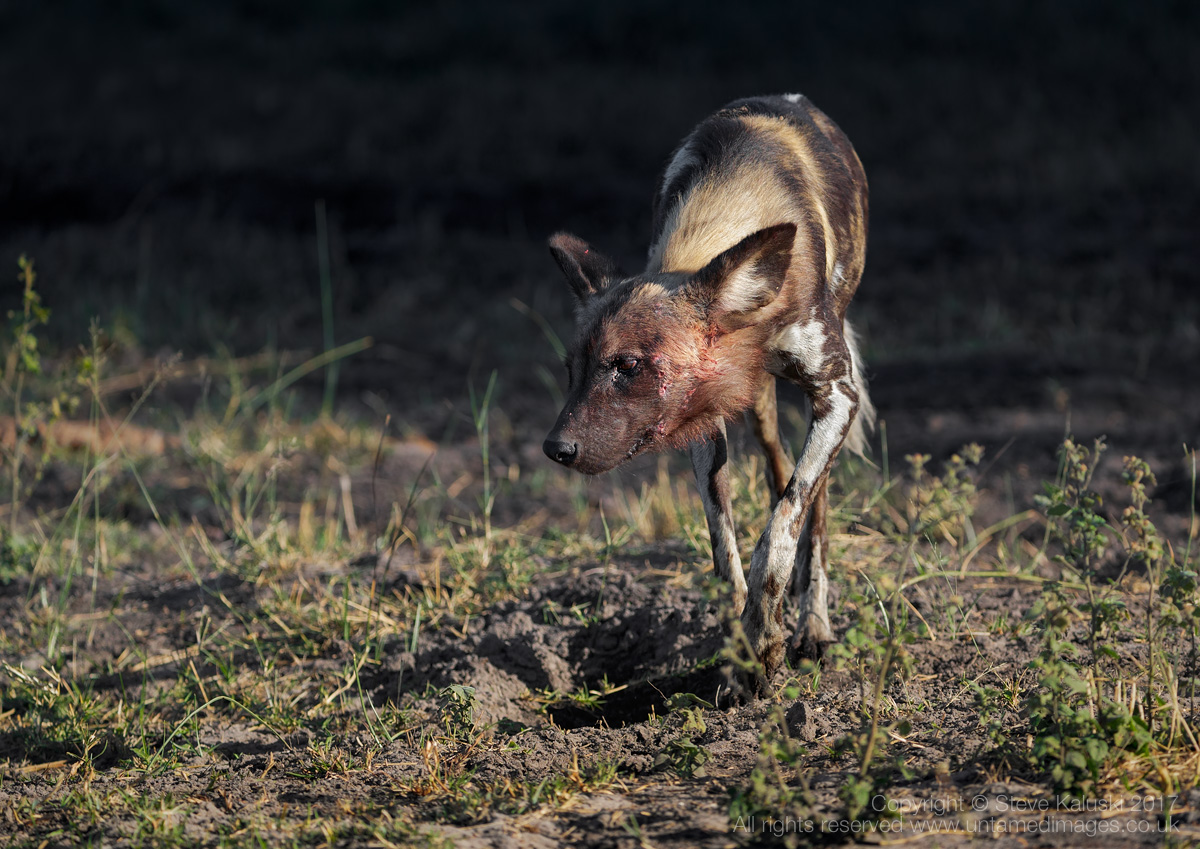
<div>The majority of the pack were off back hunting a herd of Lechwe about half a mile away, chasing them through the water, but as we parked up a few of the pack stirred from out of the shadows, with faces still showing signs of the previous meal</div>
Thanks to those who viewed or posted a comment on the previous thread.
Steve
Subject: African wild dog (Lycaon pictus)
Location: Botswana
Camera: Canon 1DX MKII
Lens: 200-400f/4 HH
Exposure: 1/2000s at f/5.6 ISO1600
Original format: Landscape, very slight crop
Processed via: LRCC & PSCC2017

Comments
9 commentscheers
Steve
Nice dramatic lighting here...and I do agree with you and Jim that this mid-stride capture and lowered head makes it appear as though the subject is "cowering" or a "bit sad". Coloration of the dog is real interesting.
On the technical side - you really seem to opt for MUCH higher shutter speeds (and consequently higher ISO's) than I prefer. I suspect that this may reflect the different environments we shoot in - tho' I am at times FORCED to go to high ISO's by lack of light, I always try to minimize the ISO and, consequently, maximize the DR. But...on average I'm probably shooting in a higher contrast environment than you are. And, if I recall correctly you're not a fan of using OS (whereas I LOVE what a good VR system provides me with). Different strokes, eh?
Cheers...
Brad
Like my Workflow, I'm constantly updating things because technology moves on, plus it simply allows me to do so, with ease. With the undated bodies now available and far greater ISO, I have no hesitation in going for higher SS, as any noise is easily dealt with in PP, if required. It's just staggering how far you can push things, comfortably knowing any real 'noise' is a thing of the past. IMHO Canon have now taken the lead from Nikon, the D4 is still better than the D5 I think, but... Canon now have the advantage for once and personally, it has revolutionized my way of thinking and shooting. To get the best from this body I feel you have to change your thought process and forget the old school thoughts and just believe - a 1977 well know film comes to mine here Brad.
Over the last two years, for me, it's about nailing the shot with faster SS, and the MK2 is a game changer without question and the best Wildlife camera body on the market, the other Canon bodies on offer are just too limiting. Don't get me wrong, light is always a constant challenge for me, but the MK2 just delivers and because of the various locations I choose to shoot in (and I will be back in BC next month
IS/VR - well that just depends now on the situation, I've not ruled it out.
Towards the end of the year I will tackle something new, now that really will be test for both 'the boy & machine.'
Cheers
I actually have a very different perspective. The limiting factor in cranking up one's ISO is not noise, nor has it been for at least 2 camera generations on the Nikon side. For both makers a huge consequence of dialing up the ISO is the impact on dynamic range (which falls with increasing ISO). If one is shooting mostly scenes that are midtone dominated then falling DR may not limit the photographer (as they crank up the ISO), but if you're shooting in high contrast situations, then falling DR is a huge issue (and more so with the Canon's, although both the 5D4 and 1DXII are much better than previous Canons). And, there are other negative consequences of cranking up the ISO - as you do so color depth drops, and tonal range shrinks. So, even though the latest full-frame Nikons and Canons are very noise-free at high ISO's, there are still several trade-offs associated with increasing the ISO. Obviously where one chooses to go on the ISO->Shutter Speed->Aperture exposure triangle will vary with the shooting location (including the ambient light levels and contrast conditions) and is up to the photographer, but we still aren't even close to having "ISO Freedom" (or "ISO Independence").
After extensively testing the Nikon D4, D4s, and D5 I can't let the statement "...the D4 is still better than the D5 I think" go unchallenged - I completely and categorically disagree with it. My tests have shown conclusively that the D5 has better ISO performance (in terms of noise) and it has a MUCH better AF system (in focus tracking in D9, D72, D153 modes as well as in 3D Tracking, and of course in low light focusing) than the D4 or D4s. Part of that AF improvement comes from the new 180K RGB sensor, which has also improved the accuracy of the metering (compared to the D4 or D4s there is much less need to perform exposure compensation when using Matrix Metering). The D5 also has more resolution. Another big difference is an outcome of the new mirror-driving mechanism on the D5 (compared to both previous models)...it results in a rock-solid viewfinder image at even the highest frame rates. Oh, and then there's the 200 shot bursts...no other camera on the market (other than the D5's little brother the D500) can match that. Overall, there's a WORLD of difference between a D5 and a D4, and quite a big gap between the D5 and D4s. And, most importantly, many of the improvements on the D5 aren't just "spec improvements" that are academic - they make a big difference when shooting under very demanding conditions in the real world.
Based on testing I've done comparing the D5 with the 1Dx MkII I do think Canon has definitely closed the ISO and AF performance gap and we have almost complete parity in flagships, but personally I still give the edge to the D5. Why? Slightly better low light AF performance (-4 EV on the Nikon vs. -3 EV on the Canon, and I have seen that make a difference in the field), and better ISO performance in the ISO 20,000 to ISO 51,200 range (mostly there in tonal retention and DR, but also in noise). Up to ISO 12,800 I definitely think there is now parity between the two flagships. So I don't agree that the 1Dx2 is "the best Wildlife camera on the market" (it IS damned good...but I haven't seen a single instance where it outperforms a D5).
Cheers...
Brad
Cheers
Steve
No worries. No one can deny you the right to believe what you choose to. Sadly...I'm forced to follow the facts and evidence as revealed by rigorous testing and verified by field work and photographic outcomes (I just can't shake the scientist in me!).
Cheers...
Brad