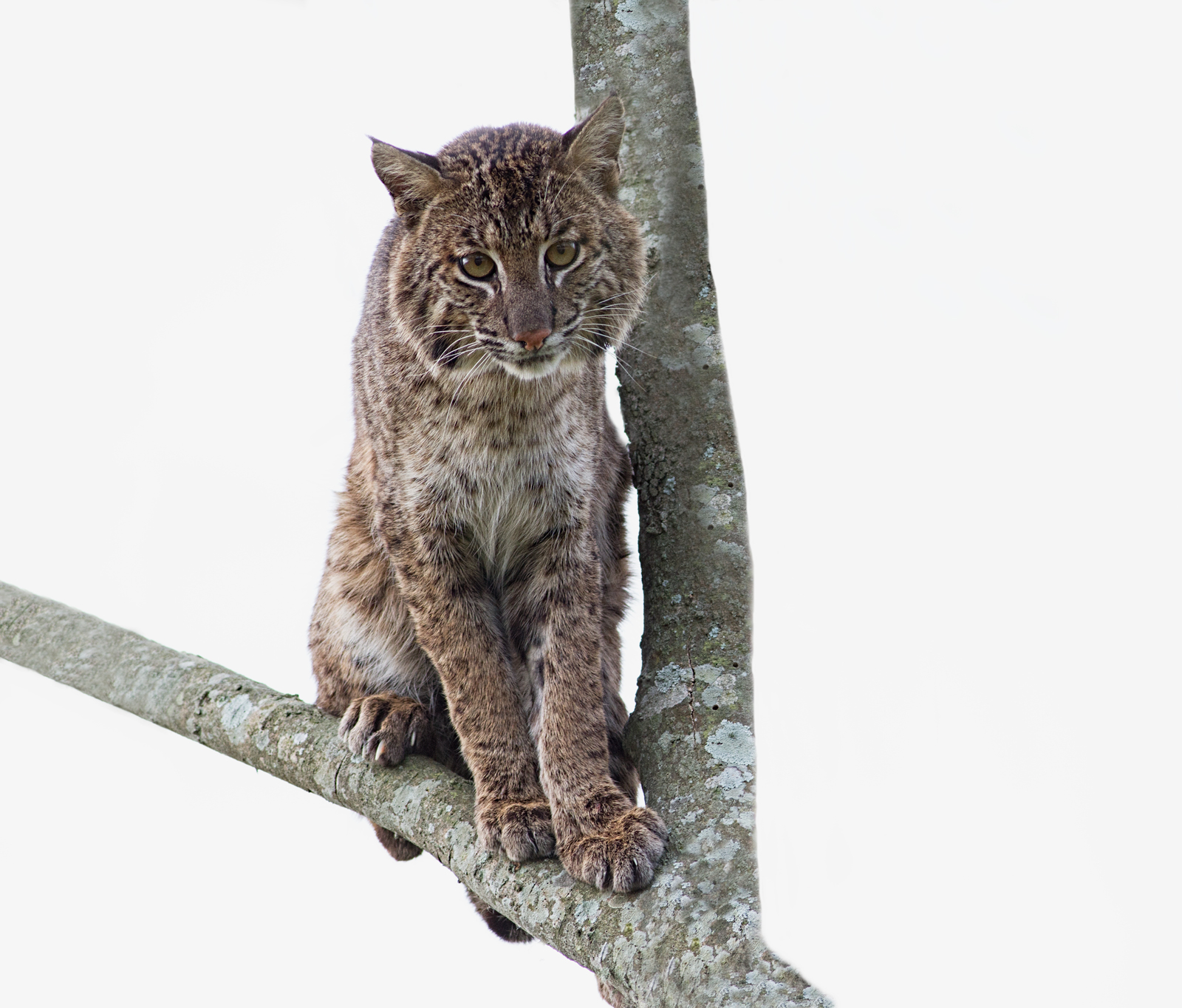
Bobcat! + redo x 3
by Barbara Graham
The exclamation mark is because it's the first bobcat I've ever seen.
Lake Apopka Wildlife Drive
1/27/2017 – 10:28:39 AM, cloudy sky
Canon EOS 7D EF400mm f/5.6L USM
1/500 sec; f/5.6; ISO 640
Manual; Spot metering
LR5, PS6, Topaz Detail on bobcat and tree
This is the first bobcat I've ever seen, and so for me for now anyway this was a once-in-a-lifetime opportunity. I knew the bobcat had to be properly exposed, so I had to not worry about the sky. I put the ISO as high as 1250 to try it and it didn't make any difference. Is there anything else I could have done (other than not take the shots, because that was not an option to me)?
Any feedback would be greatly appreciated.
Thank you!

Comments
17 commentsThere are several ways for getting the right exposure and your technique worked very well. You can also use aperture priority and then use exposure compensation to work out the differences between BG and subject. I use that when photographing birds and fast moving insects. In this case, a high key presentation resulted from your efforts and I like the graphic and simple presentation of this image. I like the composition--I would not do any more cropping--comp looks fine. Well done.
Always fun to get shots on first sighting of a "new species" - congratulations. I like how the cat is positioned in the "V" of the branches. And the eye contact is great.
An alternate approach to the exposure challenge would be to expose to just retain highlights in the sky and then increase the exposure of the bobcat during post-processing (i.e., selective exposure adjustment). This can be done many different ways (during post-processing) and, of course, the amount of exposure tweaking (whether it is shadow recovery or selective exposure adjustment via masking, etc.) is partly dependent on the camera the image was captured with...especially the noise characteristics of the camera. This method has the advantage of allowing you to present the image as seen (which MIGHT mean in this case some light-on-light detail in the background) rather than choosing to expose EITHER the cat correctly OR the background correctly. Of course, how you want to present the final shot (e.g., high key as above or more "as seen") is a creative decision that is up to the photographer.
Cheers...
Brad
Cheers,
Hisham.
I agree with your decision to spot meter and get the exposure correct on the bobcat while lettting the sky go whiute. I've sent you privately a way to address this and I look forward to seeing how you manage..
On the technical side of your camera, you mention that you are shooting in Manual mode. The next step would be to consider in shooting in Auto ISO, knowing that your camera will choose the lowest ISO needed for an exposure. I'm not familiar with your camera model, but I assume that you can modify as desired via exposure compensation. Your camera will also likely allow you to set a low and high limit for ISO.
Working in Manual and Auto ISO makes life easy. You set the parameters you want for aperture and shutter speed and the camera chooses your ISO, which you can modify as needed. Works a treat. Richard
Just want to add one thing after seeing Richard's comment: Auto ISO is implemented quite differently on your 7D than it is on Richard's Nikons. Everything Richard says about Auto ISO is spot-on correct on Nikon cameras, but I think you'd find some pretty major limitations on how Auto ISO works on your camera. LATER iterations of Canon models did seen an improved Auto ISO implementation and now with current models they are virtually identical between brands.
Cheers...
Brad
I'll post another image of the bobcat as he worked his way around the tree trying to figure out the best way to get down. I'll just post one more here, and maybe I'll post a short series in the Wildlife Photography forum.
I would be extremely happy with this as a first sighting!
I prefer the 1st image!
Max