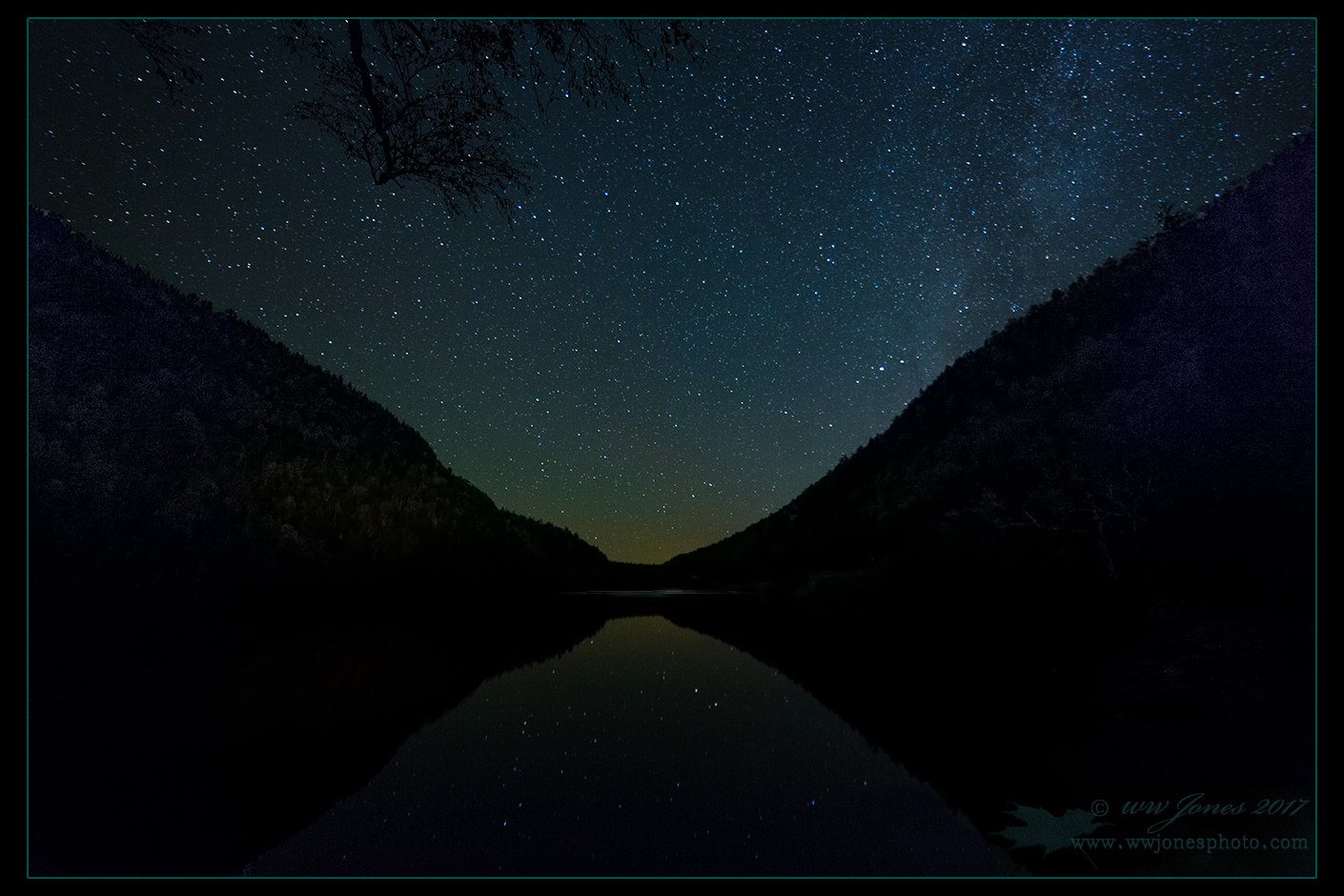
New Moon, Cascade Lake
by Wayne Jones
NOTE: You will not be able to see this image unless you click on the image above or the expansion symbol under it to see a larger view.
On a clear night a couple of weeks ago, I tried some night photography. I was actually thinking of shooting this scene when there was a little moonlight, but the night was clear, and I was there even if the Moon wasn't. (I suppose one of these days I'll devote more time to night shots, and make a twilight exposure to blend with a starry night, but I have a hard time getting excited about creating a scene that cannot exist in nature.) I tried overexposing to get a touch of detail in the land, but did not do that well enough to avoid noise. Any other advice to help me improve a scene like this would be appreciated.
Thanks
Canon 5D Mark III, Samyang 14 mm. f/2.8
25 sec. at f/4; ISO 1250 for the sky, and ISO 2500 for the land.
I kept the sky pretty dark for realism, but you can see an overhanging branch in the top of the scene. It was so dark that I could not see that when I was there. Poor planning? Nope -- no planning; it was a spur-of-the-moment trip before going to bed.

Comments
8 commentsGood job with this. I've dabbled in a few starry night images with little success, so I'm with ya - and this is better than any of my attempts. I don't have any advice. ;-(
I do really like the graphics and symmetry created with the reflection and opposing hillsides. The night sky looks great.
At first the tree kinda seemed out of place, but then understanding this was taken with a 14mm lens, it all makes sense. The good news is that there is enough of the tree to make it feel included.
Just noticed there is some odd purple coloration going on both sides. Not sure if it's noise or what, but the landscape closer to the center looks properly exposed/processed, but something is happening towards the edges.
Lon
I have shot a few night pictures and have found that the best way is to set up the camera on the tripod, composed and with all the proper settings, the evening before dark. I remember the first time I tried focusing at night. The camera seemed to go nut as the autofocus tried to settle on something.
I always shoot wide open for night shots, not sure why you chose F4...
You will also get noise, just a fact of night photography. I also shoot as high an ISO as I need to for exposure and deal
with the noise in PP. I use Topaz which works well.
I really do not like to shoot with no moon, just too dark. A partial rising moon from behind adds some nice light to the scene.
light painting done right can look real but it takes some practice. but I also like to shoot at the end of the blue hour when there is still some ambient light.
Another trick is to manually focus the lens before dark or know exactly where to place the focus ring.
Hope this helps.
FOCUSING: I have shot at night a few times and learned quickly that focusing was a problem. I don't bother trying to use AF (and the lens I usually use does not have AF anyway). My solution was to put a piece of tape on the lens to mark the real infinity line (in daylight). However, I discovered during this shoot that the tape had moved during storage and handling. As a result, I had to guess where the line used to be, so I shot at f/4 instead of wide open to avoid soft focus.
MY SOLUTION: Before my next night shoot, I plan to mark the infinity spot again, but this time with some of my wife's light-colored nail polish. I used it to mark a carbon kayak paddle for measuring fish, and it seems to hold up pretty well. I will cover the edge of the lens sleve with transparent tape first, to make sure I don't get any nail polish where it might gum up the lens.