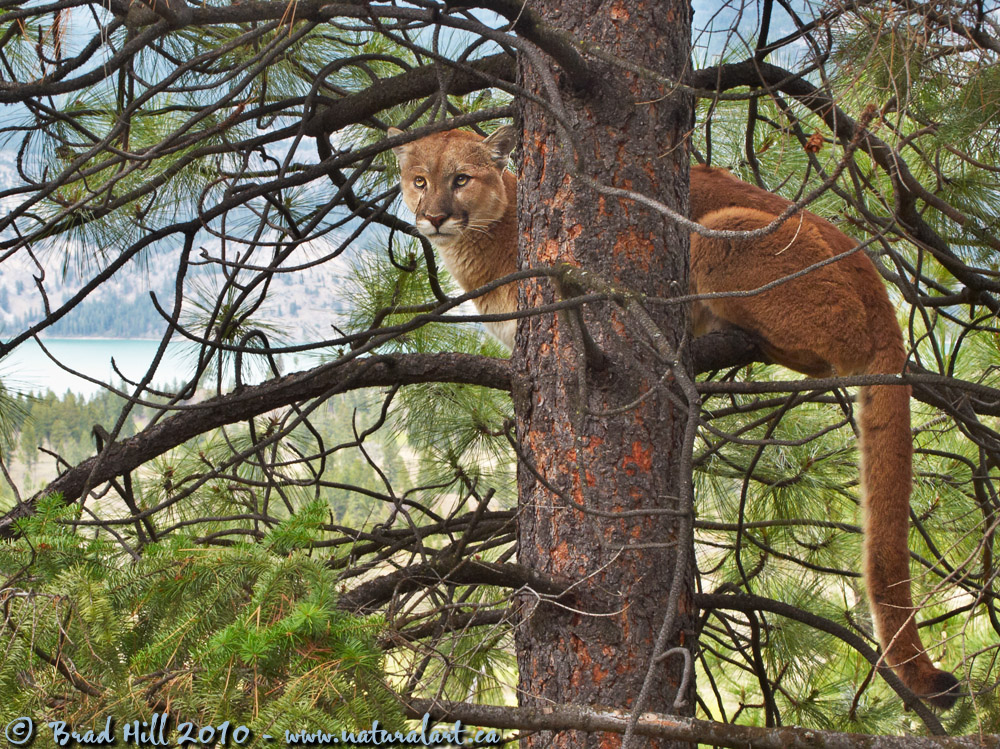
I bumped into this little "kitty" late last Thursday afternoon while I was walking my dogs near our home. The cougar went up a tree that was right beside a cliff that wasn't too hard to scramble up. So the positive thing was that I was able to get to eye level with the cat while it was in the tree. Unfortunately, all I was carrying for a camera was an Olympus E-P1 micro 4/3 format "point & shoot". Boy, did this picture-capturing experience make me appreciate the speed and performance of a dSLR!! Between the autofocus stumbling over all the branches and the ambient daylight interfering with my ability to see the LCD to manually over-ride the focus, capturing this image was quite the challenge! But, I did manage to at least capture a "record the moment" image...
I know this isn't what anyone would call a great shot, but it serves a good purpose: I know a LOT of pro and serious enthusiast shooters who wonder if it's worth "investing" in one of the new(ish) compact and lightweight large-sensor Micro 4/3 format "point & shoots" just so they can always have a camera with them (for those "oh, I wasn't expecting to see that" moments). There's no simple answer to the question - the worth of these cameras to different users will vary with the image quality expectations and standards of the photographer as well as with their chosen subject matter. Based on my own experiences, I'd be surprised if many sports or wildlife photographers would be too thrilled with them (they're just so SLOW compared to SLR's), but those shooting more static subjects might be quite pleased by what they can produce with them...
Subject: Adult cougar (
Puma concolor) perched high in Ponderosa Pine
Location: Findlay Creek, BC, Canada
Camera: Olympus E-P1
Lens: 14-42mm kit zoom @ 42mm (84 mm EFL) - hand-held
Exposure: 1/60s @ f10; ISO 400; +0.3 stop exposure compensation from metered exposure setting.
Crop: This is about 80% of full frame
All the contextual information surrounding this shot, including a longer discussion of the merits of the Micro 4/3 point & shoots, can be found here:
http://www.naturalart.ca/galleries/mammals/other/detail_2.html.
Comments and feedback greatly appreciated...probably better to view larger version prior to doing so...
Cheers...
Brad

Comments
34 commentsYou truly are the master of modesty... I'm not sure why you think this isn't a great shot. How many photos of cougars in trees @ an EFL of 84mm have you seen? Especially where the face is so out in the open? It is true that a DSLR would have been better, but knowing you, you would have been struggling to change from your 600mm and put on your 70-200 mm and been fumbling lenses and dog leashes and all sorts of things
All kidding aside, this is a really great photo which would have been even better with a DSLR I think in regards to the bokeh and the dynamic range (the water looks a little washed out). I solve the extra camera problem by just always carrying my DSLR when I go for a walk... put on the smallest lightest lens and have the others in my bag.
- Luke
The reds seem a bit strong on the monitor I'm viewing this with (uncalibrated), but otherwise I think the results are pretty great for a P&S.
Max
Nick Bristol
Lone Rock, Wi
You are kidding me, this is phenomenal !!! A Mountain Lion is on my to-do list but I dunno where to seek one before it seeks and eats me
I knew immediately when I opened this, that something was very different with this image. This shows how much our tools can change drastically, but a Craftsman will get the best possible result from the tools at hand. Well Done!
Master of modesty, indeed!
Neil
This is quite an unbelievable photo Brad! If you would have stated you used a D3s with 24-70mm lens I would have believed you too, the quality and detail on the larger version look excellent. Maybe you do not rate this high yourself due to the clutter and the lack of a smooth bokeh. IMO the way you composed this and the fact that the cats head is clear of any obstructions actually make the clutter of branches a complete non-issue. I also love the DOF used with that lake in the BG. Thanks for sharing this really cool photo and the info on P&S's.
This is what a 'point n shoot' can do in the hands of an expert. It it were hands of a point and shooter, I'm sure focus would have gone haywire & tail would have been cut.
Jagdeep Rajput
Holy smokes - I honestly did not expect a response like this to this shot. It's those kitties I guess!
Besides being posted here this shot is circulating amongst a group of photographers I keep in touch with. The comment that keeps recurring (a few times here, but more from the other group of shooters) is how the shot doesn't look like one of my "normal" shots (but it's not being said negatively). Well, I hope it doesn't look like one of my normal shots! Two things - both related to the equipment I was forced to work with here - influenced how I had to approach this subject:
1. Lack of telephoto lens and lack of big aperture. This image was captured with an 84mm lens (in full-frame SLR equivalency). My normal modus operandi is captured by what has become my mantra: simplify and isolate. But, in this case, with an 84mm lens and without a huge aperture, I knew it was impossible to isolate my subject from the background (and all those branches). So, I took the opposite approach - stop down and create an image where detail is shown throughout the image, included the lake and distant hills in the background. That is, show the cat in its habitat. Thus the f10 setting. Interestingly, several folks have noticed this (like Peter Vaudrey who recognized the region because of that detail), and some have even liked it! Interesting...
2. Thinner dynamic range and less file "malleability". I'm used to shooting with a camera with a very wide dynamic range and that produces files that are VERY malleable, especially in terms of their "friendliness" of pulling out shadow detail without introducing noise. But, with this point & shoot I knew that at ISO 400 (required to get that f10 depth of field) I couldn't rely on pulling back shadow detail. So, I had to expose for the cat and let a little of the highlight detail in the background go. I knew I could bring enough of that highlight detail back to make the image presentable (and Luke noticed it was close to blown). Normally, with my "real" equipment I would have exposed a little differently (i.e., would have used a slight "under-exposure" and made sure I retained all the highlights, knowing that I could always bring back shadow detail).
So...maybe a little more thinking than "point & click" went into this shot!
As for the subject - I've only seen four wild mountain lions in my life and none of them sat still long enough for me to even reach for my camera - jealous is most definitely an understatement...
I really hope you take the SLR with you when walking the dogs from now on...
I believe you were lucky to get a clear view of its face considering all of the branches.
Nice work Brad.
~ja
In looking at this again (and again, and again) it looks like it might need a CCW rotation. Judging by the little amount of water that is visible on the left hand side it appears that it's slanted to the right. Sorry.. had to find some nit in this P&S shot
1. Vincent...my dogs are small!! Well, maybe medium-sized, but not big (they're Portuguese Water Dogs).
2. Josh, you asked:
Actually, I take a SLR kit with me probably 2/3 of the time. On this day I was going to be climbing a rocky ridge and was feeling a little lazy and figured I could do without the extra 15 lbs or so! BAD decision!
3. Luke: RE: the rotation. Sorry...you're assuming a straight shoreline - and it's curving around a mountain there. Yank the large image and open it in Photoshop - then pull out vertical guides and line them up on each side of the tree. Yep...it's level (and that tree was as close to perfectly vertical as you can get). Sorry!
BTW, how did you get the brighter background so well balanced with the darker foreground? It doesnt look at all like HDR.
Thanks for sharing, Brad!
Amazing shot. I would love to see one in the wild. You did well with the camera knowing he might be eyeing you as dinner.
Wow !!!
Andrew
You asked:
Ahh, that would be my proprietary (but totally not-a-secret) exposure blending technique. Two raw conversions (at different exposure settings) from a single raw file, then blended by hand in Photoshop (using layers and masks). Not a true HDR technique - more of an XDR one (Extended Dynamic Range). But my favourite way of blending exposures and I haven't found an "automated" HDR technique that can touch it in the "naturalness" of the result...
If you want more details about the technique feel free to contact me...
Brad
My first cam was an Olympus C8080, it was a great cam.
I like the way the tree branches frame the face, and the lake visible in the BG there.
Well done
Laura Stafford