Nature Photographers Network
This is the preserved archive of the original Nature Photographers Network. The community continues at naturephotographers.network.
Red-tailed Hawk
‹ PreviousAvian GalleryNext ›

Red-tailed Hawk

by Steve Balke

Gallery: AvianPosted August 20, 201056 views5 comments
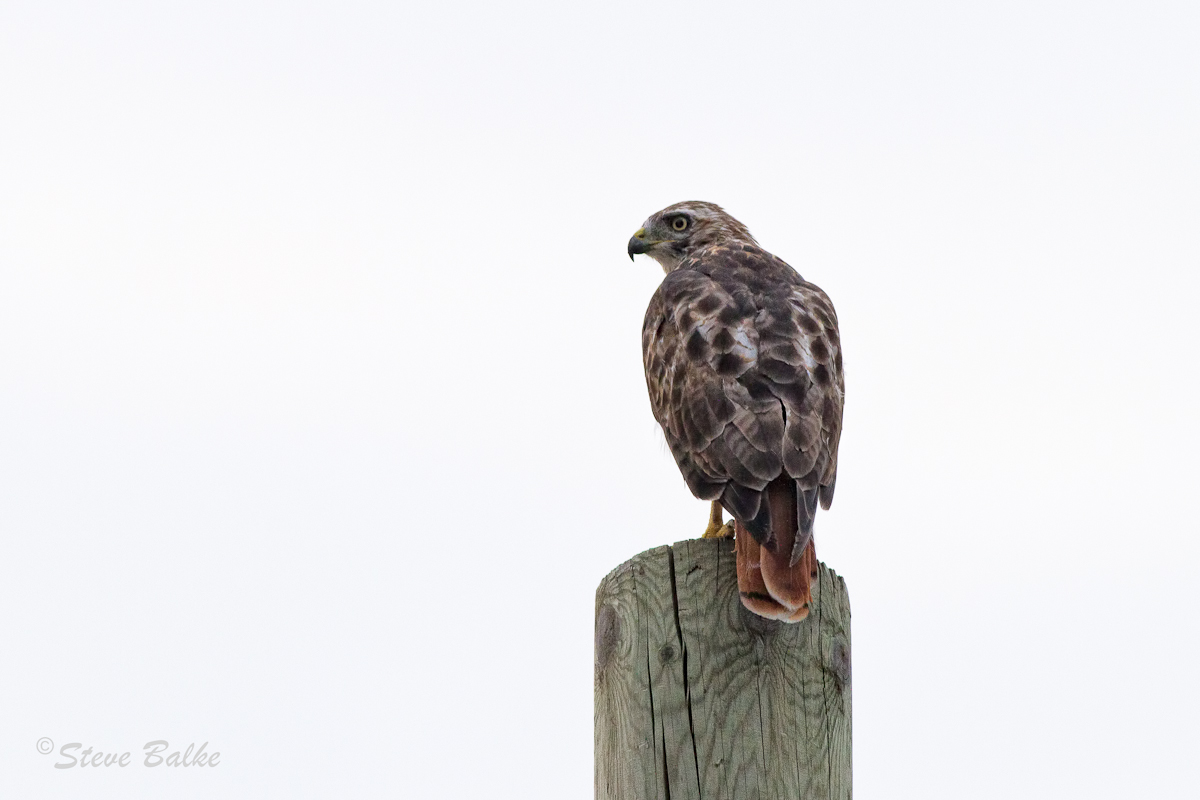
Red-Tailed Hawk (Buteo jamaicensis)

This hawk showed up very suddenly on this extremely grey morning. It was only by increasing the ISO to 2000 was I able to obtain other than a silhouette. I particularly like all the patterns in this image. They seem to have been emphasized by the diffuse light.

All comments welcome.

EOS 7D, 400 mm f/5.6: ISO 2000, 1/640 s, f/7.1, image is 10.8 MP (Noise reduction, some exposure modification and sharpening applied)

Comments

5 comments
Comment posted by Richard Ditch on August 20, 2010 at 11:28 PM
It was only by increasing the ISO to 2000 was I able to obtain other than a silhouette


I'm trying to understand what you meant by this comment. You would get the same exposure, and thus the same amount of detail, by using ISO 1000 and a shutter speed of 1/320th second, or ISO 500 and SS of 1/160th with the aperture constant at f/7.1.

Also, looking at the EXIF for the image I see you had set exposure compensation to -2/3 stops. That seems contrary to getting proper exposure on a subject against strong backlight as this situation appears to be. Camera meters tend to be swamped by light like this leading to underexposure of the subject. In such situations I engage the spot meter and take my reading off the subject to reduce the influence of the sky. Or, I'll take a substitute reading off something else (the bottom of the pole lower down against a building or hedgerow that excludes the sky).
Registered on November 1, 2003, 1031 Posts, 12705 Comments
Comment posted by Steve Balke on August 21, 2010 at 6:20 AM
Richartd, thank you so much for taking the time to come up with such thoughtful comments and for stating your approach for dealing with the situation. Regarding obtaining the same exposure and detail at a slower speed: This is a hand held shot. I like to stay at 1/640 s or faster to avoid motion blur. Regarding the exposure bias: In this light I'm not sure what exposure will be best so I use exposure bracketing of +/- 2/3. Given enough time, I also try different ISO settings. Here, I used ISO 500 and 1000 as well as 2000. Then from all of these images I picked what seemed to me the best. If I was using film this would be a pretty expensive strategy! However, I think this empirical approach is quite effective with this camera: it can be done very quickly before that bird decides to take off! It's possible that a more optimal selection from all these images would give even a better final product. However, I just picked one that looked good to me and I like the image that resulted. :smile:
Registered on June 18, 2009, 229 Posts, 2915 Comments
Comment posted by Ron Dudley on August 21, 2010 at 11:04 AM
Steve, I like the head turn and the good look at that namesake tail but have to admit that I'm not particularly fond of all that high key background or the relatively steep angle.
Registered on March 30, 2007, 437 Posts, 10915 Comments
Comment posted by Mia McPherson on August 22, 2010 at 8:17 PM
Steve,

Richard has given you sound advice on the EV compensation, with gray skies and dark birds I often bump up my exposure comp to get the details in the plumage, I can always attempt to darken the sky a bit in post processing. For posting his key images on the light background on NPN I would suggest adding a dark one pixel border so the comp is more obvious.

I do like the view of the back and the head turn you caught here.

We've been seeing more red-tailed hawks in the area, they are slowly coming down from the high country.
Registered on June 25, 2007, 491 Posts, 12566 Comments
Comment posted by Steve Balke on August 22, 2010 at 9:41 PM
Thank you all. I do much appreciate all of your comments and will keep trying! :wavey:
Registered on June 18, 2009, 229 Posts, 2915 Comments