Hey all,
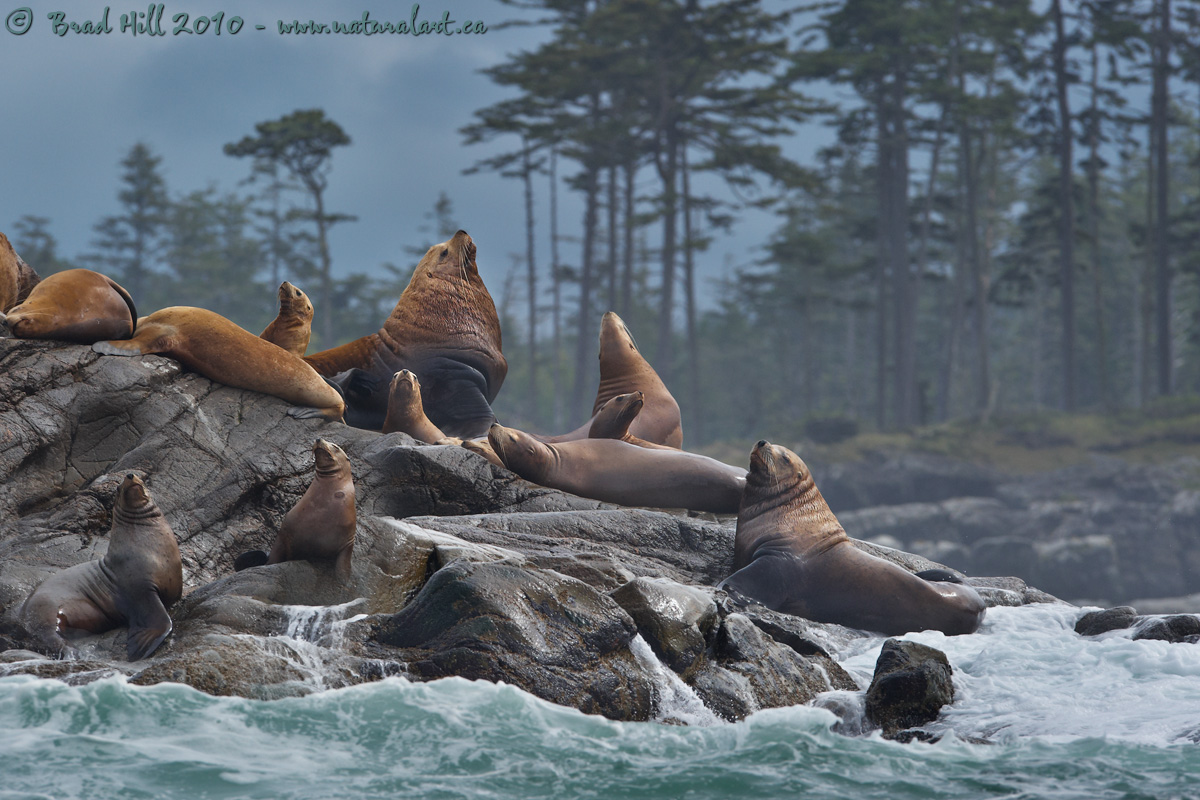
There's no doubting which of these Steller's Sea-Lions is the "Leader of the Pack" - at least on this rock! This image was captured on a small, relatively remote island just north of the northern tip of Vancouver Island. There were a number of small "haul-out" rocks in the area, and each was absolutely covered in sea lions - in total there had to be 400 or 500 individuals. Interestingly, each rock appeared to have a single male perched atop it who was clearly dominant to the other seals (mostly females or young males) and each was posed in a way that showed he clearly knew he was top dog (like the very rotund male shown here)! Steller's Sea-Lions have a polygynous mating system where males actively defend a territory against other males - which is normally a "prime" piece of rock. Females move freely between the territories of males and will display in a way that solicits the males to continue defending their territories for months on end (and long after the males' own drive to defend the turf and mate has begun to wane). Reproductive success for the males is tied to their ability to defend their turf, and pitched battles WILL occur between nearly equally-matched males to gain and hold those key breeding territories.
While this may appear to be simply an "f8 and be there" shot (i.e., the hardest part of getting it was finding the subjects), both capturing it and processing it was on the tricky side. On the image capture end - this image was shot from a small inflatable boat. At the time of the shot we had both medium-sized swells (between 1-2 meters in size) and wave-induced surface chop to deal with. So...suffice to say that there was NOT a stable platform to shoot from! I was hand-holding a large telephoto lens (a 400mm f2.8) and while I was tempted to shoot wide-open (at f2.8) to maximize the shutter speed, I really wanted all the sea lions and the rocks in sharp focus. So I had to stop the aperture down considerably (to f7.1). And, even with the VR function on the lens helping to stabilize the image, it was absolutely impossible to keep the subjects in the viewfinder as the boat rocked. So I decided to NOT fight the boat and simply went with the rhythmic bobbing of the boat and shot bursts of images as my lens went up and down (and the subjects passed through my viewfinder).
On the processing side...even though this image was shot with a light cloud cover, the brightness range in the image (from the dark regions on the sea lions through to the white foam in the breaking waves) made it impossible to retain critical shadow and highlight detail in a single conversion of the raw file. So I made three raw conversions from the original raw file (one at -1.5 stops for the water in the foreground and the "foam" near the right edge of the image, one at 0 stops adjustment for the rocks and background, and one at +0.5 stops to bring out the shadow detail in the dark portions of the sea lions - especially the big guy near the middle) and then later composited (stacked) them in Photoshop and adjusted the opacity of the layers (via masking) to end up with the final composite image you see here! Of course, along the way I made some selective changes to the contrast as well - I wanted to keep that misty, ocean-spray softened background quite low in contrast while increasing the contrast of the subjects (and rocks) to make them "pop" just a little more. At the end of the day, I kinda like the near 3D affect that these image "tweaks" produced!
Subject: Steller Sea-Lion (
Eumetopias jubatus) colony
Location: Off the northern tip of Vancouver Island), BC, Canada
Camera: Nikon D3s
Lens: Nikkor 400 mm f/2.8 VRII lens - handheld from inflatable zodiac. VR on and in "Normal" mode. Circular polarizer used
Exposure: 1/1600s at f7.1. ISO 500. No compensation from matrix metered exposure.
Crop: This is about 90% of original capture
All the contextual information surrounding this shot (field notes, all camera settings and processing details, conservation, etc.) can be found at:
http://www.naturalart.ca/galleries/mammals/other/detail_3.html.
Comments and feedback greatly appreciated...probably better to view larger version prior to doing so...
Cheers...
Brad
I intend to begin offering an 8-day Instructional Photo Tours to this fantastic region in August of 2011. If anyone is curious about the tour, feel free to email me or check out the tour entitled
"Orcas, Humpbacks and More: Aquatic Mammals of the Central Pacific Coast" on the
Photo Tour page of my website...

Comments
23 commentsIstván
Nice processing , and I appreciate knowing the details.
Sandy r
Ken Archer
Jagdeep Rajput
Cool shot, Brad.
Thanks for sharing.
Neil
Lee
Thanks for all your nice comments. The experience of shooting this image was a whole lot of fun (and a really "salty experience", to say the least!!) and I'm very glad that I was able to capture this image as a nice reminder of that day. To have others appreciate it is a real bonus!!
Cheers...thanks again...
Brad
You've done an outstanding job, start to finish. From shooting in an inflatable, to this beautiful end result. Your passion is quite evident, this is truly a labor of love
RE: the use of shutter priority shooting mode in this situation.
I don't use it. I use Aperture Priority about 99% of the time. But with the newer Nikons you can have the best of both worlds if you use their Auto ISO function. With it, you specify the range of ISO that is acceptable to you and a "target" shutter speed. The camera will always attempt to attain that shutter speed given the aperture you have chosen (in Aperture Priority mode) while minimizing the ISO needed to attain that shutter speed. So, in this case I gave it a shutter speed of 1/1600s and had the freedom to choose the aperture I wanted. The trick to using this function effectively is knowing the maximum ISO you're willing to accept. And, I find the function has the most utility on cameras that perform well at higher ISO's (such as the D700, D3, and D3s). It's my experience that this feature is a "hidden" gem that few users really understand - I know during my workshops most users have never thought of using it and when the light bulb goes on about how it works they invariably love it. I don't know if the Canons have a similar feature or, if they have, if it's implemented as well. The whole key to making it useful is the fact that the camera always tries to minimize the ISO to get to your chosen/required shutter speed - which parallels my philosophy of always trying to minimize the ISO needed to get the shot...
Hope this helps...
Brad
Thanks for the details on your approach to the shot. Key insights for us less experienced folks.
This is beautiful .. really well done.
Cheers
Carl