Camera vs scanner
by Gary Yeoh
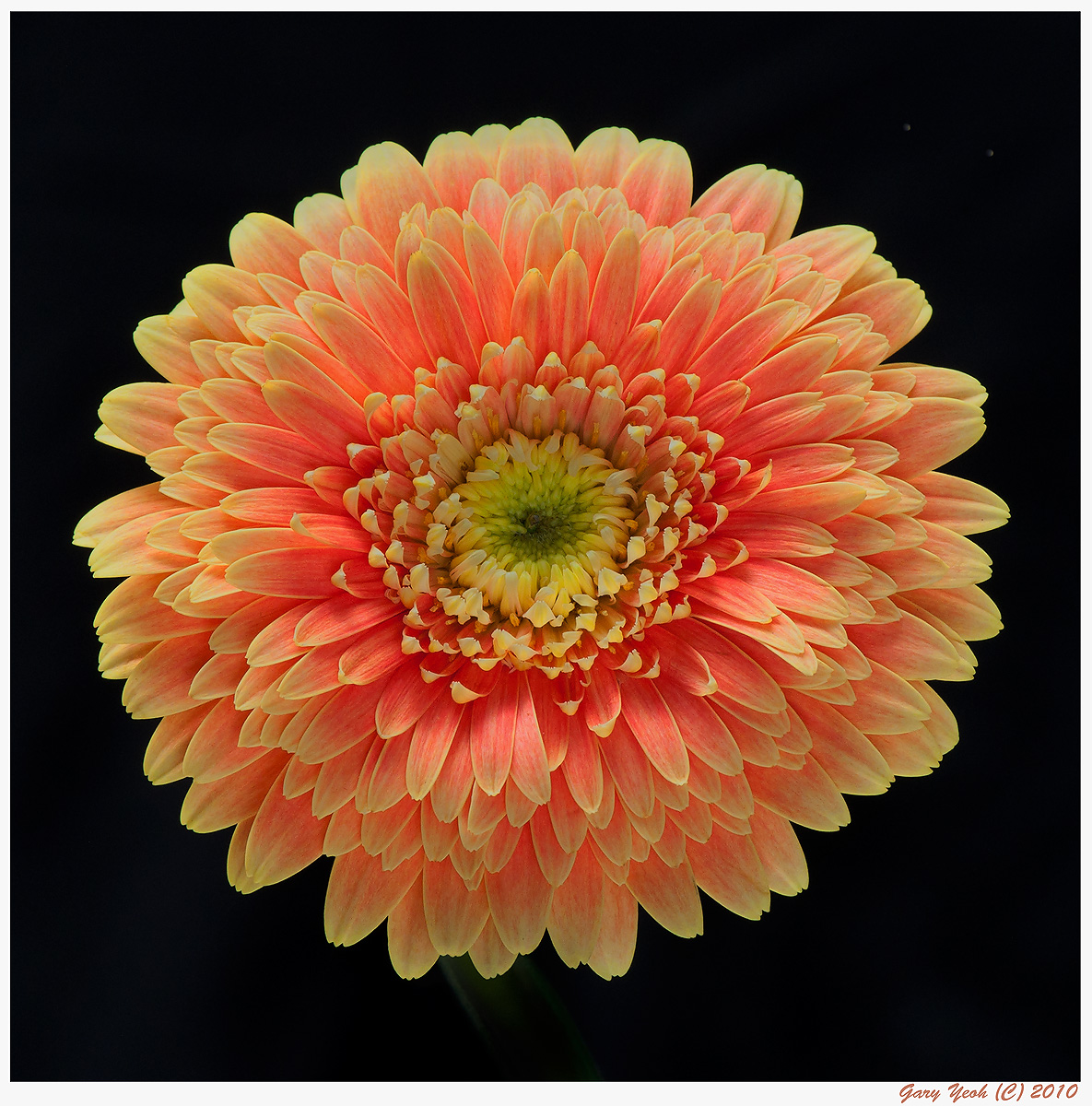
Inspired by Pat's work and the recent discussion on the use of scanner for flora work, I decided to try both of them out. This image is stack of 5 images taken in my kitchen/conservatory with clear perspex plastic roof, cloudy rainy day, natural light with reflector to the center. BG is my black gym T-shirt. Automatic stack on CS5, brightness adjusted with Viveza2, curves and levels and USM with fade unsharp mask on luminosity.
D90 105mm F11 1/2sec iso640 . Larger version included.
The following post is the same flower using the scanner. Would be interested to hear your views on the comparison.

Comments
15 commentsI've recently gone through about eight books of flora photography and while there are images in all of them that I admire, Feinstein's are consistently my favorites. I've done a little research on the web regarding scannography and while there are again images that I like, I don't find anything that I like as well as Feinstein's. His lighting is undoubtedly part of what appeals to me but there's a lot more going on as well and I still don't think I understand it. The images have the flat lighting shown in your second image but they're also more underexposed and desaturated. The colors and the light are flat but flat in a way that I find very appealing.
You're second image here reminds me of Feinstein's light but I much prefer your first image.
I've really enjoyed looking at these and comparing them to each other and to Feinstein's work. Hope you'll do more of these. I'd love to see where you end up taking them.
Pat
I like the glow in the first image as well as the detail. The glow is inconsistent if I study it but I find it more appealing.
Yes, the second flower is flatter/more solid looking in appearance, and I have to wonder what would happen if additional lighting sources were used.
I've found another article on using a flatbed scanner.,
Cheers,
Carol
You did a great job with this.
Congrats
D&L
I like both images as presented. I think a lot can be done including some interesting blending of both into a single image. I don't have a scanner so it will have to be others to take this forward. Perhaps you'll lead us down some new paths?
Cool experiment.
Nathan
Having said that about photography, one has to be pragmatic. As Bob has mentioned it is about what effects you would like to achieved. If it is flat lighting and solid image, then scannography is the way to achieve it. This is just my first attempt at scanning and tweaking the process with additional lighting as suggested by Carol may by the a further way to modify the image. I have use the scanner attached to my new iMac which only use the image capture software that is bundled with Mac OS. On the window platform, the Epson software allows for ambient light correction, dust removal, sharpening etc and I have not tried these. Also I have made several scans and the color rendition is inconsistent from scan to scan - I do not know how to control this with the scanner. I am sure there are many 'tricks' in scannography which I am not aware of and is a whole new field to explore.
Bob - your suggestion of blending the camera and scanner image is a very interesting one and may indeed start a new hybrid genre. However it is technically very challenging to get the exact same POV with the camera and scan image to allow blending.
Albert Darmo. Canada