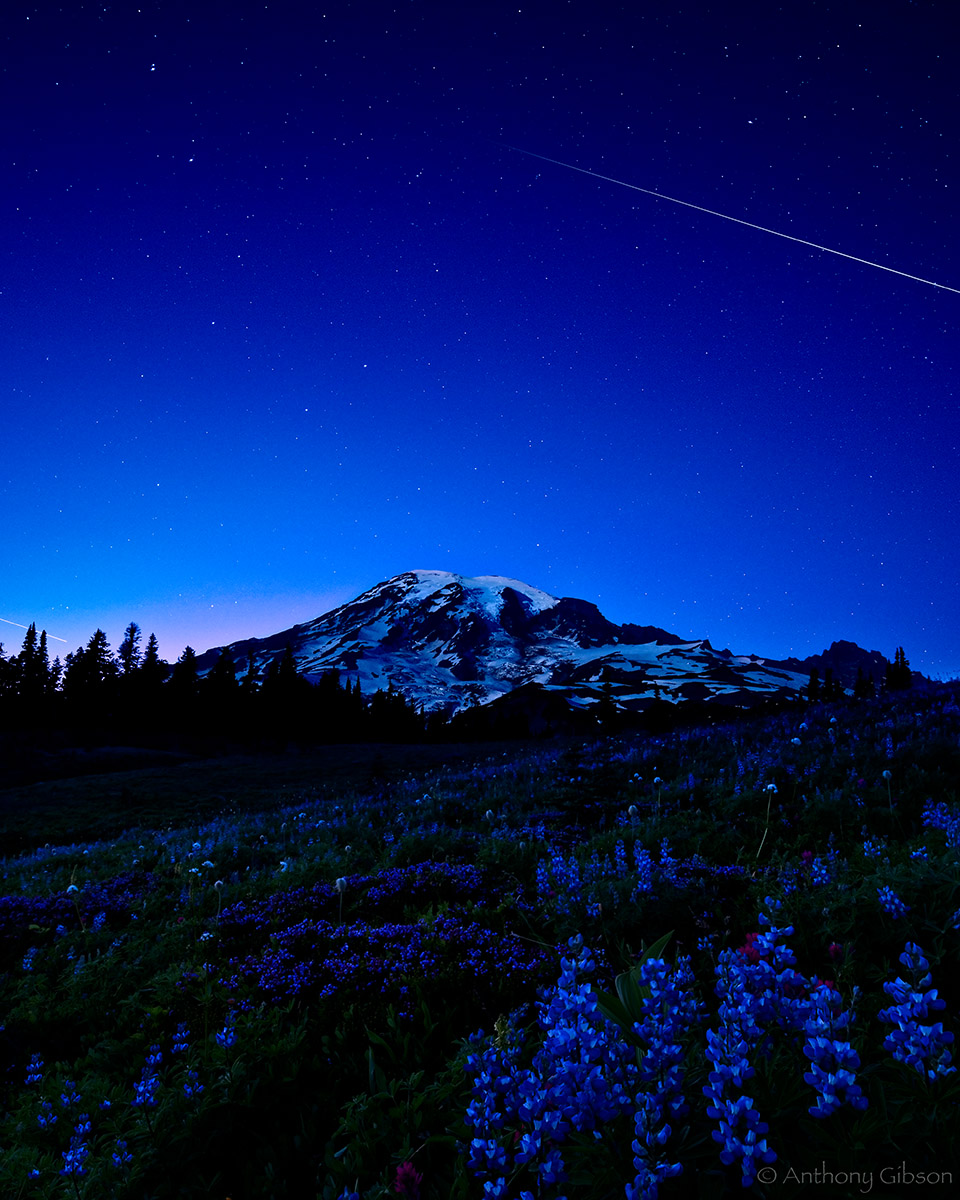
This was taken at Mt. Rainier National Park in the Paradise wildflower fields while touring around with Marc Adamus. We spent an afternoon hiking and scouting for potential images at sunset using Mt. Rainier as a backdrop only to discover that the sky was just "too clear and cloudless" to produce any drama in the sky above the peak. As sunset started to unfold, as expected, I was less than thrilled with sky portion of my images. The weather was gorgeous and the sky was crystal clear, so we decided to hang around for several more hours to do some twilight and night photography over the mountain.
This image required blending 4 images together taken at different points over a few hours for both exposure and focus. While we were standing around talking between shots, I did notice a shooting star to the left of where we were shooting. It wasn't until I got back to the studio and began sorting through the images that I discovered I had recorded two separate shooting stars throughout the evening. It goes without saying that I instantly knew I had lucked out and found my "drama" for the sky portion of my image. I used the two sky portions with the shooting stars along with the other two foreground images to recreate that evening in one slice of time.
Marc seems to think the big star trail might be a satellite, but I am happy with the thought of it being a shooting star.

I have no idea if there a small meteor shower that night or what was going on, but it made for a neat show over this iconic peak.
All C&C welcome.

Nikon D3x
14-24 @ 17mm
f/2.8
ISO 400-1600

Comments
7 commentsKenn,
I know what you are saying and the reason is there was a steady breeze that would just not lay down at all. We made the move to do some star stuff with just enough time to get setup and make sure settings, focus, etc was where it need to be and still have enough light to get the initial exposures. I struggled greatly to get the foreground flowers sharp, but could not get the whole wildflower field to stop moving
Floris,
Thanks, and I used your techniques as a guide to help me with this capture and processing. It is funny several of you have mentioned the darks, as that has been my biggest struggle (although the blazzing white of the forum isn't helping). If I pull back the darks then, yes, the scene opens up some and you notice the details in the field, but it also decreases the "glow" in the lupine some as well. I have flipped between both versions many times, but decided that the main focus was the shooting stars and the glowing lupines. The lupines just seem a little more flat with the darks opened up...but I am certainly open to opinions.
I was there about 5 days after that Floris.
Tony,
I am still fighting those issues we were discussing