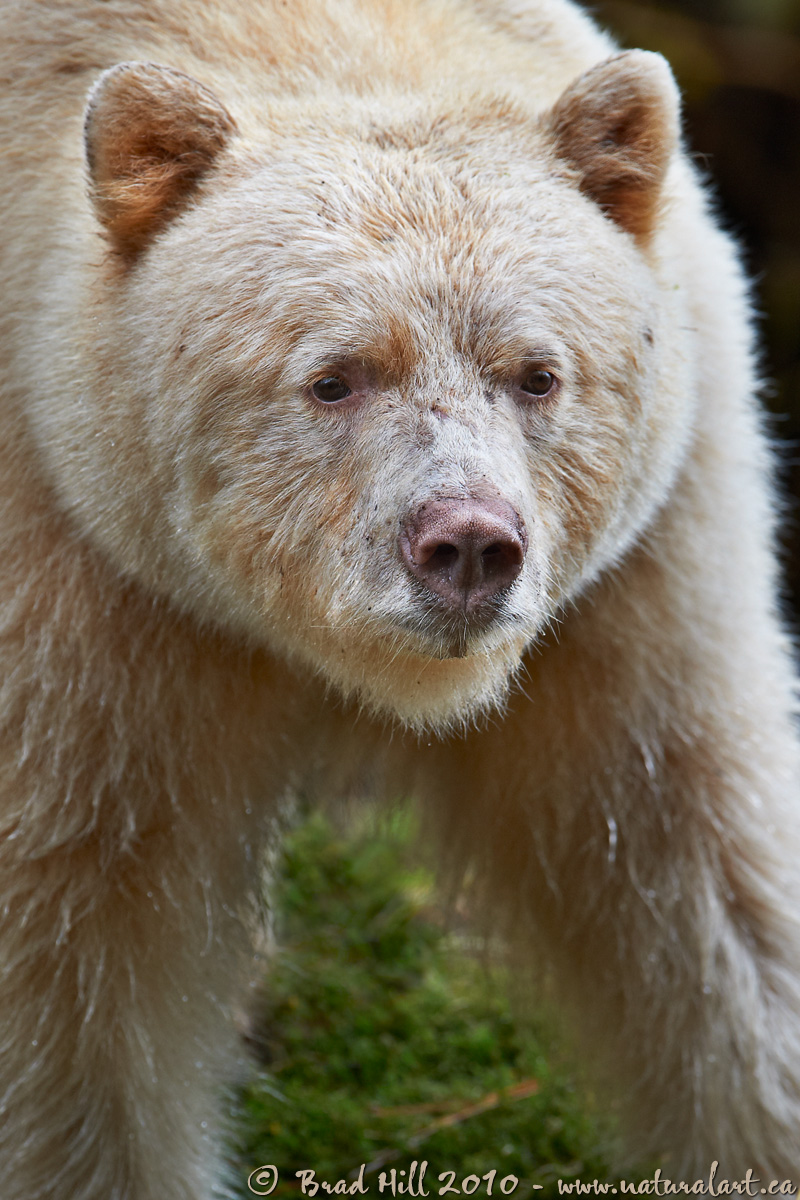
On my recent annual trip into the Great Bear Rainforest I had a very short "hit-list" of images I really wanted to capture. Images on this list included close-up portraits of both a black bear (which was the topic of another recent image post) and of a rare white-phased form of the black bear known as a Spirit Bear. I've always found the eyes of black bears quite tough to effectively photograph, and those of Spirit Bears are even tougher - not only do they tend to be jet black, but for some reason most Spirit Bears (at least those I've seen) tend to have long "light-absorbing" eyelashes and thick eyebrow hair. Add in the fact that Spirit Bears are normally found in heavily forested regions of the Great Bear Rainforest that have very low light, and you end up with a challenging situation, especially if your goal is capturing an effective portrait of one of these elusive beasts! So I was VERY happy when the planets aligned a few weeks back and this helpful bear gave me the opportunity to create this image!
I recently used a black bear image (that was shot an hour or two before this image) to bring up the whole topic of eye contact in wildlife photography (this discussion found
here) and, more specifically, if there's a "best direction" where the subject should be looking. While I maintain there is no one single "best eye direction", I do often like when the subject is looking toward me, but not quite directly at me (and thus I'm NOT obviously changing the behaviour of the animal and/or influencing what the image is about). When I shot this image the bear DEFINITELY knew I was there, but was clearly VERY focused on something else (and that something happened to be fish in a stream). While I readily admit I did NOT notice this at the time I shot the image (I was really focused on getting those very focused eyes in sharp focus

), when I first looked at this image on my computer monitor I really loved the "triangularity" of the image - there's triangle patterns all over the place in this image! If Lon happens to read this over I'm sure he'll point them all out (he never seems to miss compositional details!!).
Subject: Spirit Bear (
Ursus american kermodei) in full focus
Location: Northern BC Coast (Great Bear Rainforest), Canada
Camera: Nikon D3s
Lens: Nikkor 600 mm f/4G ED-IF AF-S VR lens - supported on tripod. VR on and in "Normal" mode.
Exposure: 1/160s at f5.6. ISO 400. -0.67 stop compensation from matrix metered exposure.
Crop: Negligible (this is about 90% of full frame)
All the contextual information surrounding this shot (field notes, all camera settings and processing details, conservation, etc.) can be found at:
http://www.naturalart.ca/galleries/latest/.
Comments and feedback greatly appreciated...probably better to view larger version prior to doing so...
Cheers...
Brad

Comments
14 commentsCongrats on meeting a photography goal, they can be so hard to obtain. The sharpness is wonderful and I'm impressed with your ISO restraint
To me this image is a bit of a double edged sword, however. It certainly is a rare and unique image of a Spirit Bear, but it's almost "too good". I think the layman would assume that this is a captive bear, or that it's easy to get close to, it's a photo that is similar (though on a higher level) to a lot of bear shots that come out of zoos. Now, it all depends on your "goals" for the use of this image, and knowing you, you already have them lined up. My point is that your photos sometimes make it hard to tell the difference between reality and faux reality (which is a good thing... I think!)
Agreed that it can easily be assumed that a portrait like this is zoo/captive shot - that risk is always there. That's one reason I rarely shoot these kind of images (i.e., pure portraits of wild, free-ranging animals). But, as you suggested, I DID shoot this image with a specific use in mind (and definitely NOT as a wallhanger!). When all is said and done, I suppose I can live with a criticism that an image is "too good"! (thanks!).
Cheers....
Brad
Technically great shot from my perspective. Perhaps the left ear could be sharper, but he may have been moving a bit to cause a slight blur?
Ken Archer
The calm intensity of the bear, and you for that matter, is well captured here.
Neil