Nature Photographers Network
This is the preserved archive of the original Nature Photographers Network. The community continues at naturephotographers.network.
Half a.sleep duck
‹ PreviousAvian GalleryNext ›

Half a.sleep duck

by Ron Huff

Gallery: AvianPosted November 4, 2010100 views10 comments
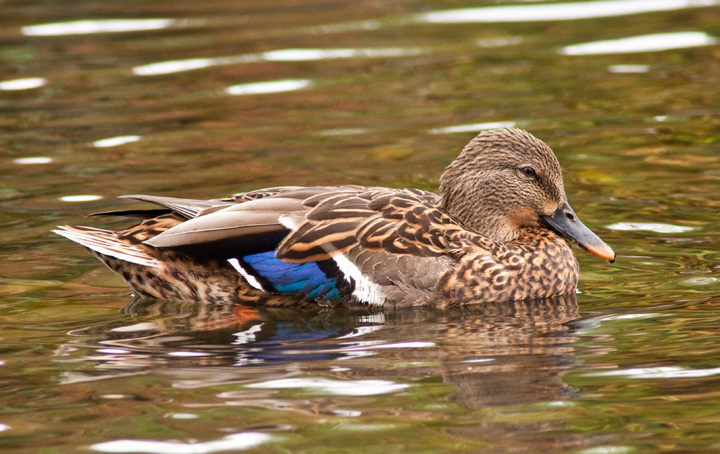
I am posting this because I like how it turn out and also because of the white line that goes up on the wing. Can anyone tell me why this happen? Also is this a Blue-Winged teal duck? Shot on the same cloudy day as the last two I have posted. I am learning and any honest ( good or bad ) feed back is welcome.

Thanks
D90, Tamron 70-300mm lens @ 300mm monopod

Ron Huff
Culdesac, Idaho

Comments

10 comments
Comment posted by Ron Bielefeld on November 4, 2010 at 5:39 AM
Ron, the white on the wing belongs there, it is a natural part of this ducks plumage. The white is showing through a very thin part of the scapular feather that is laying over the greater covert feathers and then continues up as part of the greater covert feathers. This is not a blue-wings teal, but a spot-billed duck, or a hybrid there of. The spot-billed duck is an Asian species, but they are in NA as escapies from collections and by direct transplant.
Registered on December 6, 2008, 360 Posts, 7132 Comments
Comment posted by Nate Chappell on November 4, 2010 at 2:34 PM
I was thinking this was a female Mallard or a female Mallard hybrid with something else. Ron covered the wing question. I would like to see a little more room in front of the bird on the right, your exposure and detail look good to me. :toast:
Registered on February 1, 2006, 1158 Posts, 19528 Comments
Comment posted by Audrey Rice on November 4, 2010 at 5:05 PM
Ron, Nice looking duck. I shoot many at the lake by my house. Question, did you use a polarizer when shooting this image? I find the white highlights in water a bit distracting, and a polarizer would have cut down on the glare. You might try cloning them out in Photoshop to see the difference. Just a suggestion.
Registered on November 2, 2010, 12 Posts, 39 Comments
Comment posted by Ron Dudley on November 4, 2010 at 7:02 PM
This duck looks pretty good to me Ron. Ron B covered your questions. As Nate said a little more room in front would be nice.
Registered on March 30, 2007, 437 Posts, 10915 Comments
Comment posted by Eric Diller on November 4, 2010 at 7:54 PM
Nice capture....agree with comments mentioned. For me it looks like the image needs a tad bit of clock wise rotation.

TFS
Registered on October 2, 2009, 69 Posts, 434 Comments
Comment posted by Ron Huff on November 5, 2010 at 12:11 AM
Thanks for all the comments and help. I will try to do the suggestions you have offered and post soon. I am still learning PS and I move very slowly through it. Audrey for what ever reason, I have not got a polarizer for this lens yet, and I do agree it would improve the photo to get rid of the white glare lines, plus add some space to the front of the duck Nate.
Thanks again,
Ron
Registered on August 31, 2010, 69 Posts, 440 Comments
Comment posted by Nate Chappell on November 5, 2010 at 12:29 AM
I wouldn't generally recommend using a polarizer for bird photography because you lose about 1 stop of light which can be important working in low light or trying to stop the action.
Registered on February 1, 2006, 1158 Posts, 19528 Comments
Comment posted by Ron Bielefeld on November 5, 2010 at 5:35 PM
I agree 100% with Nate on the use of polarizers when shooting birds. Polarizers also can have some funky affects on irridescent feathers.
Registered on December 6, 2008, 360 Posts, 7132 Comments
Comment posted by Audrey Rice on November 6, 2010 at 8:32 AM
I find it interesting that you don't use a polarizer when shooting birds. There are many swans in the lake by my house and I find it hard to retain the detail in their feathers without using a polarizer, even if I compensate for the exposure. What do you do in such a case - and how would you reduce the glare on the water?
Registered on November 2, 2010, 12 Posts, 39 Comments
Comment posted by Nate Chappell on November 6, 2010 at 6:16 PM
Hi Audrey,
I just reduce the exposure compensation with white birds to try and retain detail. I don't tend to do a lot of shooting against water with glare. When I do I will generally just work with the light and go for a high key type image. In your case (shooting swans against water with glare) it probably does make sense to use one. I shoot a lot of action and bird in flight shots, so the cost of the lost light and slower autofocus make it not worth while using a polarizer for me personally.
Registered on February 1, 2006, 1158 Posts, 19528 Comments