Grebe + Repost
by Steve Balke
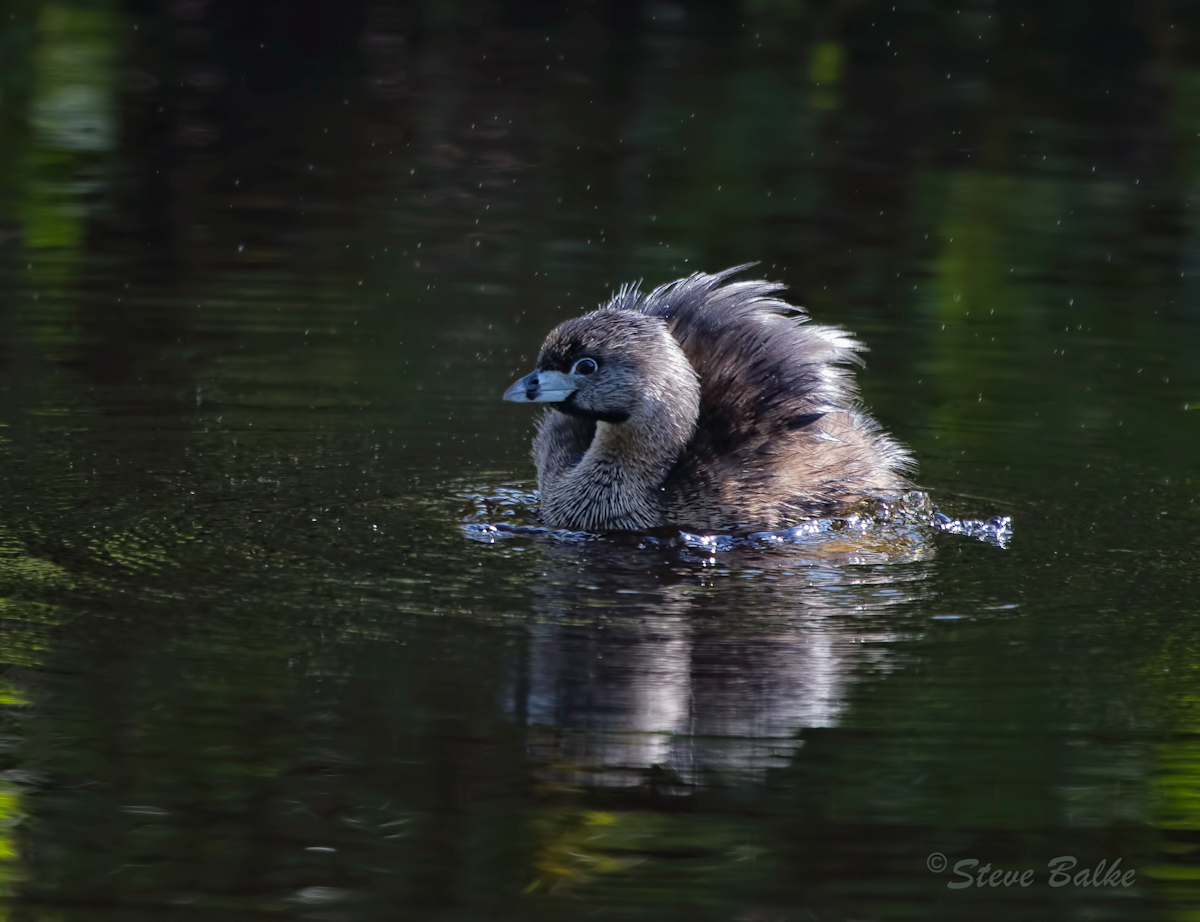
Pied-Billed Grebe (Podilymbus podiceps)
This image was captured at the Queen Elizabeth II Botanic Park in Grand Cayman on Dec. 20. It is a very beautiful place with a fine variety of very interesting birds. This little bird was so much fun. It would dive and the game was for me to try to figure out where it would come up so I could photograph it. At this point it fluffed up its feathers. If you look closely you can see water droplets all over.
All comments most welcome.
1D Mark IV, EF100-400 f/4.5-f/5.6, hand held: 365mm, ISO 800, 1/1000 s, f/5.6, -2/3 EV, 5.3 MP after cropping, usual NR, exposure adjustment, sharpening.

Comments
7 commentsCarol
i. lightening the face/image: I found that just increasing exposure on the face did not look right. There is quite a complex range of light intensities across this image. So, in this repost I've brightened the whole image a little.
ii. ccw rotation: although there is not much to go on here, I do think a slight ccw rotation does improve the image. Please see the repost.
iii. cropping causing lack of fine/crisp detail in the feathers and causing the need for NR. As I've said previously, obtaining as many bird pixels in the image as possible maximizes detail. So, being close to the bird and/or large focal length lenses are certainly desirable for maximizing detail. However, once the image is obtained and the number of bird pixels fixed, then I've seen no evidence to indicate that, even quite severe cropping, causes further degradation of the posted image. The level of detail we see in the posted cropped image is the same as in the uncropped original. In this case, I would attribute any deficiencies not to cropping, or even to distance from the bird, but rather to lighting. However, I do feel happy with the detail for this image and, comparing with the original, see no reason to think that NR or cropping caused problems. To see even a higher level of detail in a larger crop, I'd encourage you to have a look at the image that I posted just previous to this one ("Brown Booby") at:
http://www.naturephotographers.net/imagecritique/ic.cgi?a=vp&pr=162996&CGISESSID=b4cc5e4de62924147d82d191af7f19aa&u=25589.
Thank you all again. I do much appreciate your comments, especially your critical comments. They help all of us learn more about this wonderful art.