Snowy Woods
by Pat Sampson
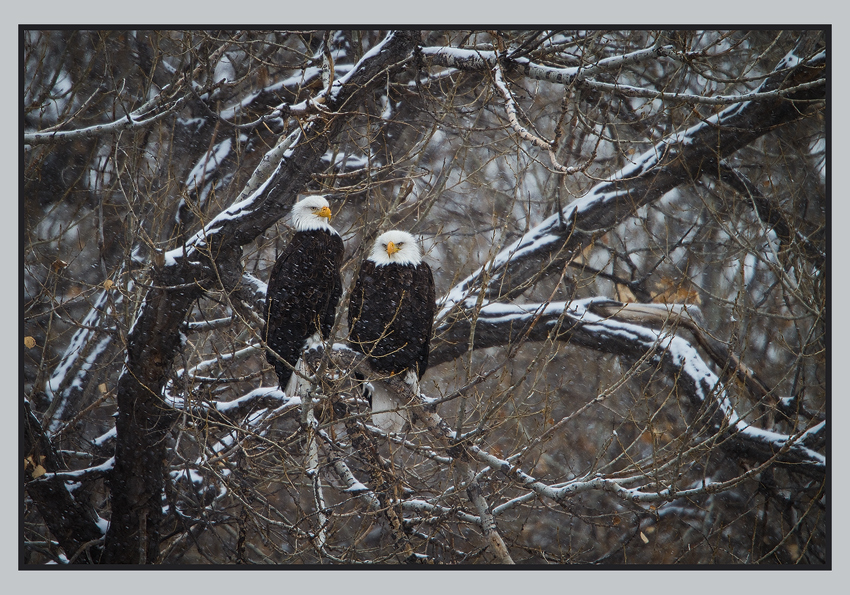
Woods at Cherry Creek Reservoir - coming home from work this afternoon.
Yes, I am aware that there are two bald eagles in this. As I started cropping the image to emphasize the birds enough to post in avian, I also started liking it less. The woods in this might not be as interesting without the birds but the birds without the woods don't work at all. So, I guess where I ended up is that in my mind this is a landscape of snowy woods and that there happen to be two birds in the image that add interest to the landscape - party crashers if you would.
Bill, I'll defer to your judgement as to where it belongs but I wouldn't post it on avian without cropping it more and that's just not the image I want.
Canon 7D
Canon 500mm w 1.4tc
ISO 120
F/5.6
1/200
Two image stack.
bean bag on car window
Helicon Focus (for noise reduction), NIK sharpening software, LR 3, CS 5, MacBook Pro 17
Selective sharpening applied to the birds only and a little vignette applied in LR 3.
Comments and suggestions welcome.
pat

Comments
20 commentsAlbert Darmo. Canada
Keith,
My first inclination was to post this on Avian but I thought folks would want to see more of the birds and the only way I could get there was to give up the flora and I didn't like that version of the image as well. Thank you for the comment though. I'll certainly keep it in mind going forward. I still shoot birds at least once a week and sometimes more frequently. I enjoy it a lot even if I rarely get anything that I think is worth posting.
Again, thanks to all for the comments.
pat
Congratulations
Mauro
I'd say you were successful with this.
I thought I am the only one who goes in to work on Sunday and bring a camera along. Great capture of this pair of early. It is hard to decide whether I like the birds more or the woods but having both makes this an even more engaging image.
Well seen and well composed. My opinion is it belongs in both galleries. As much as I like macro and close-ups, it is also nice to see flowers, birds and other animals in their habitats.
Sandy
Berkeley, CA
Natural History Wanderings
http://picasaweb.google.com/sandysteinman
Okay, Pat, everyone else said it more eloquently, especially Gary and Morris. And it doesn't really "flunk" for flora; it's just not "you," if you know what I mean.
"two image stack" - hm - tell me more
Pete D.
I shot this in continuous drive mode on the 7D. I had plenty of light and the 1/200 worked to freeze their action. They weren't doing much. So I figured I could get two images with an effective exposure speed of 1/100 for the pair. Since I thought I might need a severe crop I thought that anything I could do to reduce noise would probably be worthwhile.
In my experience stacking is a pretty good way to reduce noise. I've thought about it some and I'm guessing it goes something like this. Let f = the fraction of noise in any given image. Assuming the merging software masks noise with signal (I think it does), then merging two images with approximately the same amount of noise, reduces the noise in the composite image by a factor of 1-f. For example, suppose f - .1. Then, statistically .9 of the noise in the original image is masked when the images is merged with the next. This leaves .99 signal and .01 noise in the composite as opposed to the .1 noise in the original image. I don't know how much of an image is noise to begin with. I'm guessing a lot less than .1 but whatever it is, every time you merge an additional image you reduce the noise by .9 of the total noise in the image. If n is the number of times you merge the image then the noise in the composite at the end of the process is equal to f to the n. That's how I think it works anyway. The more pixels, the greater the statistical reliability of the model.
Basically, the idea is just that every image merge reduces the noise left in the merged image by a factor of f. If my assumption about masking is wrong, then all bets are off.
Pat
I like the feeling of black and white with just a hint of yellows.
Cheers,
Carol