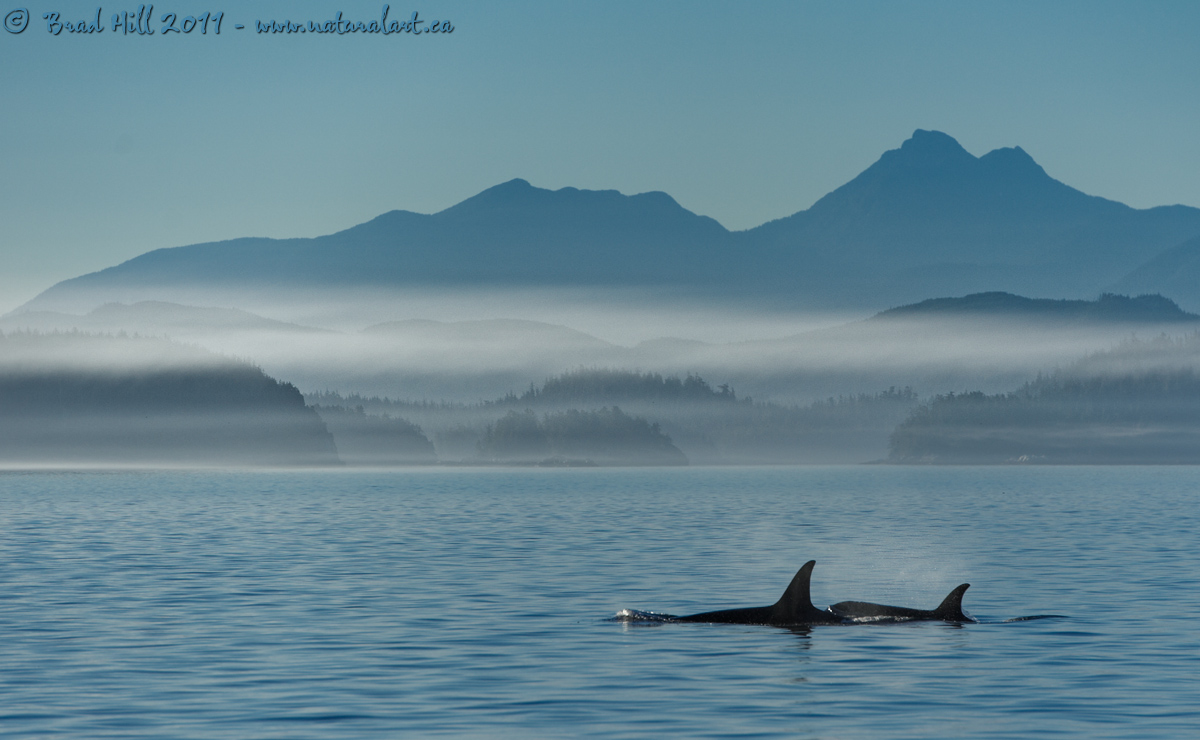
I have no idea what an Orca would consider heaven to be like (or if the thought has ever crossed their complex brains), but I'm guessing that it wouldn't involve much consideration of dramatic or picturesque backdrops like the one these two are swimming in front of. So why use the title "Orca Heaven" for this image? Well, as it turns out, these Orcas - which are members of a resident pod found near the northern end of Vancouver Island and, as such, are fish-eaters - are swimming through these waters just when the largest sockeye salmon run in close to 100 years was passing through! Estimated at between 32 and 35 million fish, it's hard to imagine that this run didn't at least please or - less anthropomorphically - reduce the hunger stress on these amazing mammals!
Talk to almost any experienced pro (or serious amateur) photographer and you'll hear them say that on any important "shoot" you should always bring at least two camera bodies along. This is especially true if you're shooting in a region that's remote (or, equally important, expensive to get to). The first reason for this is common sensical - if one camera fails you have a backup to use. In wildlife photography there's often another reason that's related to the non-uniform distribution of your subject in time and space. Huh? Well, by this I mean that wildlife photography is often characterized by long periods of waiting when nothing is happening (no subjects around or, if they are, they may be doing nothing that's interesting photographically, like sleeping in long grass). During this time BOTH cameras are sitting there doing nothing. But...things can start happening awfully fast when the subjects show up (or, using my other example, wake up).
In the case shown here, we had been waiting for a good hour with nothing happening around us when suddenly Orcas starting showing up all around our boat. They were surfacing at various distances away from the boat and, depending on where they surfaced, in spots where the backgrounds were far in the distance (as in 25 or more kilometers) or quite close (a kilometer or two). On top of that, you often only had a few seconds (and certainly less than a minute) to catch the whales surfacing in the right place to create a pleasing image. JUST prior to shooting this image I had been working with a pair of whales with a mountain range far in the distance (
this image) and had been using a super-telephoto to "compress" the distance between the subjects and the background and to increase the size of the background. Then I heard these two "blowing" nearby and when I turned I had the scene above unfold (very, very fast) in front of me. Fortunately, I had a second camera body with a shorter zoom lens right "on-hand" (that I was wearing using a belt and holster system) and I was able to capture this image. In this case having that 2nd body (with a lens mounted on it) handy was the sole reason I was able to capture this image...
Subject: Killer Whales (
Orcinus orca) - just after sunrise
Location: Johnstone Strait region (northern Vancouver Island), BC, Canada
Camera: Nikon D700
Lens: Nikkor 70-200 mm f/2.8 VRII lens - handheld from sailboat. VR on and in "Normal" mode.
Exposure: 1/2000s at f5. ISO 200. -0.33 stop compensation from matrix metered exposure.
Crop: This is about 75% of full frame image
All the contextual information surrounding this shot (field notes, all camera settings and processing details, conservation, etc.) can be found at:
http://www.naturalart.ca/galleries/latest/.
Comments and feedback greatly appreciated...probably better to view larger version prior to doing so...
Cheers...
Brad
PS: I intend to begin offering an 8-day Instructional Photo Tours to this fantastic region in August of 2011 and have ONE spot left for this tour. If anyone is curious about the tour, feel free to email me or check out the tour entitled
"Orcas, Humpbacks and More: Aquatic Mammals of the Central Pacific Coast" on the
Photo Tour page of my website...

Comments
11 commentsIdeally, I prefer to have three bodies with three different focal lenghts, but two are absolutely must.
Jagdeep Rajput
Just to be clear after looking at the second photo - you had TWO D700's on you? I'm surprised you didn't have one FF and one DX camera body with you.
This is a really nice image and I like the soft cloud/mist around the mountains - but I much prefer the previous shot for it's grand appearance
Nope - was using a D3s and a D700 when this was shot - so both were FX. There wasn't a DX option that I worked for ME when I was on this shoot (I do have a D7000 now and am hoping that there's a high-quality, durable replacement for the D300s soon that performs well at least in the ISO 1600 range).
Brad
PS thanks for sharing the cowboy solution on carrying a spare body
Well Vincent wasn't too wrong about the cowboy thing (see image above), tho' I kinda fail as a true cow-poke on my choice of hats. Much of harness and holster obscured by my lifejacket, but it does resemble someone going to a gunfight!
Cheers...
Brad
PS: Thanks to Ray Rafiti for sending me this image - I am almost always BEHIND the camera - not in front of it!