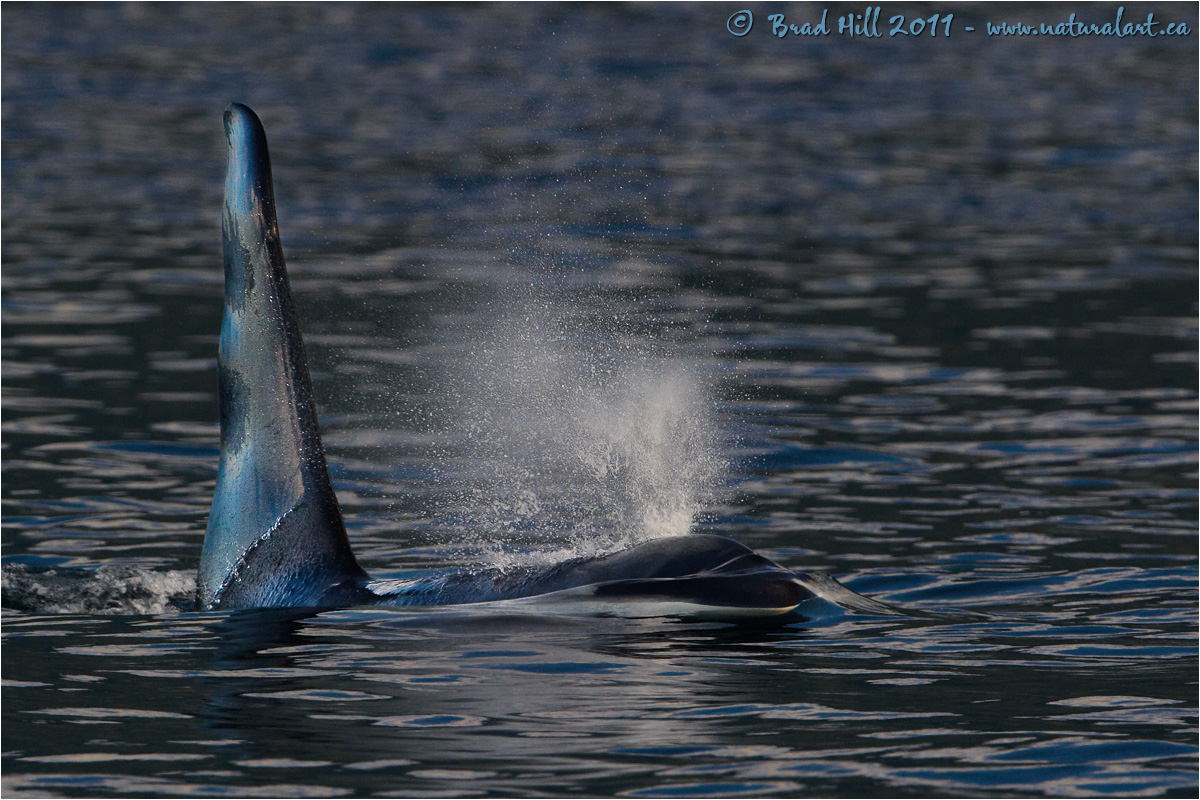
It's hard to describe the feeling experienced when a large male Killer Whale swims purposefully in your direction - even if you're safely ensconced on a boat. It's kind a mix of awe and a little fear - and certainly a respect for the power they simply exude. At the same time there's admiration for their beauty and grace, especially given their large size (the dorsal fin pictured here is about 2 meters - or 6 feet - tall).
I captured this image during a week-long photo trip in the late summer of 2010. While this is a pretty simple image, there's a few things I like about it - some are from a photographic perspective and some are from a biological perspective. The first thing is the timing of the capture (which was pure luck) - those "blows" expel water vapor at an amazing velocity and the odds of catching one just as it's beginning (and totally within the picture frame this when this close up) is low, low, low. Someone was smiling on me when I shot this. I also like (and this is another flukey thing) that the white underside of the whale is showing through despite being underwater. And, last but not least (and I DID see this when I shot the image, and focused on it) was the "standing wave" of water low on the dorsal fin. To me that adds visual interest to the shot and is just plain cool.
Before this trip I thought that Killer Whales were black and white, with perhaps a few grayish areas below their dorsal fin (their "saddles", which are used in identifying individuals). After all, every photo I've seen of them before - and certainly all illustrations I've seen in field guides - shows them as having only two "colours" - black and white (I know that technically black and white aren't single colours per se, but give me some latitude here!). But soon after I began this trip I noticed that parts of the body - most noticeably the dorsal fin - reflected various colours (most commonly a baby blue). Under bright sunlight the colours weren't visible, but when the sun went behind a cloud (like in this shot) the colours just popped. When I shot this image we had a mix of clouds and blue sky - which accounts for the blue reflections in the water. To me the most interesting thing to these coloured dorsal was that while the colour changed depending on the light, the positioning of it didn't. So, those two very dark patches on the trailing edge of the fin were ALWAYS dark - they were obviously a different colour and/or texture and reflected light differently than the lighter blue zones. By the way - the colours here are "natural" - I haven't selectively manipulated or saturated them.
Like most nature photographers I used to seek out direct sunlight (often in early morning or evening) to photograph wildlife. But, since converting to digital, and especially since the ISO performance of digital cameras has improved so much, I have found myself actively seeking overcast (and even rainy) conditions to photograph wildlife. This is especially true if I'm working "in tight" with my subject. The reason? This image illustrates it well - the colour (including tonal range and range of hues) is often SO much better when the lighting is more diffuse (and less harsh). Nowadays I tend to shun the light I used to seek! Funny how things change...
Subject: Male Killer Whale (
Orcinus orca) - up close & personal
Location: Johnstone Strait region (northern Vancouver Island), BC, Canada
Camera: Nikon D3s
Lens: Nikkor 600mm f4 VRII lens - handheld from sailboat. VR on and in "Normal" mode.
Exposure: 1/1250s at f5.6. ISO 2500. -0.67 stop compensation from matrix metered exposure.
Crop: This is about 75% of full frame image
All the contextual information surrounding this shot (field notes, all camera settings and processing details, conservation, etc.) can be found at:
http://www.naturalart.ca/galleries/latest/.
Comments and feedback greatly appreciated...probably better to view larger version prior to doing so...
Cheers...
Brad

Comments
17 commentsMy father used to say "Operknockity tunes only once, so be ready". He would have admired your work for your preparation as much as the quality of the images.
Well Done, as usual!
Neil
Total processing time - probably under 10 mins. I didn't do too much to this image beyond quite simple adjustments. I don't time how long I work on individual images, but I usually know where I'm going with them pretty quickly - I would think I would between 5 and 10 mins on an image would be about average for me (some are faster, and the odd one takes way longer than this).
RE: How long was it? They go up to about 32', and this was a big male, so I'm guessing maybe 25-27 feet long. Unless they breach you rarely see the whole whale (they're actually dolphins, but that's another story) so it's hard to say for sure...
RE: "Is there a way to see the B4 version? I ask this b/c..."
Will dig up the raw file tonight and post a reasonably facsimile of the original full frame capture to help answer your full question...
Cheers...
Brad
**************************************************************************************************************
Hi again Jerry,
You asked: "I ask this b/c as a beginner/novice, it would be helpful to see how to position a subject, and to also see the light/color corrections...
OK - facsimile of my original full-framed raw capture above. Bear in mind that this image would look very different with different raw converters before adjustment (i.e., the quality of the previews varies significantly).
All I really did to this shot was:
1. Selective increase in exposure - mostly limited to the orca itself.
2. Some selective tonemapping - again limited to the orca. I use a product called Lightzone for adjustment to tonality of an image.
3. Selective sharpening for web output - mostly limited to the dorsal fin (with less sharpening applied to the spray).
Note that there was a deliberate underexposure of the original capture to save the highlights within that spray - one had to be very careful of this if the overall scene is quite dark (like this one) and the region containing the highlights occupies only a small portion of the original image (thus the camera's metering system doesn't properly weight the highlights and over-exposing them is real easy).
In terms of framing the original capture: I saw the direction the whale was coming from and wanted to leave more room in front of the whale than behind it (to give it more room to swim into than it was coming from). BUT, I wanted sharpest focus on the dorsal fin. So, I toggled my focus bracket over to the LEFT side of the frame so I could leave that extra space in front of the whale.
I hope this helps...
Cheers...
Brad
An awesome shot of this incredible mammal.
Be Well,
Jerry
Your description is just as awesome as the image, Your are really are passionate about your subjects and your breadth of knowledge proves it.
Paul
Much appreciated, i got lots of thing to learn.
Ken Archer