Falling From Grace
by Robert Beideman
Hello all,
Brand new member of NPN....and my first post here.
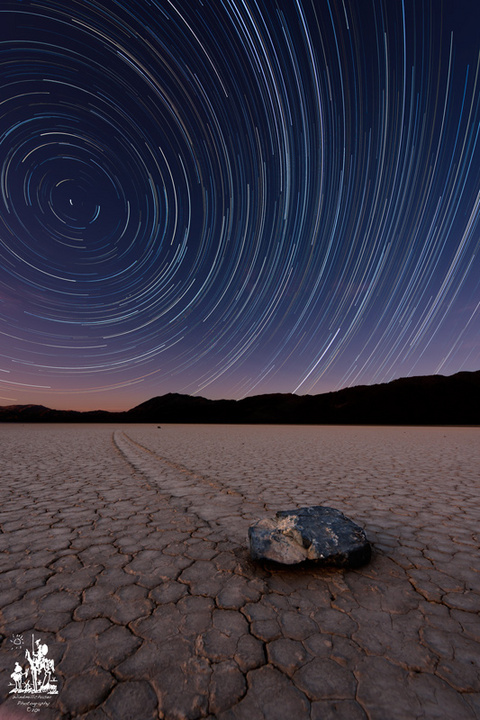
Here's one of the first images from my recent trip out to Death Valley's Racetrack.
Nikon D3x
14-24mm f2.8 @14mm
Star trails: 420 30s exposures at f2.8, ISO400 layered (lighten)...then...
blended with foreground image captured at 1/25th, f14, ISO100.
C&C requested...
Thank you,
Robert Beideman
Windmillchaser Photography
http://www.windmillchaser.com

Comments
23 commentsI thought this was another post by Jared Antencio (see his post from March 11, a few pages down) The scene is pretty familiar, especially after youve seen it a bunch of times. But if its done well it doesnt really grow old. I like your comp better, since the track leads to the n star here, which is cool. But i like Jared's foreground better since it has better contrast in the playa and better color contrast to the sky. Overall, a cool shot and nice intro.
aF
Nice first post.
-Jay
Welcome to NPN and the Landscape Gallery! An outstanding first post despite this being such a popular location. But I will certainly say this is a pretty fresh take and certainly technically wonderfully executed. 420 exposures????
I think this is perhaps one of the best digital star trails images I've seen. Amazing how this was put together. Great job withthe comp and the lighting of the foreground as well.
Welcome aboard.
Lon
Michael
Of particular concern was the softness of focus in the foreground mentioned by Ian, Jared, Tyson, and a few others. Truth be told, I'd forgotten that I'd captured a few images for potential focus stacking. One of those has now bee put to use...and the softness in the foreground is gone (as is whatever was hiding in the llc of the image behind the watermark).
Also the slight rotation....once I really looked again....it was there. And it had to go away.
I'm always conflicted by the choice to maintain the dim colors of the late/early twilight sky in these images...or to drive toward a more "true-night" feel by just using the sky from the star trails shots. In this case, I ended up going a little further toward the dark than in my original post, deciding to use an exposure that was captured a few minutes later than the one used in the first post. Reason for this was that I thought that having the color in the sky only around where the rock was "coming from" seemed to accentuate the visual path through this image. But that's open to critique as well. I just think that it's a tough call...
@Tony - the oval-ness of the pattern is due to this being shot at 14mm...the wider angle really accentuates the movement of the stars as they approach the edges of the frame. You'd not have seen nearly thee same amount of oval-ness had Polaris been in or around the centerline of the lens... Actually, I did a complete second Racetrack trails shot this particular evening (having picked out a second rock before the sun went down). That composition doesn't show nearly the same amount of oval in the trails...and yet it was shot with the same rig...with the lens set at 15mm.
@Lon - I know....420 images sounds ridiculous...and a bit like self-torture once back at the computer. But the intervalometer let me rest while it was all going on. ;-) I've been playing with exposures of different lengths for these star trails shots, in an attempt to make these images less painful to process, but I've settled on 30s exposures to assure that the noise is kept to an absolute minimum. I also believe that this makes the removal of meteors, shooting stars, and airplanes simpler....as they rarely span more than one frame....and it seems that you risk less of an impact to the actual trails when you remove them on these shorter exposures. Where the 30s approach seems to make the most sense, though, is for the removal of satellites that are not geostationary. Since a single one of these guys can trash a complete exposure that's a few minutes in length, I've found that removing their impact is a lot easier working with a set of frames in which each one has a very minor impact. Lastly, I've found that exposures more than 30s get royally messed up if you happen to have the moon rise during your hours of shooting (the background level of the frames jumps up from true black as the moon rises...making the stack behave badly when every layer you're combining is being combined as a "lighten" layer. But, after looking around this forum a bit in the recent days, it's clear to me that there are a number of people with a LOT of experience in this realm...and I claim to be little more than a new guy at this start trails stuff! ;-)
Finally, to Jay's point...if the foreground on this were to be made any darker, I fear that the the print result on most mediums would be muddy (no pun intended) and detail would be more difficult to resolve. So, again...just trying to find a balance... ;-)
Anyway....enough of my musings...here's the refreshed version. Please tell me I didn't make it worse! ;-)