This One's Mine?
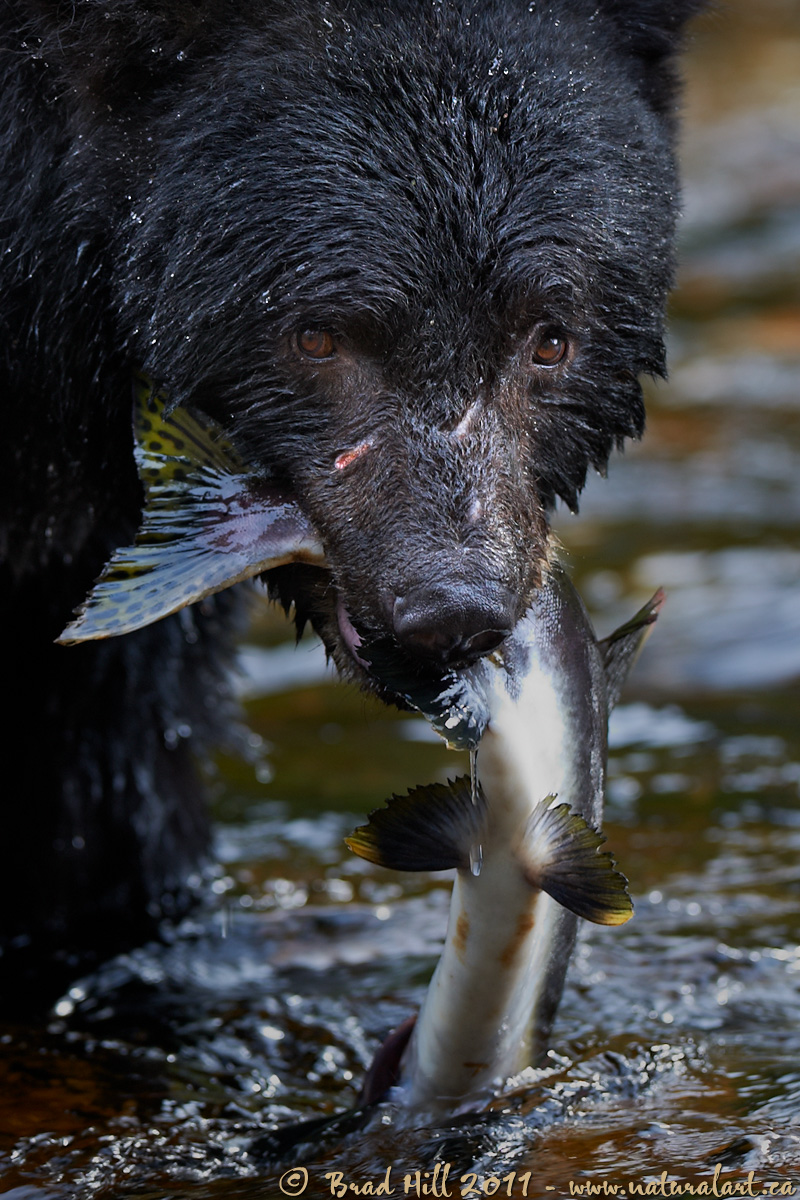
A few posts ago I coined the term "active portrait" to describe tightly framed wildlife shots where the subject is doing something (other than JUST looking at me or into the distance) and where I'm trying to capture a bit of the "essence" or personality of the subject. Anyway - here's another example of one. Judging by the scars on it's snout, this smallish black bear has had a bit of a rough go fitting in with his "pals" and when he approached me closely, snagged a salmon from right in front of me, and then looked me in the eye, it was almost like he was saying "Please let me keep this one!" Anthropomorphic? Probably - but, inadvertent or not, he was definitely communicating something to me!
There were some challenges in capturing this image (including enduring bootfulls of very cold stream water!), but the bigger challenges were in processing the image. Between the whiter-than-white belly of salmon and the dark black-on-black tones of the bear this image pushed the limit of what my camera's sensor could capture. As always, I exposed to retain highlight details and left retrieval of the black-on-black detail to post-processing. I'm not a fan of the shadow/highlight tools of raw converters or image editing programs so I use a more time-consuming (but, I would argue, more precise and less prone to noise creation) exposure blending technique. It's similar to HIgh Dynamic Range (or HDR) processing, but instead of combining multiple exposures captured in the field (which is pretty impractical with wildlife photography), I combine multiple versions of a single converted raw file where each version differs in the exposure assigned to it. This image was one of the most complex I've ever blended and I ended up blending 5 exposure versions before (over a 2.5 stop range) before I got this one to suit my taste (and, I think, recreate what I saw through the viewfinder).
This image is going to be used shortly in a conservation campaign to draw attention to the increasing number of threats to a region of the BC coast known as the Great Bear Rainforest. It's probably not appropriate to include a long conservation spiel here - interested parties can check the full rant out on my website (link below).

Anyway...all I'll say now is this: Good luck little bear - I hope that despite mankind's actions that hamper you, I truly hope you can find enough fish to sustain yourself over a long life...
Subject: Young Black Bear (
Urus americana kermodei) trying to drown a salmon!
Location: Great Bear Rainforest, BC, Canada
Camera: Nikon D3
Lens: Nikkor 200mm f2 VR - handheld (VR on an in "normal" mode)
Exposure: 1/160s at f2.8. ISO 220. -0.33 stop compensation from matrix metered exposure.
Crop: More than I'd like - this is about 50% of original vertical capture
Besides the usual info (field notes, processing, etc.), you'll find a bit of a conservation rant here on my website...
http://www.naturalart.ca/galleries/latest/.
(just click on the "In the Field" tab under the image to see the discussion).
Comments & critiques welcomed. Probably better to view larger version first...
Cheers...thanks for looking...
Brad

Comments
14 commentsThanks - I agree with your comment on the ears and they ARE in the original. We debated including them (this is the crop we're using in the campaign), but in going to a wider crop the eyes were less compelling (and yes, we're "using" the "bambi eyes" to maximize the impact!
Cheers...
Brad
That said, this example of what you've been able to achieve by combining multiple images has my mind racing once again with all sorts of possibilities, the only thing is, with so many other techniques and skills I'm trying to learn and get my head around, I reckon it's gonna' to be a while yet before I can afford the time to fathom the finer points of this technique out and make the best of it ;^)
Nevertheless, you've planted yet another seed in my ever-fertile mind, and I thank you for that :^)
Much like Luke, I'd be very interested to see the original with whatever basic adjustments you would have made had you not gone the multiple layer route, as this would offer a clearer idea of how much more you were able to bring out of this image, but I'd also understand if you'd rather not ;^)
The image you've presented here is thoroughly captivating and compelling and, I think, very well suited for drawing the attention you're aiming for. Great job Brad :^)
I find it amazing, the way you go into great details in processing the image.
I like Luke's idea to post the image before processing, so that less skilled, like myself can learn from it.
The image straight away stares at the face, as if asking the questions, it will be very effective in conservation campaign ! If this was mine, I would prefer to darken the whitish (water reflections)area around the fish.
Jagdeep Rajput
I think you know how much I like black bears from previous comments, but you just completely nailed an exquisite capture and representation of the species here. I'm sure the pp helps make this as good as it appears here, but the beauty of it is that the pp is completely out of the viewer's mind. The power of the image holds you.
I'm stretching to find anything to suggest (why bother?), but it did suddenly cross my mind: what if you cropped a little extra off the top and eliminate any hint of the ears altogether? Kind of like your suggestion on my muley shot legs?
Just stunning, Brad...did I mention I love this image?
Thanks SO much for sharing this one with us...I am almost pacing with impatience for the bruins on this side of the rocks to start foraging!
Ken Archer
Just a few responses...
Luke & Jagdeep: I'm on the road right now and don't have access to my images (coming to you now from my iPad!). I can post a couple of the "before" variants when I return (in just over a week). By then the image will be old news, but I'll ping you via email after I've added the "un-post"
John: Thanks! I was wondering if you'd suggest the slight crop on top. Can't argue with the logic and my only hesitation is that this is quite the crop already and going further seems almost like "cheating" (soon it will be a 1-pixel image
Vincent: You ask "...how did you manage to get so close to a fishing bear btw?". I did the "disappear in plain sight thing" - simply positioned myself in the creek a safe (and approved by bear-viewing guidelines) distance long before the bear was around. It first popped out about 100 meters downstream and slowly came in my direction as it worked the stream. It knew I was there the whole time - I wasn't hiding or in a blind. After catching the fish the bear moved off a few feet, ate the fish, then calmly proceeded upstream past me and kept doing his thing. Other than casting me a few glances the bear pretty much ignored my presence. To be honest, even tho' the bear was quite rude and didn't offer me any of his catch (
Cheers...
Brad
Nate
I took time before deciding on commenting on this image. I don't know precisely what I like about it, but there is something (perhaps the eyes, the fur and those marks on the snout) which makes me come back to it again.
If there is only one thing I could ask for more in this image is, perhaps, the head of the salmon. But then, it would be asking for too much. :-) That white patch on the salmon is a tad bright and distracting, but then again, it is how it is.
As always, the amount of details that you have here is something only you can get out. The processing is top notch and as always, provides a great insight into how to go about making an image from the field to the computer.