Something Happened + RP
by Tony Kuyper
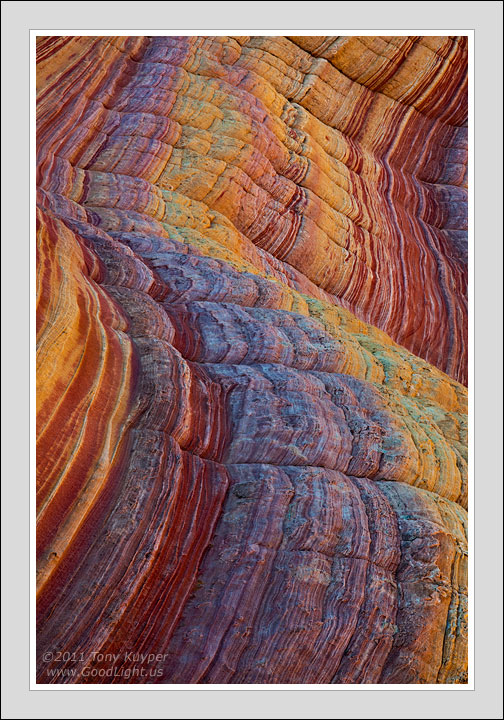
I'm no geologist, but this sandstone doesn't seem entirely normal. My understanding from talking to other geologists is that plain old sand, mostly colorless, piles up in dunes, is buried under additional sediments, and then is eventually lithified (turned to stone). After lithification, various oxides seep through the rock and just small amounts remain behind to add color to what is still mostly colorless grains of sand.
What I think is unusual about this sandstone is how the color is so confined to specific layers in the rock. It's almost as if the color was laid down with the sand layers when they were deposited so that each layer had its own color. I'm no hydrologist either, but this laminar flow of oxide-bearing water would seem somewhat unusual in rock that looks pretty much the same top to bottom, so that's why I wonder if the sand was maybe colored before it lithified.
The only scenario I can imagine is that maybe these now horizontal stripes were once vertical stripes. Oxide-rich water was simply pulled downward by gravity to produce vertical lines of color, and these vertical colors were eventually shifted horizontally through some layer-shifting process. Still, the natural capillarity of sandstone would seem like it would cause these lines of colors to be much more spread out as they penetrated to deeper layers. Although, under significant pressure of the additional layers above, perhaps the expected capillarity doesn't exist.
Regardless, it's some seems somewhat unusual and causes me to wonder how it got this way. Part of me likes to believe that it might simply be magic, but if someone knows what's going on here, I'd like knowing more about it.
Simple though the comp may be, this turned out to be a surprisingly difficult image to finish, and even now I'm not sure that I have the balance of brightness, contrast, texture, color, and saturation right. I'm somewhat frustrated that the Internet version is lighter than the actual print. I added a Multiply layer at 10% opacity to darken down the PS version for this jpeg. If this looks a little dark, that's possibly why, but, at least on my monitor, it matches the lighting in the print pretty well.
Your thoughts and recommendations would, as always, be most appreciated.
5D2, 28-200@92mm, ISO 100, f/16, 1/8 sec, 7 exposures blended with Helicon Focus.
(Repost below is hopefully improved.)

Comments
41 commentsAs soon as saw this picture I thought, this is Tony Kuyper's pictures, and I was right
Your pictures are pretty good
nice colors, perfect composition, etc
thanks for sharing your pictures
My guess is that these layers would have been laid down horizontally over a long period of time. given the location, water mixed with specific minerals and the seepage you discussed would be responsible for the variation in colors. But the depositional environmental conditions may have changed through time as each layer was developed that gives them there distinction. With uplift etc, the sedimentary strata, are bent or curved as a result of permanent deformation of siltstone/sandstone that produced such photogenic creations such as your capture.
I love the lines and colors! excellent focus blending.
Peter
One of your best IMO. Nice.
I too have had a strong interest in geology over many years (how can you not when you do the work we do) and got to talking with a very reputable geologist (and class and field geologist and works with Stanford U) out at that location I have been shooting a lot lately (you know - w the brain rock...
Youssef Ismail: "The small sliver of darker stone in the upper right traps my eye." You know, I see these things in others' images too and completely missed it in mine. I've skewed it off and prefer this for the very reason you mention.
Tom Dobrzanski: "Yes it is a tad dark." I nixed the multiply adjustment layer on the jpeg. I like this better on my monitor too.
The work is absolutely awesome as what you have brought previously
Well done
Nick Bristol
Lone Rock, WI
repost is wonderful. magic, even.
I really like the colors and comp here. Nicely done. By the way, I am a geologist, but this is not my area of expertise. If I remember right, the various colors are the result of minerals deposited with the sand. The sand is deposited in horizontal layers (or cross bedded if it is dune sand). Various minerals produce different colors. Red, pink, and yellow is the result of iron. Mica and manganese produces green and purple, respectively. As the minerals are exposed to the elements, they oxidize to produce the various colors.
I my honest but non-technical opinion each layer and color records a different depositional event, under different conditions and with different minerals carried by dust and water contributing to the banding. As conditions altered the color changed. This is on a macro scale but you can see somewhat of the same structure in agatized nodules with banding some just shades of white, and some fantastically colored like this. I see your theory has affected your POV as I believe this is tilted. It's still nice despite the orientation. I see Rudy's previous reply echoes some of my thoughts.
Paul
Sorry I'm no geologist but I am a rockhound and have read up on sedimentary formations and of course how agates and jaspers are formed.