Lizard Series – Part V
by Ashley Vincent
Canon EOS 7D, EF 500mm f/4L IS USM, Aperture Priority @ f/4 (1/640 sec), +1 EV, ISO 640, Lens Supported by Backpack as I Lay on the Ground, JPEG from RAW, Full Frame
Subject: Water Monitor
Location: Lumpini Park, Central Bangkok
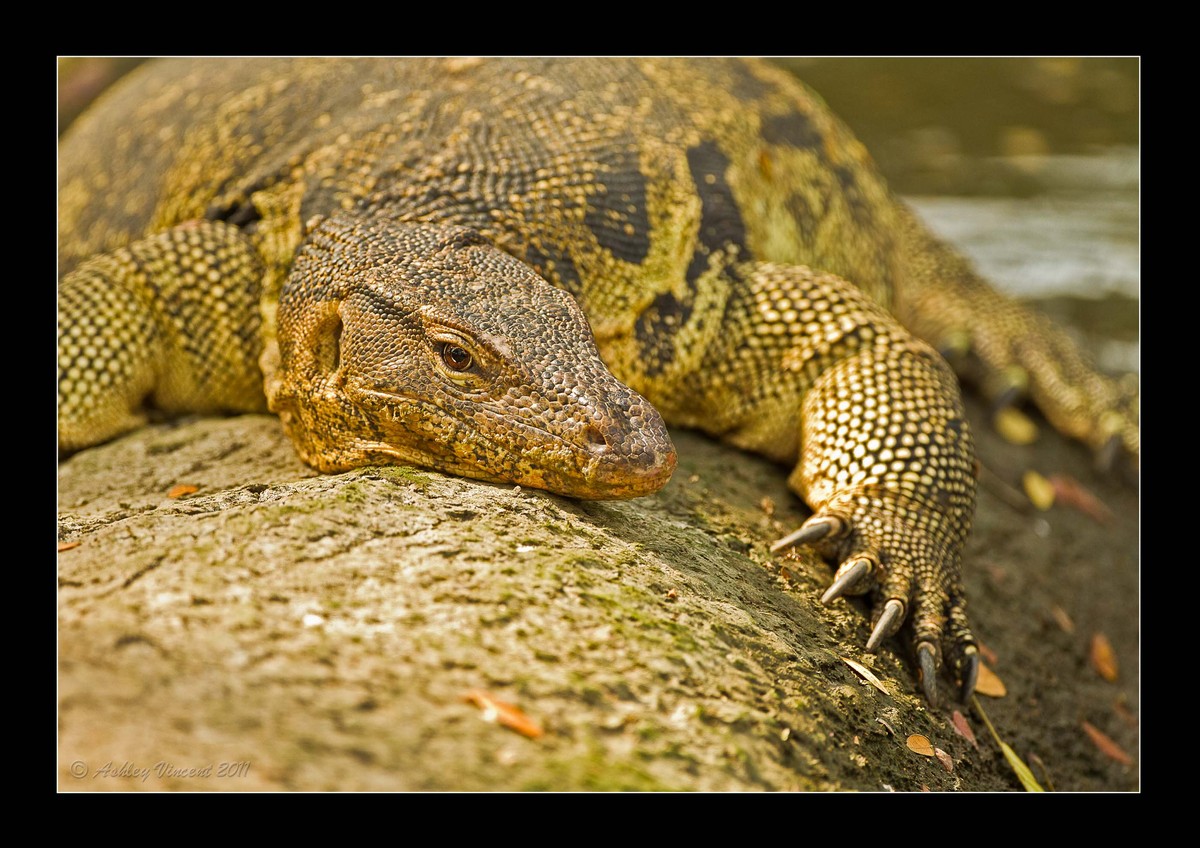
With this final picture in my current series I've taken you from the smallest Lizards I have on file up to the largest. Some of you may recall seeing several other shots I've posted here of my favourite Water Monitors, but for those that haven't, let me just say that although these Monitors are found in a park that attracts many daily visitors, they are not captive in any way; they have complete freedom to roam the walkways and grassy areas, where one can often see them, though most prefer to stay in or by the waterways that skirts a part of the park.
I spent many hours at the end of last year with these wonderful reptilian creatures, observing and photographing them. By my estimation there are easily 40-50 of these Monitors, going by those I counted on one occasion just by walking near to the water, but likely there are more, seeing as it's not uncommon to spot one suddenly poking it's head out of a hole in the ground or looking down from the branch of a tree above.
Depending on age, they come in all sizes and the one above was perhaps the largest I've seen there, probably about 5-6 feet in length, although I understand that adults can grow up to 10 feet!
Being that they're so used to seeing people around, one can get much closer to these than one might be able to with others in more natural environments, but they too have a comfort zone and will quickly move off (usually into the water) if they feel you're getting too near. This behemoth, however, wasn't didn't appear in the slightest concerned by my relatively close proximity, in fact, judging by it's demeanour I think if I'd chosen to crawl closer I would have been the one quickly jumping for safety by the next move made ;^)
Critique and comments always welcome :^)

Comments
4 commentsAs I wrote in the shooting date above, this is actually full frame. While I appreciate where you're coming from with your remarks and preferences, my objective when shooting this subject was to get it looking pretty much like you see it here; I wanted just enough of the body showing to give the impression of it's relatively gigantic size, while not wanting to include it all allowing it to dominate more of the frame.
I liked (and still like!) the amount of foreground as I wanted to include the subject's left arm and claws, leaving enough room between the bottom edge of the frame and the tip of the lowermost claw. I also liked how this situated the subject's eye in the composition.
The only thing I'm not completely happy about and would like to change if I could (which obviously I can't) is the aperture setting, as I would have preferred to have the arm and claws in sharper relief as well as less of a sudden drop off in focus from the back of the subject's head to where one sees the back of it's neck. Something I will no doubt remember should I find myself in similar situations in the future ;^)
Interesting shot of an interesting subject. I tend to be with John on this one - not my favourite Ashley Vincent shot. Two things don't work well for me - and both could be remedied by the same solution. First, the out-of-focus zones don't work too, too well for me on this - particularly the out-of-focus foreground zone on the rock (to me it's a bit of a distraction and doesn't add to the image). Overall I think the proportion of in-focus elements is a little too low. Second, it's my opinion that there's a danger zone when cutting off parts of a critter - if you do too little (most refer to it as "clipping") it looks like an accident. I think at least parts of this image look like clipping - the hind left foot is the best example.
What would work better for me visually (and I know your goal isn't to please me - just stating my personal preference) would be to simply crop the image tighter and increase the emphasis on, and the predominance of, the tack-sharp head region (with the front left leg as a supporting element). If you did choose to use a tighter crop the hot spots on the front left leg would become more noticeable and may require some "toning down" (I don't think they're a problem in the current crop).
Cool experience in what sounds like a great place to shoot these guys...one could have a LOT of fun there!
Cheers...
Brad