The Nature of Distractions (AKA - A Shy Forest Denizen)
Yep, I know you've all been inundated with bear images lately - I was going to hold off posting for a while but this "came up" over the last couple of days and i suspect some of you might find it interesting...
I KNOW this image won't have wide appeal, but I'm posting it in the aftermath of a multi-day debate with someone about the state of the union of modern digital wildlife photography and for a very specific reason. The details of the debate aren't critical but my "opponent" in this academic debate and I obviously have some areas we disagree on - I'm fine with a plethora of post-processing techniques (which I feel can overcome the limitations of our cameras in recording a scene as seen in the field) where he/she is quite firmly against virtually any post-processing of images on a computer. But we have areas where we agree - both of us are uncomfortable with digitally adding objects to an image or digitally removing "distractions" during post-processing. Yet even here we have found something to disagree on! And it comes down to the "nature of distractions" (clever term, eh?). So consider this commentary some food for thought - feel free to add your two-bits worth (and definitely feel free to disagree with me!!).
I'm of the belief that even if a branch or leaf or rock (or whatever) WAS in the original scene and thus could be argued to be a part of "natural environment of the animal" and "showing the animal how it really lives" it can still seriously harm, or even ruin, an image. And it doesn't mean that that stick or leaf has to cross over the subject's snout or one or more eyes to ruin the image and it has zero to do with whether or not the object is in- or out-of-focus. It's my view that if the "offending element" is discordant (or off-theme) from what the photographer is attempting to accomplish with the photo, then it harms the image. It COULD be totally "natural", but if it doesn't fit with the mood or even colour scheme, or if it grabs the viewer's attention first, then it harms or ruins the image.
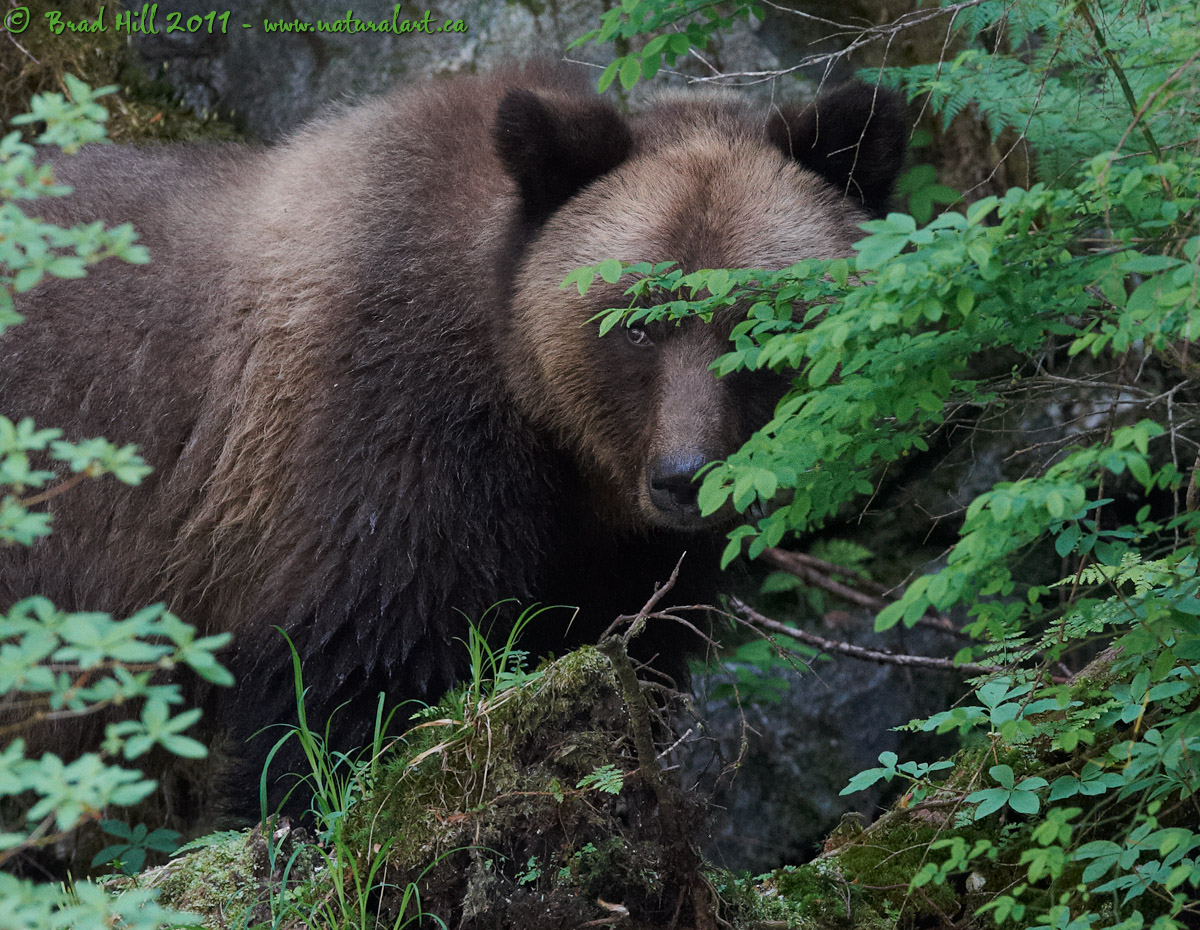
But, to me this doesn't mean that the subject of an image CAN'T have overlapping elements and still work as an image. Take this image (as an example) - I know SOME will automatically discount it because of the foliage that overlaps its head and - heavens forbid - there are even some out-of-focus leaves overlapping its butt! But this was an uber-cool scene - the bear had wandered into the woods and at this instant gave a look which said so much to me (about the shy nature of this wonderful forest inhabitant and about how the bear is actually PART of the forest). In my opinion the overlapping leaves actually HELP this image succeed (at least to those who agree that it works) and it wouldn't be the same without them.
And...one more issue that came up during the "great debate" - it's my firm belief that even if one chooses to handicap themselves by refusing to digitally remove distractions (if they ARE indeed distractions) in post-processing, that's NOT a license to rationalize away things that are true distractions (from the image's goal) just because they are "natural" or "actually were there". It just means that you have a MUCH bigger challenge to overcome during the image capture process - 'cuz you WILL have to compete against others who will have no compunction about getting that clone tool out!
So next time you're looking at an image with a "distraction" in it - look more closely and think about it. Maybe it IS a distraction. But MAYBE it's a critical part of having that image work or achieve its goal and the image doesn't need to be "uber-clean"!
Subject: Female Grizzly Bear (
Urus arctos) "hiding" in its home
Location: Khutzeymateen Inlet - Great Bear Rainforest, BC, Canada
Camera: Nikon D3s
Lens: Nikkor 400 mm f/2.8 VRII lens - handheld from floating Zodiac
Exposure: 1/320s at f7.1. ISO 5600. -0.33 stop compensation from matrix metered exposure.
Crop: MAJOR - this is only about 50% of full frame
As usual, more info about the image (including processing details) available here on my website:
http://www.naturalart.ca/galleries/latest/.
Any feedback welcome - and appreciated - on either the image or the commentary (if it gets too chatty we'll just take it over to "our" Wildlife Forum!).
Cheers...thanks for looking...
Brad

Comments
13 commentsBrad, what you shoot is pure art work...that is obtained thru much computer processing...does that matter? With the enjoyment and pleasure your images, and the other great photographers on NPN, it's just a matter of personal opinion.
Regarding post processing in nature photography: I think what is happening is a convergence of photography and art. It's easy to see that there is now a spectrum of images ranging from those produced using only in-camera processing through those produced with post-processing to those produced as nature digital paintings. It's reflected in the software: Photoshop with artistic functions of all kinds (textures, plug-ins such as Snap Art, etc.). Corel Painter, software often used by artists, with many offerings to photographers directed at converting their images to paintings. Such freedom places the onus on us to decide what we want to communicate: what we saw? something we imagined? something we wish that we saw? We know that a camera sees different than our eyes see. Also, the same scene taken with different camera types will show different scenes. Finally, even human eyesight is variable: what you see is likely different than what I see.
In nature photography, normally my primary objective is to try to communicate what the subject looked like to me. In cloning, I don't like to generate new animal image pixels because I then need to assume what that part of the animal looked like. Most often I've to communicate the true appearance of the environment too. However, that's a secondary objective. Lately, I've broadened my whole attitude: Photo Art can be used to communicate some particular aspect of the subject or even how I felt about the subject. I think we should relax about all this and just welcome and enjoy this new, wonderfully broadened freedom to communicate with images.
Thanks for sharing this image and your thoughts. I don't much mind the vegetation since the 1 eye can clearly be seen and it gives the sense that the bear is trying to "hide" - rather poorly anyway. However, with regards to the rest of the image, I think it's quite flat in contrast, color and a general feeling of "depth". Nothing about the image pops (for me) and as far as your images go, it's rather pedestrian (now if this where mine, I'd be singing a different tune!)
- Luke
Thanks for the quick feedback, a few responses:
1. Jerry: Don't over-estimate what can be done in front of the computer - it ALWAYS starts with a good capture. If one is good behind a computer they can extract the maximum out of what's there, but if it isn't there, it isn't there! At the end of the day, my post-processing is 99% about exposure and contrast adjustments. The actual tools may be different, but not a whole lot different than what could always be done in a darkroom (especially since I'm not one to add or remove things from my images).
2. Steve: Some very good points - I especially like the comment about how everyone should just "...relax about all this and just welcome and enjoy this new, wonderfully broadened freedom to communicate with images." I am fine with folks doing whatever they want with their own images - my biggest issue is disclosure (i.e., being honest about what was done to the image) and not misrepresenting your work.
3. Luke: You know, with all due respect, I think you kind of missed the point of the image. It would be simple for me to make this image "pop"...but bears lurking in the dark shadows of a forest don't pop - and a scene in a thick rainforest doesn't have much contrast or colour. I'm totally fine with the image not working for you, but I think I'll pass on turning this into a happy, sunny scene!
Cheers...
Brad
I agree, and disagree completely with you!!!!!! Where I agree is with everything you said about this image. I think all the things that would "normally" be regarded as distractions work to every advantage with this situation, and composition. Absolutely critical to the message this image conveys. I think, and it's just my personal opinion, that any attemp to criticize this image as having distractions would be cliche. I have no doubt that it will happen, and that's another's personal preferance, fine.
Where I disagree is with the thoughts regarding the clone tool in general. If you can walk into a scene, and remove a distracting object, then why not do it digitally, and avoid corrupting the forground with footprints? Or, where a situation absolutely restricts you from being able to do so, why not do it digitally? I understand, it's a personal preferance, that's fine. I don't think adding big moons, or whatever is an ethical thing to do, if it's not disclosed. But, I also don't think it's unethical to digitally remove small distractions, such as small protruding branches into the frame from the edges. Or bits of detritus on an animals fur, or whatever. I do think it should be used with caution, and restraint though. The thought of no digital processing to an image period, is obsurd to me. I'd like to see some of the images from the person you were debating with. I have been getting much better responses to my postings in the Landscapes Gallery over the past year or two. Partly because of what I choose to photograph, and how I compose it. But also partly because my post processing has improved. I can post a better, cleaner image because my post processing has been refined. If someone wants to document nature, fine don't proces the images. If you want to sell images, and prints, you better learn how to "photoshop" at least to make tonal, contrast, and sharpening adjustments. You also may need to know how to work with layers and masks, be able to blend, focus stack, etc... Just my few cents worth!
Chris
Thanks for the feedback - don't think we're disagreeing much at all. For the record:
1. I have NOTHING against post-processing (I'm kinda known as a bit of a post-processing junkie!
2. I have ZERO against others using the clone tool or other means of digitally removing things from an image. I prefer to limit my OWN use of the tool to removing artifacts of the photographic process - like dust spots on the sensor). But I never impose this view on others.
3. I DO think that some nature photographers get a little obsessed with removing any possible distraction in an image and put perhaps a little too much emphasis on producing "uber-clean" images. But that doesn't mean I don't recognize that some objects in an image ARE distractions (I try to exclude them at the image capture phase myself, but I know others do it during post-processing and I'm not criticizing them).
Thanks again...
Brad
I'd like to offer an analogy: Back in the days when I used to pump iron in the gym, one thing I often noted was people either snickering behind another person's back for what they perceived as bad form or workout routines that greatly differed from the type they'd swear were the only ones that produce the desired result, or big, helpful guys that would offer unsolicited advice to anyone they believed was going about things in the wrong way.
What struck me about such practices was that, as far as I could tell, none of these guys ever really bothered to think about (let alone ask) what the other person's goal was in working out. There are any number of reasons someone might choose to work out in a gym from simply wanting to keep fit to developing mass of gigantic proportions, and from wanting to stay in shape to careful working of a particular muscle group to help repair and strengthen a part of the body in a recuperation.
The point I'm trying to make is that all too often I think nature photographers of the "purist" mentality hold the same limited mindset, insofar as they believe that everyone is out to achieve the same result and there's only one correct method of approach, so they choose to either discount or dismiss the efforts of others who are doing things differently either by pushing their opinions too hard or ignoring these people completely, giving no thought to what the photographer is actually trying to accomplish.
One of my primary aims with nature photography is to create images that are so striking, captivating and appealing that some (hopefully a lot!) of people will feel compelled to whip out their wallets and throw money at my feet ... OK, I don't quite see it happening that way, but what I'm trying to say is that I would imagine most people who are interested in purchasing one of my prints won't be professional wildlife photographers themselves, or the type of person that's used to sitting on a panel of judges deciding the winner of a Wildlife Photographer of the Year competition and, as such, the audience I'm aiming to show my work to is the type much more likely to buy an image based purely on their appeal for and enjoyment of the finished article with little or no concern for what work went into it's actual creation.
I have enormous respect for the wonderfully inspirational work of nature photographers from back in the days of celluloid film, all the same, times have dramatically changed, and for anyone hoping to capitalise on their own work these days, with the ever-increasing numbers of people learning so much faster how to use the tools of this trade, IMO you have to learn how to use these tools to their optimum effect otherwise your best images simply won't match up to what's available in the market that holds the most appeal.
I've probably used up at least four-bits instead of the two that Brad suggested ;^) but I'd just like to round off by pasting a couple of thoughts others added that I totally relate to and agree with:
By Steve: "I think we should relax about all this and just welcome and enjoy this new, wonderfully broadened freedom to communicate with images."
By Chris: "If someone wants to document nature, fine don't proces the images. If you want to sell images, and prints, you better learn how to "photoshop" ... "
I don't have much time tonight to write a long rebuttal or reply or rant of any kind here (might return to do so later), but for the most part I totally agree with your ethics as stated in your last post. That has been my modus operandi with regards to post-processing for the last 2 years. I love post-processing and will try my hand at any technique to be able to learn and master it...but that doesn't mean I go an apply it to all my images.
I also don't have a problem with using the clone tool when making an "artistic" B&W rendering, yet I stick to using it for dust spots and the likes in "natural history" images (a category into which most of my colour wildlife imagery falls).
Unfortunately Nature does not always provide us with a clean setting or background. It is really hard to get that and I personally think there is an unreasonable expectation for many nature shots to be that way (avian and wildlife in particular) . Nature is cluttered and really that is one of the reasons I like getting out there, kind of like organized cluttered in an artful way, much different from the clutter inside our houses. I can certainly understand and see that cleaned up images would sell better and that nature photographers who choose to not clean up images are going to have a harder time selling their images until they build up a certain client base that appreciate their work and effort in getting those images in the first place.
Thanks for another interesting post.