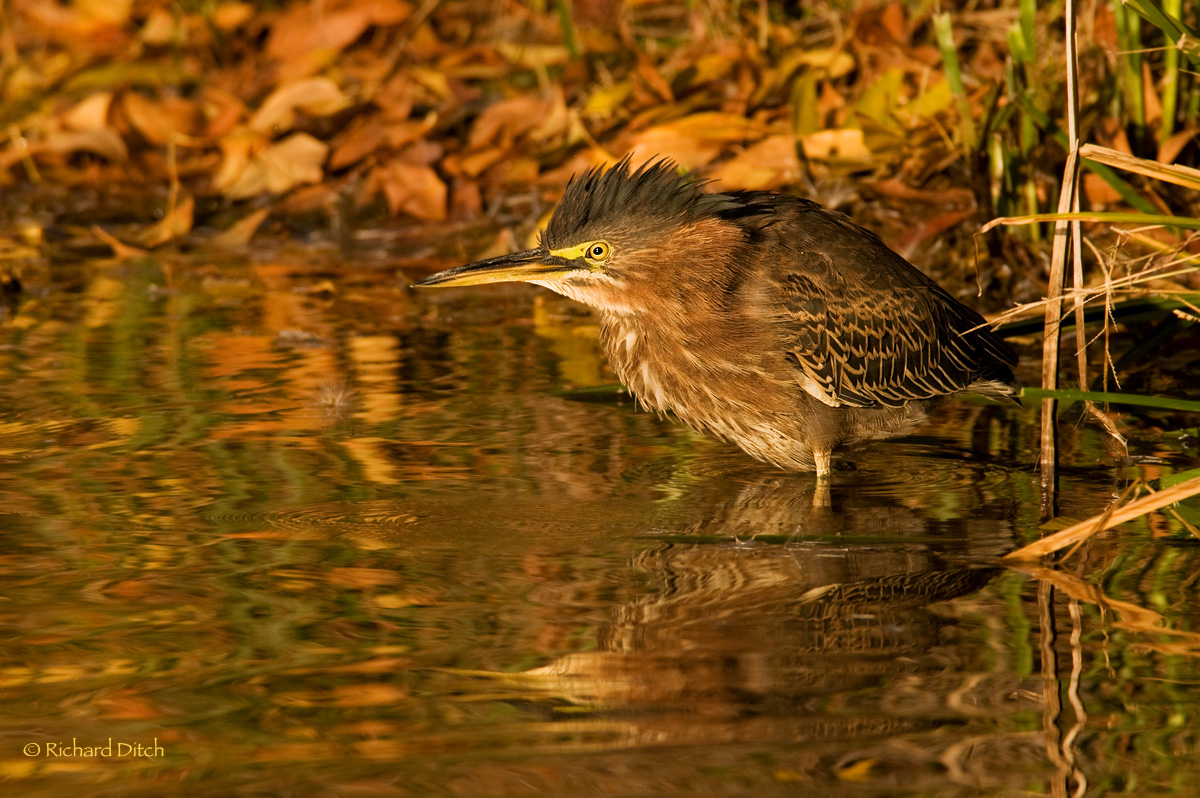
Green Heron (Butorides virescens)
Place: Gilbert Water Ranch, AZ
Date: December 16, 2011, 4:15 pm
Equipment: Nikon D300, Nikkor AF-S 300/2.8, TC20E (2x), G1325, RRS BH-55, Sidekick
Exposure: Aperture priority matrix metered, ISO 400, 1/640th, f/10, -2/3rd ev compensation
Raw, PS CS3 on G4 Mac, 78% of frame
Not baited or set up
Taken one minute before the image I
posted here on December 19. This bird is a regular at this pond although it has only recently become so tolerant.
Honest critiques requested; all comments appreciated. I hope you will view the larger image for maximum impact.

Comments
22 commentsLove the intent look. 78% of full frame shows me this bird is very tolerant. I know you want honest critiques so I would say to tone down the reds, see what it looks like and maybe the yellows if it still needs it. Regardless of the color hew you had some seriously good light. Neat image.
- Peter
The image was made at pond 6. If you park on the south side of the library, follow the paved walk SE and turn right along the gravel path through the first gate, then pond 6 will be on your right. Walk across the tiny concrete footbridge (about two feet long) and find the opening in the hedge that slopes a bit towards the water. You get morning light about an hour after sunrise on the opposite (west) side of pond 6, and in late afternoon get the light form the setting sun on the east bank (where this was taken).
May
My goal with my bird photography has always been staying true to the subject and scene. That's why I don't do set ups, I don't call in a bird with playback of a recording, I don't groom an area I'm working, I don't clone out branches or parts of other birds in the frame, etc. I've always stated that for me nature photos should be natural.
I get out at sunrise, or begin shooting close to sunset (as in this image) because of the quality of the light at those times of day. I also take advantage of the way the vegetation around the place that I shoot reflects the light and adds warmth to the image.
When I took this image I was keenly aware of the golden glow present as it was so much more intense than I expected or had experienced at this pond.
Of course I could shift the color balance and desaturate the image to take out some of the golden glow, but what would be the point of that when it was what I saw and what the camera recorded and one of the main reasons I was shooting late in the day in the first place?
I talk about the effects of the color of light in this post on my blog, showing two shots of a Northern Mockingbird taken 2 hours apart.
Attractive late afternoon light and warm color also.
Great sharpness and environment, well done Rich.
Ray