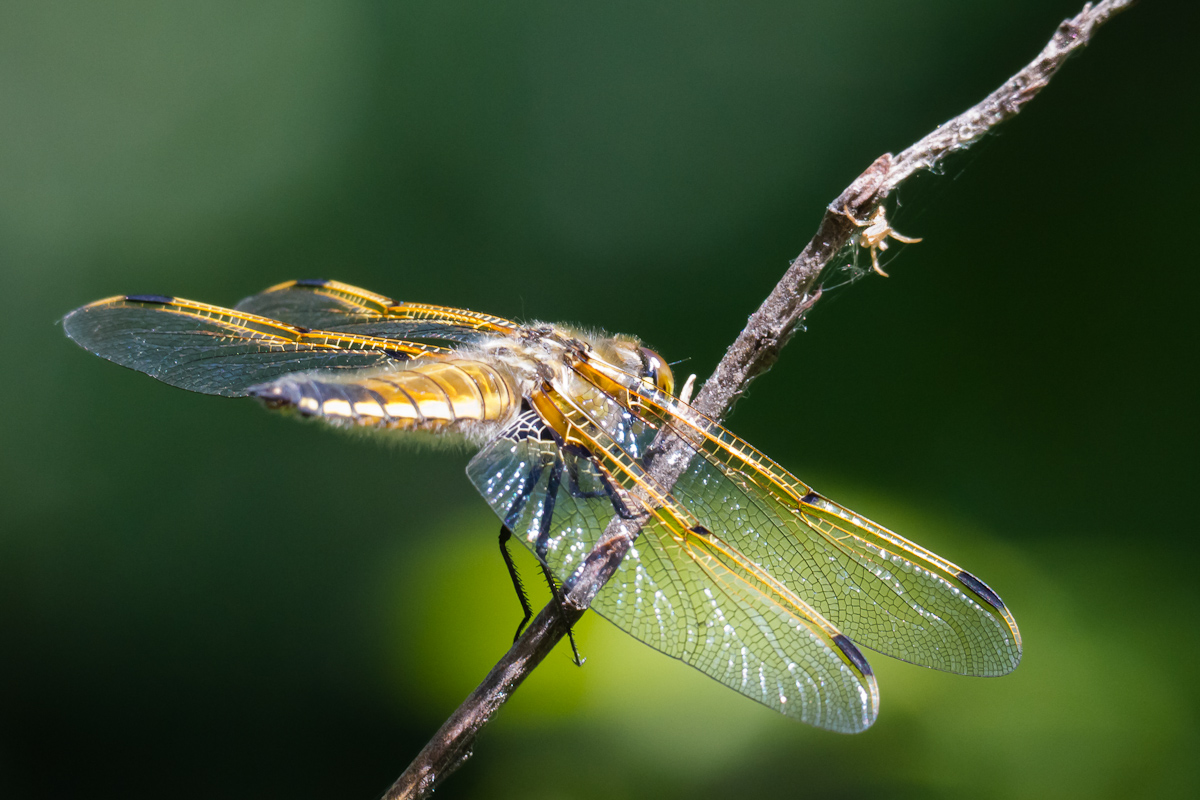
..or bearing UP, rather, on its tiny prey. This is another photo from the same series as my other post. Even though this one shows the back of the Four-spotted Skimmer (Libellula quadrimaculata), I like the POV as it shows the attack. I also like the golden reflections of the sunlight on the wings of the dragonfly.
Canon 7D, Sigma 150-500 at 500 mm, ISO 1250, 1/125 at f/13, handheld, no artificial light, large RAW cropped to 50 %. PP in LR3.
I haven't had a chance yet to go out and try my macro lens

All C and Cs are most welcome and much appreciated. Thanks for visiting. Roger.

Comments
7 commentsI like this. How would we ever see the back side of a critter if all photogs followed those silly rules about what angles are "proper" for photographing animals (especially birds, but also insects and anything anything else with eyes). Some insects can only be identified by seeing those other angles. Keying out dragonfly families often requires a good look at the veins in their wings, and you have done a nice job showing them here. Compositionally, this shot is beautiful, too.
BEHAVIORAL QUESTION: Just looked at your previous post of this DF and read your narrative. Did it actually eat that little spider shell? I'd be interested if you can tell me about it. A dragonfly scavenging would be a highly unusual, as I have never seen any dragonfly stalk anything on foot, especially something that was not alive. In fact, I have never seen one eating anything it did not catch on the wing. Some species, such as most of the skimmers, spend a lot of time perching on twigs, but they spring into the air to hunt. Was it quite cool when you took this? They normally don't fly in cold weather, so I wonder if it might have stumbled on the spider shell and scavenged it opportunistically?
WAYNE: Thanks for all the information about dragonflies. To answer your question, I don't know if it ate the spider. The (other) photo that I posted was the last usable one from the series. I have a couple after it. Then I tried to change position and unintentionally stepped off the deck and landed in the bush. No harm done, but the dragonfly was gone. I have regretted that step more than once. I assumed that it would eat the spider based on the situation. I do not know much about dragonflies at all though I had been wondering how successful a dragonfly could be in getting food by walking up sticks. I did notice that they seemed to prefer dry twigs, on this bush and on another one on the other side of the house. This was a sunny day. I checked the weather record (June 10, 2011): min. 12 deg C and max 25 deg C. The photo was taken at 11:15 am, so I would think the temp was somewhat above 20 deg C. I recall it as being sunny and warm.
Attached is the second last shot from that series (last +/- usable one), very severely cropped. It's quite noisy and unsharp, but maybe the dragonfly's facial expression does indicate whether it intends to take a bite.
The important thing is that you and your equipment survived the fall, AND you still got some very nice shots!
Enjoy that Sigma 150. It's a super lens.