Scram! This One's Mine!
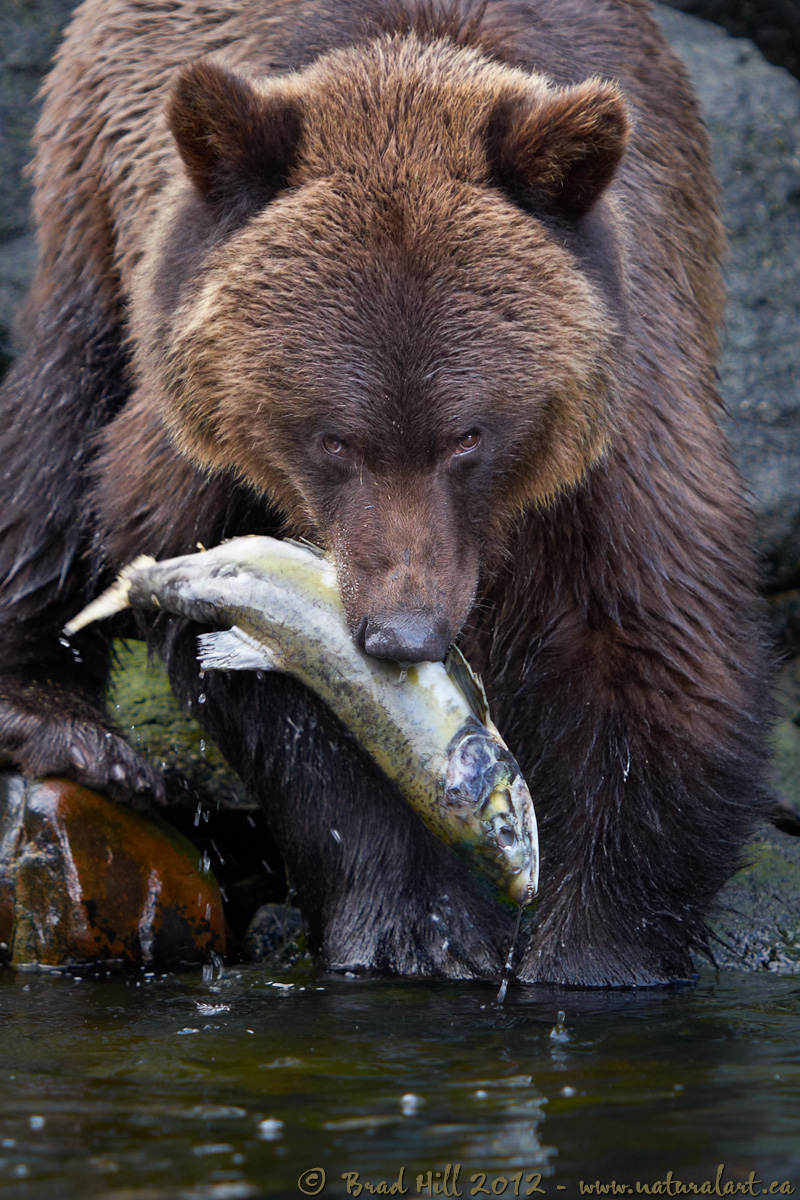
A couple of guys (no names mentioned, but if you guessed Lon and Vincent...) wished my last post was framed tighter, so...guys...this one's for you...
If you've ever tried taking a bone from a hungry dog you'll understand what this looks means! Perhaps if the fish was a little fresher I might have considered smooth-talking the bear out of it (and if you believe that...). And on the note of fish freshness - most know that when salmon are running in coastal streams bears congregate to take advantage of the huge energy bonuses they can accrue by snagging a few fish as they swim by. But the vast majority of fish pass by the bears unharmed, only to die upstream after going through their breeding ritual. When the fresh fish are no longer available the bears (and many other animals, including eagles, sea gulls, martens, and countless species of invertebrates) turn their attention to "fishing out" those energy-rich carcasses. For bears, the calories and fat they accumulate through scavenging the dead salmon can make the difference between surviving (or giving birth during) their long winter siesta.
I captured this image using a moderately-priced camera (a Nikon D7000) paired with a lens that's owned by thousands of photographers the world over - a 70-200mm zoom. Which leads to a question I get a lot both by email and when giving seminars:
If top-notch images can be captured with low- to mid-range DSLR's, why spend thousands more to buy professional camera bodies (and lenses)?
Without getting into the details of comparing specific cameras two generalities explain why I tend toward using mostly top-of-the-line equipment...
1. When the going gets tough... As a professional nature/wildlife photographer I (and very likely most other serious field shooters) often use my cameras in very hostile conditions - rain, snow, mud, etc. And, while I'm quite careful about looking after my gear, at the end of the day they're tools, not jewels. My personal experience is that lower end cameras simply don't hold up well and it makes little sense for me to spend thousands of dollars (and weeks of time) getting to a place like where this image was shot just to have my camera fail.
2. Dramatically fewer limitations in the field. Shooting images of your daughter's birthday party at f8 and ISO 100? Either an introductory level DSLR or pro camera will take about the same quality image. BUT, in a tough field situation the limitations imposed on you by your camera gear - be it ISO performance, frame rate, buffer size, AF performance with a wider variety of lenses, the ability to shoot sharp images wide open at larger apertures, etc. - are dramatically extended compared to "lesser" cameras. It's in tough field shooting conditions where you really see why you spent the big bucks on the pro gear.
Is it worth it for YOU to spend thousands and thousands of dollars for the best-of-the-best gear? That's your call. But don't let anyone say I didn't give you at least two solid reasons to take to your spousal accounting department when you're trying to convince him/her that you just NEED that new "latest and greatest" lens or camera body! You're welcome.

Subject: Grizzly Bear (
Urus arctosi) taking possession of a fish
Location: Great Bear Rainforest, BC, Canada
Camera: Nikon D7000
Lens: Nikkor 70-200mm f2.8 VRII @ 135mm (203mm EFL). Hand-held with VR on.
Exposure: 1/160s @ f2.8; ISO 500. -1 stop compensation from matrix-metered exposure setting.
Crop: This is about 75% of full-frame shot
Additional details about the image (including processing details) available here
http://www.naturalart.ca/galleries/latest/.
Comments and critiques welcomed - probably best to view the larger version prior to doing so!
Cheers...thanks for looking...
Brad

Comments
12 commentsfor me it is great shot, it would looks great in large print!
Anyway,
You asked: "Is there a particular reason you used a 70-200mm lens?"
Yes. At the time I was shooting primarily with a 400mm f2.8 (on a full-frame camera) and had a 70-200 zoom mounted on a cropped-sensor body in a holster on my hip. We were floating in a Zodiac at the time and the current pushed us in at the bear. I was too close to get anything other than eyeball shots with the 400, so I yanked out the shorter focal length set-up and shot with that.
Cheers...
Brad
Little bear? Fully grown adult female weighing in at least 500 lbs. I wouldn't want to call her little to her face...
Cheers...
Brad
Thank you as usual for your wonderful write ups! Even when I am too busy to post my own photos or comment on others I always stop by to see if you've posted anything new. And, as usual great shot! I for one am often a fan of your shots that aren't cropped as tight (sorry Lon and Vincent!) but still think this works quite well! I'm still waiting for the day I can get close enough to shoot a full frame photo of a bear at 200mm! Haha keep up the good work, and thanks again for your writing, whether as background to your own photos or as helpful comments for others!
-Cam