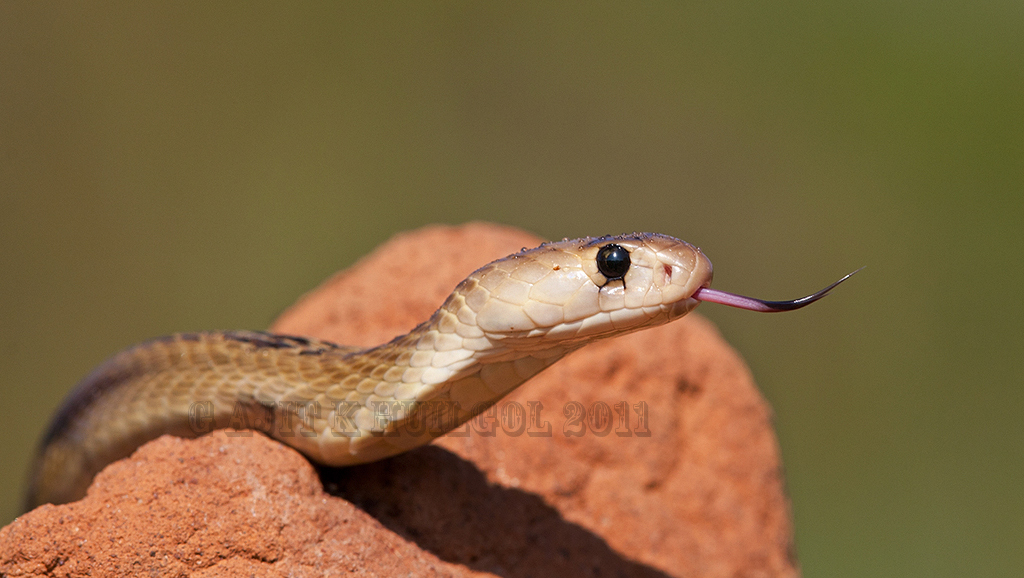
Baby cobra on mound
by Ajit Huilgol
The cobra is one of India's Big Four as far as human deaths from venomous snakes are concerned. It is estimated that about 50,000 (yes, that is correct; fifty thousand!) people die from envenomation from snakes in India every year! Cobras reside in and near human settlements because the latter attract rats, which in turn attract snakes. Consequently, snake rescuers are much in demand in and around even big cities, like Bangalore (where I reside), which has a population of about 9 million! The specimen seen in this image was one such snake rescued from a home in the city and released in the wild. I went along with the rescuer (he had 5 snakes, all venomous, in my SUV - so, there's no closed boot to keep the snakes from entering the main compartment of the vehicle!) for the release. Since the snakes were all captured a couple of days before the release, they were probably a little dehydrated and welcomed the spray of water from my garden can. You can see the water droplets on the snake's head.
Species: Indian cobra (Naja naja naja)
Location: Near Bangalore, India
Date: Sept, 2011
Equip: Canon 1D Mlll, Canon 300 f2.8 lens
Specs: ISO 400, f5.6, 1/2000s, hand-held, standing a few feet away from the snake
Thank you for taking the time out to look, and for your comments/critiques.

Comments
10 commentsThanks for the very interesting background on cobras.
Nice capture - head and flicking tongue are tack-sharp, and the shallow DOF nicely blurs the rest.
Sandy
Simple, clean, and technically very sound - this one works well for me. And love the tongue - good timing on catching that.
Really enjoyed reading the background info here - very interesting. I'm pleasantly surprised that with such high human mortality that the rescuers relocate (rather than just exterminate) the snakes.
Thanks for sharing both the photo and the info...cheers...
Brad
I wouldn't transport 5 snakes in an SUV even if they were contained