Tern + Reposts
by Steve Balke
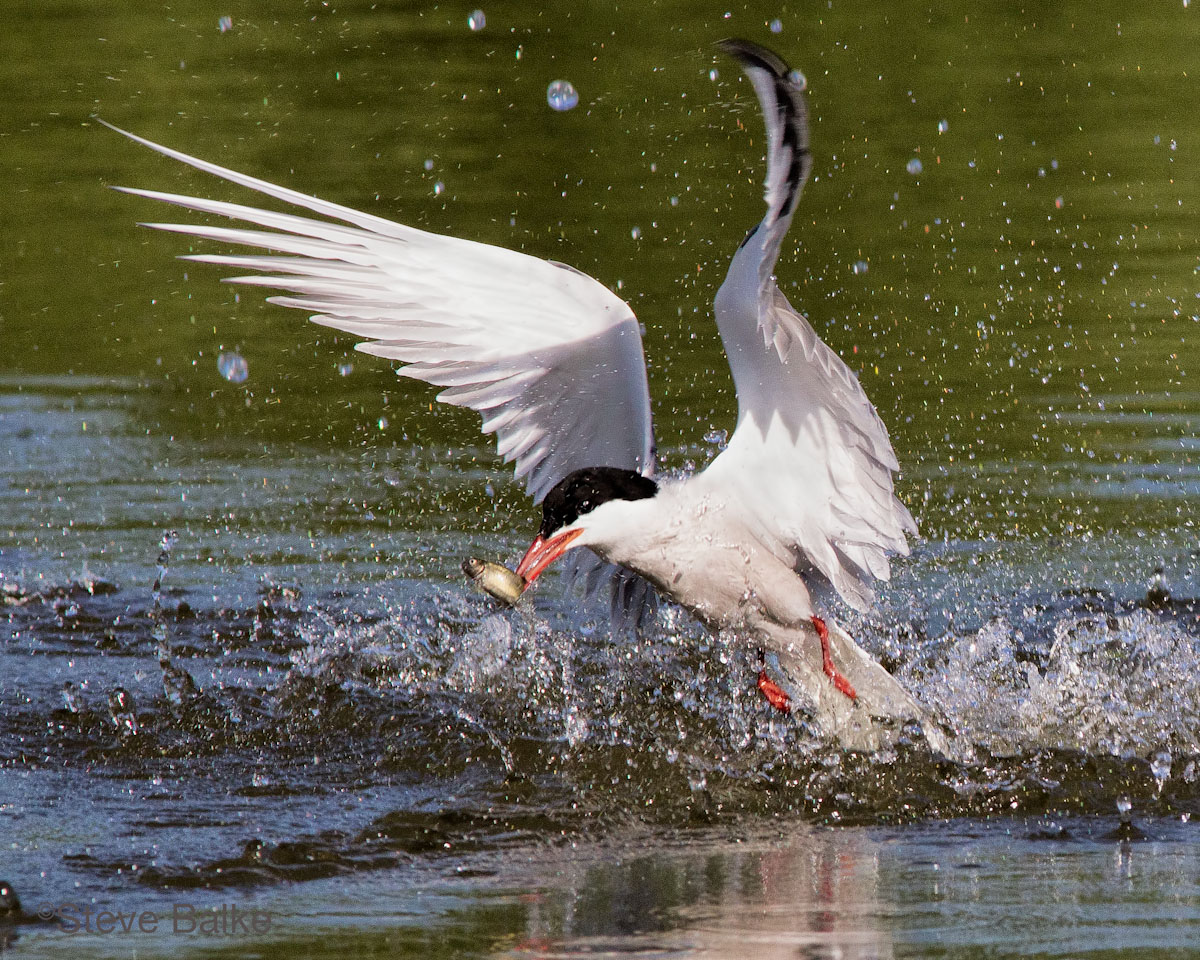
Last month there happened to be one lonely common tern fishing in a small pond near my home. I decided to try for a flight shot. This image is the best of a small number that I managed to obtain before the bird was full with fish and moved on.
I like the action in this shot. I was just lucky to guess about where the bird would dive next.
All comments welcome.
1D Mark IV, 400 mm f/5.6, 1.4x TC, hand held: ISO 1250, 1/2000s, f/13, -2/3 EV (Shutter Priority, image is 4.6 MP (29% of the 16 MP of the 1DMk4….a smaller crop would be mostly splashing water!), minor NR, exposure adjustment, sharpening).

Comments
29 commentsThere IS quite a bit of noise in the BG, including red blips.
Sandy
Really great picture. I have the same issue as you but mine is red / green so I did not pick up on it either. I am also hesitant to post here just because of this reason. But it is a really great action picture
Rich
Impressive, This kind of photo is as much about 'Right Place, Right Time' as anything else and staying cool under fire is very important. The excitement from looking at this pic could only be a fraction of what you felt behind the camera.
Ken Archer
i. There is likely not a serious color noise problem here. The colors that we see are droplets refracting the sunlight. The droplets often appear elongated because they are travelling faster than the 1/2000 s shutter speed.
ii. There is slightly more luminance noise that I am accustomed to seeing. It probably is sufficient to warrant another NR run. It's possible that the original Denoise 5 algorithm was less effective than usual because of all the droplets present.
iii. I want to be careful to not remove any droplets, colored or not, with NR.
iv. Two methods of implementing NR were suggested. Keith mentioned Dfine. Roger proposed something new to me, using Viveza to "destructure" the noise.
v. I tried both methods of NR suggested. I concentrated only on noise in the bg using masking as Keith suggested. Because of the dispersion of droplets that I wanted to leave unchanged and since both Dfine and Viveza have the control point technology, I just used control points to effect the mask.
vi. The original, the noise reduced original using Dfine and finally the noise reduced original using Viveza all as 720x720 pixel images and 1:1 viewing are shown, in turn, with this comment and below. As might be expected we see that most noise was reduced using Dfine. Dfine is such a powerful program that I could likely have made the bg as "smooth as a babies bottom". The idea here though is to obtain an "acceptable" level of noise and not a plastic look. I think I like the Viveza method more here. It did smooth out the noise to an intermediate degree and was less likely to remove sharp edges on droplets.
That was fun! Let's see if these conclusions hold up over time. Eventually, I'll submit this image in some local competition. At least now I'm prepared for the judges mentioning color noise!
The noise is definitely a problem. Comparing your first 1:1 sample against a 1:1 sample of my own Hermit Thrush shot at ISO 1600 (see original posted version here shows that there is a great difference between our work flows. The "reticulated" pattern that is so apparent in your 1:1 sample makes me think you are shooting in jpeg rather than raw and we are seeing the results of in-camera processing.
Do you shoot in raw or in jpeg?
I'm not sure what the point is that you are trying to make with this statement. Shutter speed and aperture have nothing to do with noise in the image. Noise comes from:
1. ISO (higher values produce more noise than lower values for any camera)
2. increasing exposure in raw conversion (bringing up the shadows makes the noise more prominent)
3. cropping (effectively enlarging the noise)
4. sharpening (increasing the edge contrast of each noisy pixel)
Yes, you could have shot at a lower ISO with the corresponding slower shutter speed and/or wider aperture and had less noise. But the noise reduction would have been from the lower ISO setting and not from a slower shutter speed or different aperture.
Any time you use noise reduction you are also reducing fine detail where the NR is applied. Making a good selection takes more time, especially in a complicated image such as this (what would you do about the splashing water - include it in the selection or mask it off for the NR?).
Better to get the image "right" when you take the shot rather than try to correct faults after the fact in post processing.
When we "bring up the shadows" we are seeing the noise that is present in the shadows as a result of the relatively small amount of light striking the sensor. When we view noise at 1:1 we are seeing what is there independent of cropping. Sharpening may increase the definition of noise but does not increase the amount of noise.
No.
It doesn't matter how the amount of light reaching the sensor is determined - it is independent of aperture and shutter speed. low light with long shutter speed and wide aperture is indistinguishable from brighter light with a smaller aperture and shorter shutter speed by the sensor. All that matters to the sensor is the total amount of light reaching it.
When you increase the ISO for a camera you are turning up the gain, just like turning up the volume on a radio. Turning up the gain inflates the count of photons recorded by each photosite on the sensor. But it also increases the number of false readings - the noise in the image. This is a classic example of signal-to-noise ratio - the higher the ratio the less effect of the noise. When few photons strike the sensor the S-to-N ratio is low and the noise becomes more like the signal (image detail). When you use the lowest native ISO of the camera you are getting the lowest degree of gain and the noise is not being amplified as the sensor tries to make fewer photos look like more photons. This is why noise is most noticeable in the darker parts of the image. In the lighter parts of the image the Signal is much larger than the Noise level and dominates the value recorded by the photosite.
When we turn up the ISO setting from the lowest native value we are are under exposing the image and turning up the gain on the photosites to artificially inflate their reading of photons. Where the subject is light the photosite registers enough photons that the S/N ratio is high enough for the information in the image to still dominate the noise. But where the subject is dark we are cutting back the number of photons recorded by the photosites so that their value is about the same as the inherent noise; turning up the gain for these dark photoshites means that we inflate the noise values about the same degree as we do the recorded detail.
Yes. This is the same in raw conversion and post processing as cranking up the ISO in the camera to compensate for under exposing (recordin fewer photons).
Yes. But when we crop we end up using less of the original image for our final version and make the noise more obvious by using less of the detail (Signal).
Sharpening works by increasing contrast between adjacent pixels. The controls we have in typical sharpening panels let us control how much we increase the contrast (amount), over how wide an area we blend the contrast change (radius), and how much difference has to exist between pixels before the software determines there’s an edge that should be sharpened (threshold).
It is easy to take adjacent pixels that are not different enough to look like noise in an unsharpened image and increase the contrast enough to make the difference visible, and thereby create more noise in the image.
The major point here is that, in considering the cause of noise level in two images, we need to take into account iso, shutter speed and aperture settings. Just comparing images of the same iso is not a fair comparison: we can't just blame the difference in iso for the noise we see. I think that is the important, practical point that results from this discussion.
The main thing that launched this exchange was that you earlier said that "Shutter speed and aperture have nothing to do with noise in the image." You are now saying that different combinations of shutter speed and aperture can result in the same amount of light falling on the sensor. That's now something that I agree with and, please note, I did not say anything different than that in my previous comment. Also, you are now saying that the amount of light falling on the sensor is pertinent to noise. Again I agree.
I think we're pretty close on the viewing of noise at 1:1 but I would say that both detail and noise are shown accurately at 1:1 before and after cropping.
The sharpening question is becoming more clear. We can get into characterization of noise and what do we mean by the amount of noise: a few big specs or many small ones for example. However, I think that the important point here is that noise can become more apparent because of sharpening whether we want to say there is more noise or just more clearly visible noise.
Not even close as far as I can tell. :-)
As I stated twice previously, the shutter speed (SS) and aperture (F#) are completely irrelevant to the noise level - only the ISO matters.
If SS and F# mattered then you could increase or decrease the amount of noise at a given ISO by varying the SS and F# while keeping the Exposure Value (EV) constant.
If SS and F# mattered then you could change the amount of noise by adding a neutral density filter to the lens and changing SS or F# to compensate for the light lost to the ND filter.
If SS and F# influenced noise in the image then camera reviews would plot the results of noise vs. SS and vs. F# in their tests, instead of only showing noise vs. ISO.
Yes, I said that (twice before) and I am saying it again here.
That’s the way exposure works - as long as you maintain the same EV by changing SS by an equal but opposite amount to a change in F# the same amount of light reaches the sensor. F/16 at 1/100th second and ISO 100 is the same exposure as F/8 at 1/400th second at ISO 100. The sensor sees the same amount of light, the photosites record the same number of photons, the Signal/Noise Ratio remains the same for the shadows and remains the same for the highlights, and the noise remains the same.
What you said that started the discussion of SS and F# was: “I note that in your example your shutter speed is only 1/320 s to capture a static bird at iso 1600 at f/8. This is iso 1250 but 1/2000 s and f/13.” The only conclusion I was able to draw from that statement was that you thought SS and F# had an impact on the noise in the image, and that’s why I said I wasn’t sure what point you were trying to make with that statement. If that wasn’t your point then please explain to me what you meant.
The amount of light falling on the sensor is only pertinent to the noise in how close it is to the inherent noise of the sensor and how much gain is applied (ISO cranked up) to compensate for under exposure.
As long as we are looking at the 1:1 views then cropping doesn’t change the amount of noise visible. I never said that it did.
What I did say was that the noise will be more prominent in the final image from a cropped section of an image than it will be in the same size final image from the full frame uncropped image. If you make two images of the same subject, with the subject taking up 80% of the height of the full frame in the first and only 40% in the second, and you crop the second image by 75% (cut the height by half and the width by half leaving one quarter of the frame) so that the subject now takes up 80% of the cropped frame, then the noise will be more obvious in the cropped version than the uncropped version for the same sized final image.
Finally, I think we are in basic agreement on at least this point. And I hope we can leave it at this point as this is wasting far too much of my time and energy.
http://photo.tutsplus.com/articles/post-processing-articles/quick-tip-the-real-secret-to-avoiding-noise/
http://www.pcworld.com/article/160917/reduce_digital_noise_in_your_photos.html
Looking at our discussion, I think that "what we have here is a problem in communication". At this point, I'm more than willing to leave it to our patient readers to come to the right conclusions.
I got up nice and early this morning. So, I'm now off to try to get some nice low noise images (by controlling both exposure and iso, of course....)
As is the healthy & informative debate I see unfolding here.
One day in the not too distant technological future, noise will cease to be an issue.
Hard to believe but true. The downside's all this type of discussion will fade away..
But where's the fun in that?
Well done & have a great week