Touching the Void
My apologies to Joe Simpson for co-opting the title of his excellent book for this image...
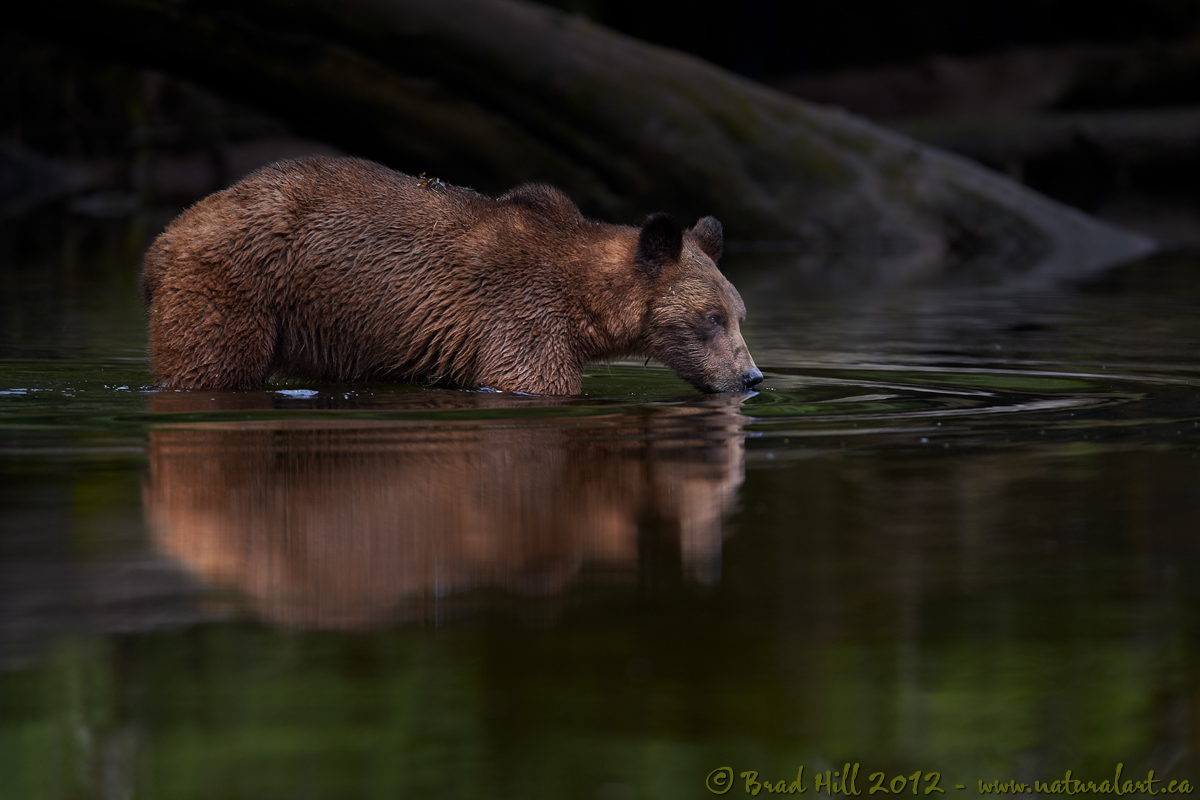
As a terrestrial being who limits most of his aquatic activity to the surface region of waters, I always think of the depths below as mysterious "voids" that may contain...well...most anything my imagination can conjure up. Bears, in contrast, seem to have no such reservations and they just wade right in! When this female grizzly lowered her snout and kissed the water's surface (and her reflection) it was - at least to me - a particularly evocative moment in time. It was like she was "touching the void". I felt fortunate to be there to record it.
Posting a dark, moody image like this in a digital format (i.e., online) has some risk to it. A key to this image is the soft, delicate - and somewhat nuanced - lighting striking the bear. The brightness of the display of the device used to view this image will make a large difference to how this image appears, which is totally out of my control. But I do have a suggestion: if the lighting of this image doesn't appear "right" to you, simply change the angle of view (tilt) of your viewing device to suit your taste. And there you go - your own custom image!

I've heard many people say that photography has gotten "easier" since it has gone through the digital revolution. This is probably true for the "snap-shooting" public - they can capture images with their compact cell phones that in many ways surpass the quality of what they usually captured with their 35mm SLR's. And today's digital images are certainly easier and more convenient to share than their old print or slides were.
But some serious photographers - from virtually all the various disciplines of photography - have struggled with the transition to digital photography. On one hand, the bar has gotten FAR higher - we can now capture images that couldn't have even been considered a few short years ago. And, on the other hand, the processing of images is no longer something you normally "hand-off" to a faceless lab - it has fallen squarely in the lap of the photographer. There were, of course, always SOME photographers who processed their own images (Ansel Adams might come to mind). But for the majority of nature and wildlife photographers the process functionally ended the moment they released the shutter. Inheriting the processing of the images is something that many nature photographers have been reluctant to accept (often because they simply don't enjoy sitting in front of a computer). But those relatively few nature photographers who have chosen to "dive right in" (into the void??) often end up with the ability to regularly produce images that far surpass those less comfortable with "pushing pixels" around. Yes, image capture is critical (Garbage In, Garbage Out), but for many images the processing is just as important (and sometimes MORE important) to the success of the final image.
And...those who REALLY get digital and pay attention to their processing soon realize that what they've learned behind the computer can affect the way they capture their images. This image is a good example of what I mean. When capturing this dark scene I was keenly aware that I had to under-expose the scene fairly dramatically - if I let the light meter attempt to produce a "neutral gray" scene on this one the critical lighter regions on the bear's snout and nose would have been completely blown out. But, because of my past experience behind the computer processing D4 files I knew I could use a variety of digital techniques to draw out the shadow details and work the mid-tones on the bear to return this scene to how I perceived it in the field. If I hadn't had this experience it's likely I would have refrained from under-exposing the image to the degree I did and would have risked blowing out the highlights, which would have pretty much killed the shot.
Just some MORE food for thought (sorry if I've over-filled your belly, Ajit
).
Subject: Adult female Grizzly (
Urus arctos) wading right in
Location: Khutzeymateen Inlet, Great Bear Rainforest, BC, Canada
Camera: Nikon D4
Lens: Nikkor 400mm f2.8 VRII lens - hand-held. VR on and in "Normal" mode.
Exposure: 1/400s @ f4.5; ISO 1250. -1.67 stop compensation from matrix-metered exposure setting.
Crop: This is about 90% of the full-framed image.
Additional details about the image (including processing details) available here:
http://www.naturalart.ca/galleries/latest/.
Comments and critiques welcomed - definitely best to view the larger version prior to doing so!
Cheers...thanks for looking...
Brad

Comments
11 commentsI especially like the low key look, reflection, and overall mood the shot conveys..
Great moment, great title as well.
Have a nice weekend!
Interesting read as ever, like the thinking behind the image. Off to play with the 1Dx
TFS
Steve
Thanks for the feedback no this one. It was a nice scene to watch unfold, but that doesn't always translate into a good image!
Steve: You mentioned about the levels and adjusting the white point (to match the brightest tones in the image). Agreed that it totally changes the image, but that change moves it away from what I was hoping to convey with it. On the pano crop (presumably removing some foreground) - considered it but simply (and quite subjectively) preferred this crop (which is very minimal). I think (but can't say this definitively) that going to a symmetrical or near symmetrical crop - which is pretty much the only way I can get to pano - raises the reflection in overall dominance a little more than I wanted...
Cheers...thanks much for the considered comments...
Brad
Exactly Brad, the look & feel gets away from the OP look & feel you wished to convey.