Testing the Waters...
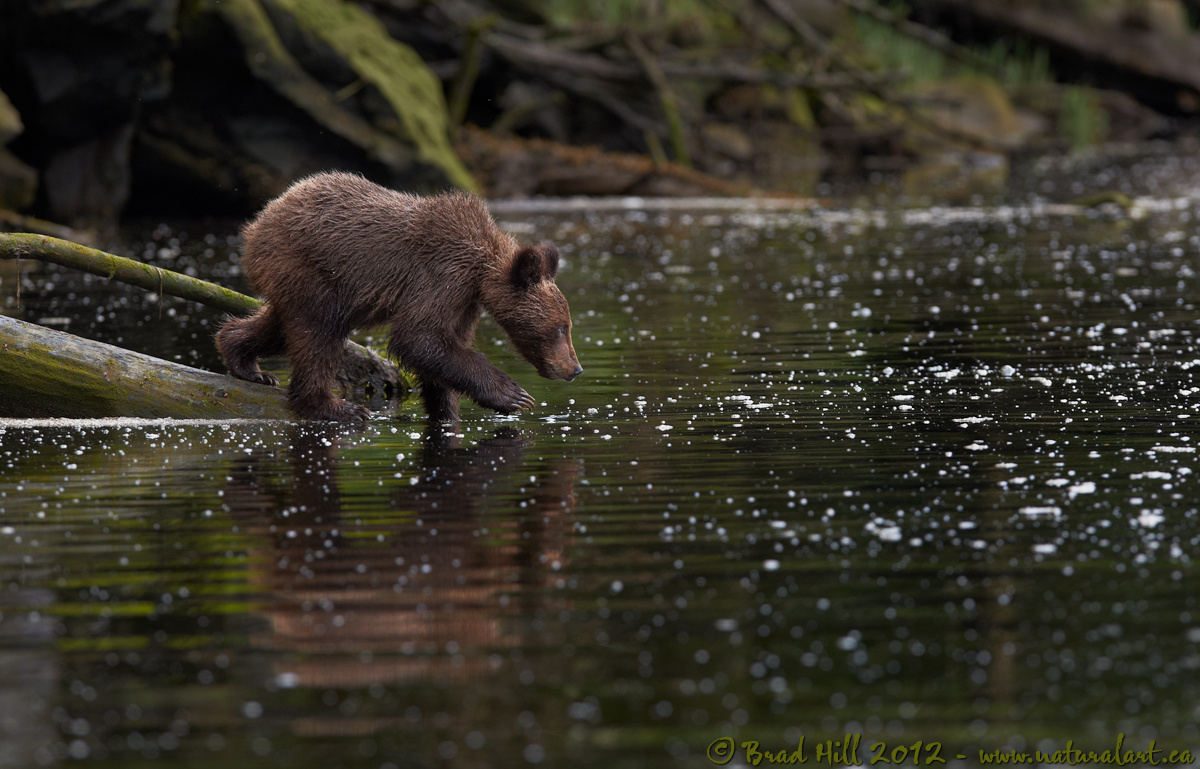
Adult grizzly bears take to water almost like a duck. Cubs, on the other hand, can often show some reluctance to wade in or swim. This yearling grizzly cub had watched its mother walk down this makeshift ramp and swim across this estuary channel and knew that if it was going to stick with mom it had no choice but to follow. But that didn't make it any easier - it waded in almost as slowly as someone not wanting to get their...well...you know what...wet! I felt lucky to capture this cub just as its right paw (and those great claws!) were just about to be dunked! I could have lived without all those white speck in the water (a mix of bubbles and the fluff of cottonwood trees), but c'est la vie...
One of the most under-emphasized aspects of capturing interesting wildlife images is the importance of capturing your subject at JUST the right second. In this shot having that paw about to enter the water adds something visually AND to the "story" conveyed by the shot - if that paw was already submerged it would be much less clear what's going on (i.e., that the cub was moving forward and about to cross the water).
And, there are both equipment-based and user-based parts to the issue of capturing images at just the right moment. On the equipment side of the equation, having a camera capable of high frame capture rates is virtually indispensable for "serious" wildlife photography. How high? Well, it depends on what you like to shoot - but if it's birds in flight or actively moving mammals, the higher the better (to a point). I've been reasonably happy with cameras that shot 8 frames per second (8 fps), but do find that shooting at 10 or 11 frames per second is, not surprisingly, noticeably better (and increases the probability that your capture is at the exact right moment). At 5 frames per second or slower capturing action at just the right moment becomes increasingly unlikely.
But...the behaviour of the camera operator is just as important in capturing those "just right" moments. Although it may sound counter-intuitive, using your camera like a machine gun and keeping it going full-time is often the worst approach. You may THINK you're capturing everything (and thus missing nothing), but the reality is often the opposite. Instead, I find it more productive to closely watch my subject, anticipate what it's going to do, ignore the stuff I'm NOT interested in capturing, and then shooting a burst as the subject starts doing what I hoped it would. The burst lengths are rarely more than 1/2 to one second long (so about 5 to 10 images or so, assuming I'm using a 10 fps camera).
Subject: Grizzly (
Urus arctos) cub about to "take the plunge"
Location: Khutzeymateen Inlet, Great Bear Rainforest, BC, Canada
Camera: Nikon D4
Lens: Nikkor 400mm f2.8 VRII lens - hand-held from floating zodiac. VR on and in "Normal" mode.
Exposure: 1/400s @ f5.6; ISO 800. -0.33 stop compensation from matrix-metered exposure setting.
Crop: This is about 75% of the full-framed image.
Additional details about the image (including processing details) available here:
http://www.naturalart.ca/galleries/latest/detail_6.html.
Comments and critiques welcomed - probably best to view the larger version prior to doing so!
Cheers...thanks for looking...
Brad

Comments
10 commentsI like the comp and habitat, great POV and low light management as well..
Nice work
Cheers...
Brad
Thanks for the story along with it. Amazing to think how a character that starts so timid evolves into one that is so self-assured.
Another great image, the reflection is a bonus and well placed, your own critique is like you were reading my mind.
The information you present on anticipating your subjects next move or the subject’s reaction to your presence is spot on. A lot of the clients that I tour do not understand this or just do not have outdoor savvy, and of course it is something that is developed with experience, that is way they are with me in the first place. Your comments are a good lesson plan for any newcomer to nature photography.
About those white speckles; I am not bothered by it at all and actually feel they provide some visual interest in the water area, which occupies quite a large area of the frame. I know you disagree, but then look at it from this perspective: you probably have many images of bears diving into water with clean surfaces, so now you have something a little different!