Starfire and Campfire
by Wayne Jones
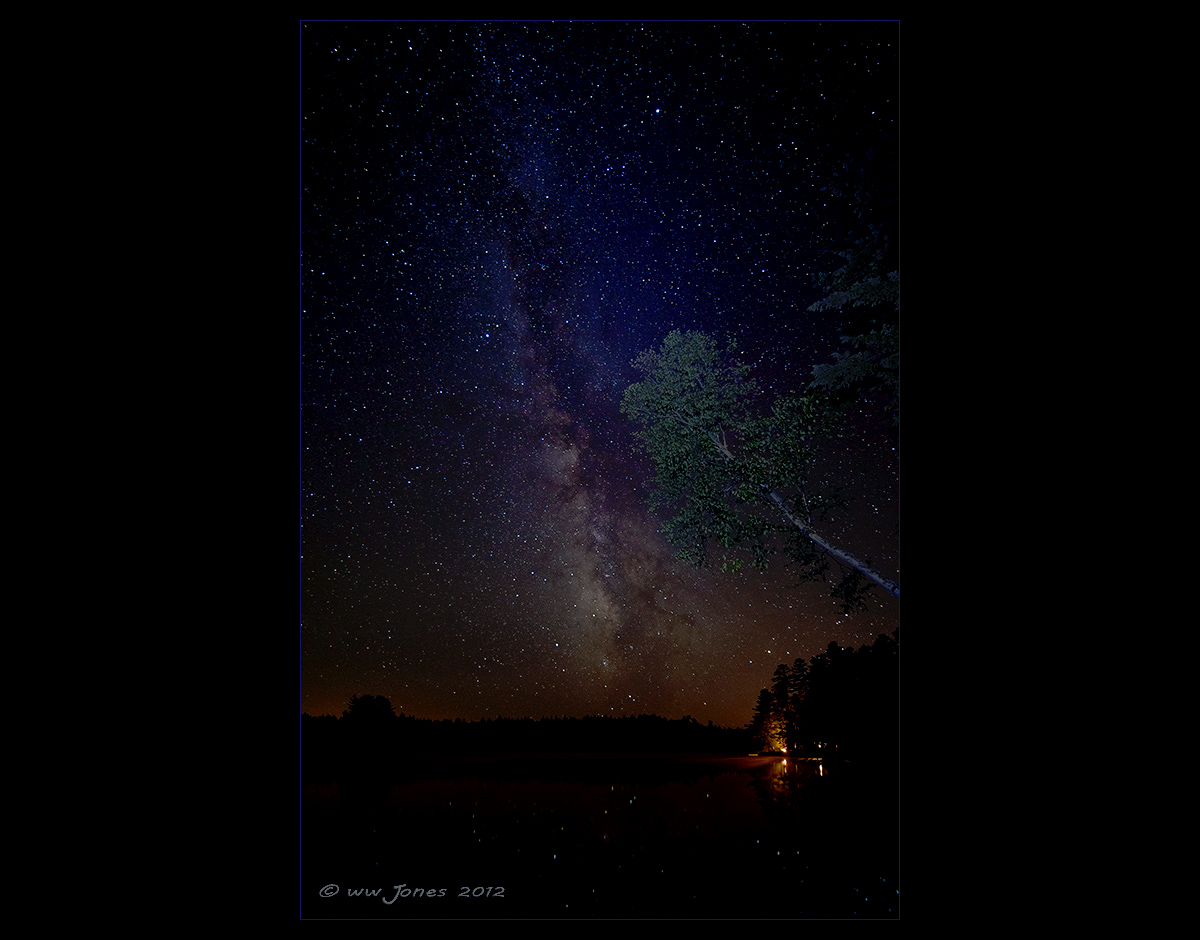
My last night shot for now...
While shooting the Milky Way from my island campsite, I noticed a flare-up in the campfire on another island that was in my view. I made a couple of extra exposures to see if the brighter glow might look OK in the scene. Adding small branches to a fire brightens up the camp, but kind obliterates the stars for anyone sitting by the fire. I wonder if they even knew what they were missing.
I think I'm starting to get the hang of these night scenes. The key to setting the mood seems to be in curves adjustments, at least for my style of shooting these with a single exposure of the dark night sky. I know a lot of people make a twilight exposure first to provide a brighter background for the stars, but I'm going more for reality than for a fantasy image that does not exist in Nature. I wonder if other people like this dark-sky interpretation of starry night scenes as opposed to the more colorful fantasy images.
Canon 5DII; 14mm.
30 sec. @ f/2.8; ISO 1600 for the sky; and 20 sec. for the campfire
Tripod; "painting" light with an LED headlamp on foreground trees.
2 exposures blended by hand in CS5

Comments
10 commentsI have taken some "fantasy night sky" images myself, and I have to say that at least for me, the colorful sky was not the result of twilight exposures. In all of my cases they are single-exposure sky shots (I did take some twilight exposures from time to time, but they were only used for ground). So I guess that it depends on altitude, air clarity, light pollution, exposure, etc.
As for the dark sky - I tend to like the "fantasy shots" quite a bit, but as mentioned by Yiming above, the sky can come out quite colorful even with a single exposure for the sky. Whether exposure blends, if used, are less real than fantasy is also not all that clear to me. Our eyes perceive things differently compared to a digial sensor or film, so sometimes, an exposure blend is closer to what I saw than is a single exposure. Just my 2 cents...
BASIL, Thanks for the reminder about the difference between human vision and film/sensor light sensitivity. I suspect that is largely responsible for the fact that the light pollution looks more pronounced in the image than in my memory of the scene. (Reminds me of how startled -- and delighted -- I was with my first color slides of night scenes in the 1960s. Ektachrome was much more color-sensitive at night than my eyes.) I agree about exposure blends; they can be used to correct the differences between human vision and camera vision, or they can be used to add something to an image that neither the camera nor the eye will ever see in nature, and that can be a beautiful thing.