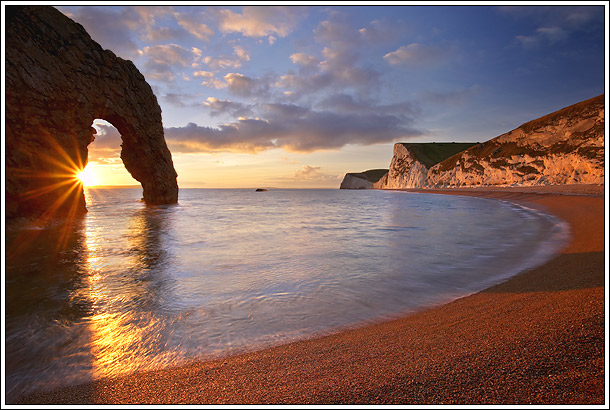
Durdle Door Coastline
by Guy Edwardes
Taken this afternoon at the famous rock arch of Durdle Door on the south coast of England.
Again, two exposures combined in PS. To me one of the major benefits of digital capture for landscape photography is the ability to control contrast without the limitations of a straight line graduated ND filter.
EOS 1Ds, 17-40L, Polariser, ISO 50, 2 seconds @ F22 (foreground exposure).

Comments
22 commentsJohn Zinn
i love the swoop of water, and the rays from the sun!
the great light on the far right stuff doesn't hurt either!
may i ask...how did you go about combining them? did you mask? if you masked...did wat did you do at the high contrast areas...like the middle part of the arch? did you use a hard brush and take a while to get close to the edge?
i've tried combining shots before, and the edges always looked weird (probably because i knew they weren't supposed to look like that lol)
well, great shot! it's gorgeous...i hope you've printed this one!
Vito
That is definitely the key to overcoming the limitations of both digital and film capture. Very well done here, Guy. The curve of the water line is just fantastic.
Curious, this would be national park here in the U.S. How do you avoid footprints in the sand.
I have to agree with everyone else this is a beaut.The shoreline,clouds and the arch make this one.I do seem to be noticing what appears to be flare or something around the sun.It is not that important and in no way takes away from what you have here I just find it a little distracting.
Also agree about the blend to get around the limitations.I have yet to use such a feature,but I can see why it is needed.
Thanks for sharing.
Good work.
Joe.
Ed
Erik
<i>Perhaps if I changed my name to "Guy" like Mr. Tal or Mr. Edwards, my photos would improve. Hmmm.
By the way, what is a Durdle?
Guy
Vito,
I always find it difficult to answer digital questions without demonstrating on-screen. Basically I layered the lighter foreground exposure over the darker exposure for the sky. I then erased the top layer to reveal the sky (and other highlights) beneath. I did this in stages using different sized brushes at varying opacities until the contrast range in the image was roughly balanced - I tend to use quite large brush sizes at a low opacity and overlap the edges of the contrasting areas grading them until I get the desired result. I then applied levels and colour balance adjustments to each layer to fine-tune the overall balance of the image. Hope this makes sense
Guy,
I have no idea what a "durdle" is - I've never really thought about it! However, I will endeavour to find out for you
Erik,
Feel free to get in touch before your next visit to the UK. I'd be happy to recommend some good locations - specific to the time of year that you're here.
i see wat you mean...i'll have to try it again with the low opacity stuff...
lol, i think i just tried to do it too fast ;)
Vito
Stunning. As usual.
Cheers
Carl
Apparently (and quite logically I guess) the name "durdle" derives from the Old English word for pierced.