St. Helens' Fall
by Alex Noriega
Please click the Purchase Print link above to view it on a dark background - really helps make this particular image pop.
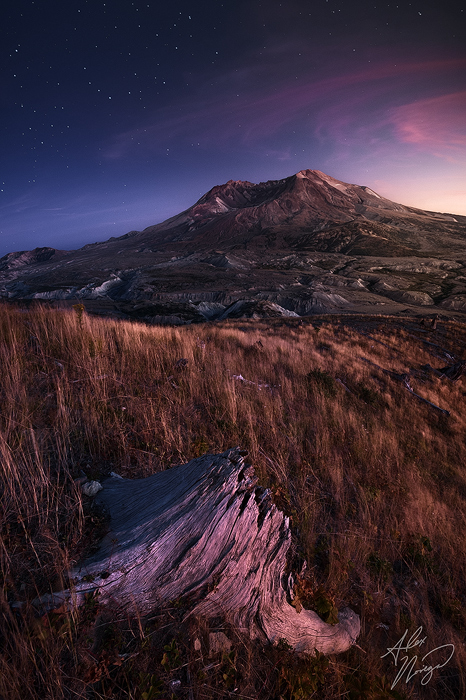
Washington's Mount St. Helens at twilight in autumn. Stopped over on a whim en route from Centralia to Portland to take my new (to me) D300 on a test run. Good to be back to a workhorse/tank body, although I'll miss the dynamic range of the D7000.
I considered titling this "Volcanic Twilight IV", but I think it's dissimilar enough (without a reflecting lake) and unique enough to bust out of the official series.
I like the overall autumn-esque hues of the final image, without any traditional autumn foliage. I also like how the foreground stump sort of mirrors the mountain, as it looks like it erupted out to the upper-right.
There was an EXTREMELY long-lasting and colorful sunset to the west, casting VERY warm light on the landscape even as the stars began to shine, as the post-sunset light filtered through the clouds. I've never seen stars when that warm of light was still on the landscape, prior to last night (although I did still have to wait to make the star exposure, as they weren't showing up in-camera at that time).
There seems to be a misunderstanding on how I make these twilight images: the "star exposure" is literally JUST for the white points of light. There's no major "blend" going on here. Without blending, this would be the exact same image without white points in the sky. All I do is overlay the stars and make them look pretty.
Nikon D300, Nikkor 10-24mm
Main exposure: ISO 200, f/11, 15 sec
Star exposure: ISO 800, f/3.5, 30 sec

Comments
23 commentsaF
Peter, you may be right that it needs a slight CW rotation - but I'm not sure. I was going off the grasses in the center, which are close to perfectly vertical - although the ones on the left lean left, these were all a bit windswept on that ridge, so that may explain it. I've looked at some other images of St Helens, and they're mostly taken from the Johnston Ridge Observatory, which is about a mile east of this spot, and has a more straight-on view of the crater. I think since I was further to the west of such a view, the western (right) lip of the crater appears higher than in most other images, since it's closer. I didn't use a bubble level (as I had it built-in on the D7000 and this was my first image with the D300, didn't have one) - but I believe my thinking during composition was that I wanted the crater "pointing" into the image leftward, while the stump pointed rightward.
Tony: I can't do without my precious stars! They're a bit more subtle/soft/glowing in the full version - the web sharpening makes them stand out more than intended.
Everything is just WOW
Max