Gallery: Weekly ChallengePosted October 15, 201254 views9 comments
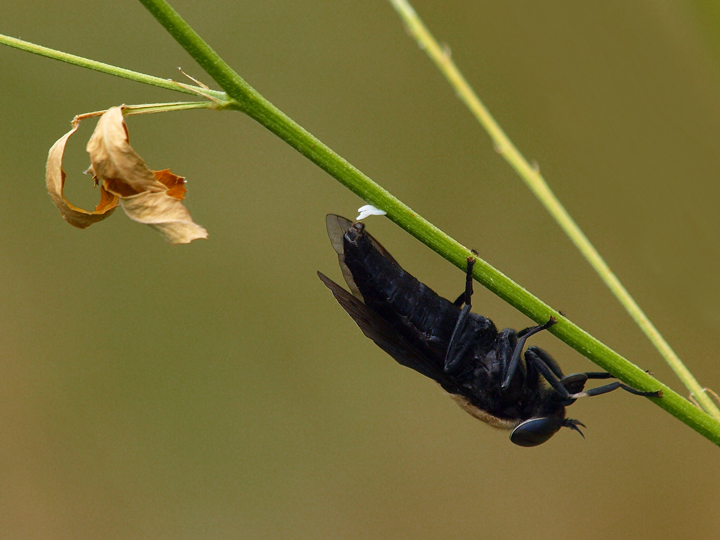
Transition to the next generation of horse flies. Ugh!
Comments
9 comments
Comment posted by Carolyn Derstine on October 15, 2012 at 5:02 PM
Great capture! Your posting got me curious so I did some research online. One finding says, "The adult horse fly's life span is around 30 to 60 days, however, the total life cycle may take a lot longer. Most species of horse fly spend the entire winter in a larval state and pupate during spring and early summer. They then lay eggs from late summer to early autumn and the process starts again." So your photo is really a great illustration of a unique seasonal transition event! Well executed photo with good comp and details. Nice one, Charlie!
Registered on February 16, 2011, 610 Posts, 3684 Comments
Comment posted by Charlie Baugh on October 15, 2012 at 5:48 PM
If I recall correctly from searching, when I shot this a few years ago. This Black Horse fly lays her eggs on a branch overhanging water (stream, river, etc.) and the larvae develop in the water to emerge as a new fly. This branch was hanging out over our pond. Glad to know you like this kind of stuff. So many don't [g]
Registered on April 18, 2011, 329 Posts, 1985 Comments
Comment posted by Philip Hodgkins on October 15, 2012 at 8:40 PM
Count me as one who enjoys the details. I am a firm believer in knowing something about one's photographic subject.
Registered on July 24, 2006, 2741 Posts, 12349 Comments
Comment posted by Paul Breitkreuz on October 16, 2012 at 1:41 PM
Charlie, this was a surprise to see as a transitional subject. I did not think about it but obviously there are many subjects in the animal kingdom such as this horse fly that go through seasonal changes. Some cases of molting, shedding, color changes for the season and other aspects of change also.
So, good subject here and the thought on the transition along with a fine example too.
Registered on February 25, 2006, 525 Posts, 8448 Comments
Comment posted by Charlie Baugh on October 16, 2012 at 3:34 PM
Phil and Paul, this strategy for animals to survive as a specie through the severity of freezing winter is one used by many species. The live animal does not survive but his progeny living and developing at the bottom of ponds, lakes etc. get by with the help of milder temps. Isn't nature so fascinating in how evolution works is so many variations.
Registered on April 18, 2011, 329 Posts, 1985 Comments
Comment posted by Howard Cheek on October 16, 2012 at 7:14 PM
Great transitional image Charlie, the egg laying behavior's well seen..
Even the single dead brown leaf speaks to this.
Well done!
Registered on July 24, 2008, 1201 Posts, 10758 Comments
Comment posted by Rob Graham on October 16, 2012 at 10:52 PM
a different approach to the theme, but a very fitting one, Charlie. Nice job on seeing the scene and capturing it.
Registered on August 22, 2006, 842 Posts, 2824 Comments
Comment posted by Jim Nall on October 17, 2012 at 1:00 PM
Excellent Charlie, nice detail on this guy. I like his stem and ever so accomodating background! A win win win.
Registered on October 5, 2012, 45 Posts, 168 Comments
Comment posted by Mark Seaver on October 18, 2012 at 10:19 AM
Great capture, Charlie. You couldn't have been too put off, because it's hard to imagine that you didn't spend some time watching this horse fly to get just the right moment.
Registered on January 23, 2011, 1103 Posts, 17270 Comments

Comments
9 commentsSo, good subject here and the thought on the transition along with a fine example too.
Even the single dead brown leaf speaks to this.
Well done!