Nature Photographers Network
This is the preserved archive of the original Nature Photographers Network. The community continues at naturephotographers.network.
What Would You Think?
‹ PreviousWildlife GalleryNext ›

What Would You Think?

by Peter Cross

Gallery: WildlifePosted January 17, 2013193 views6 comments
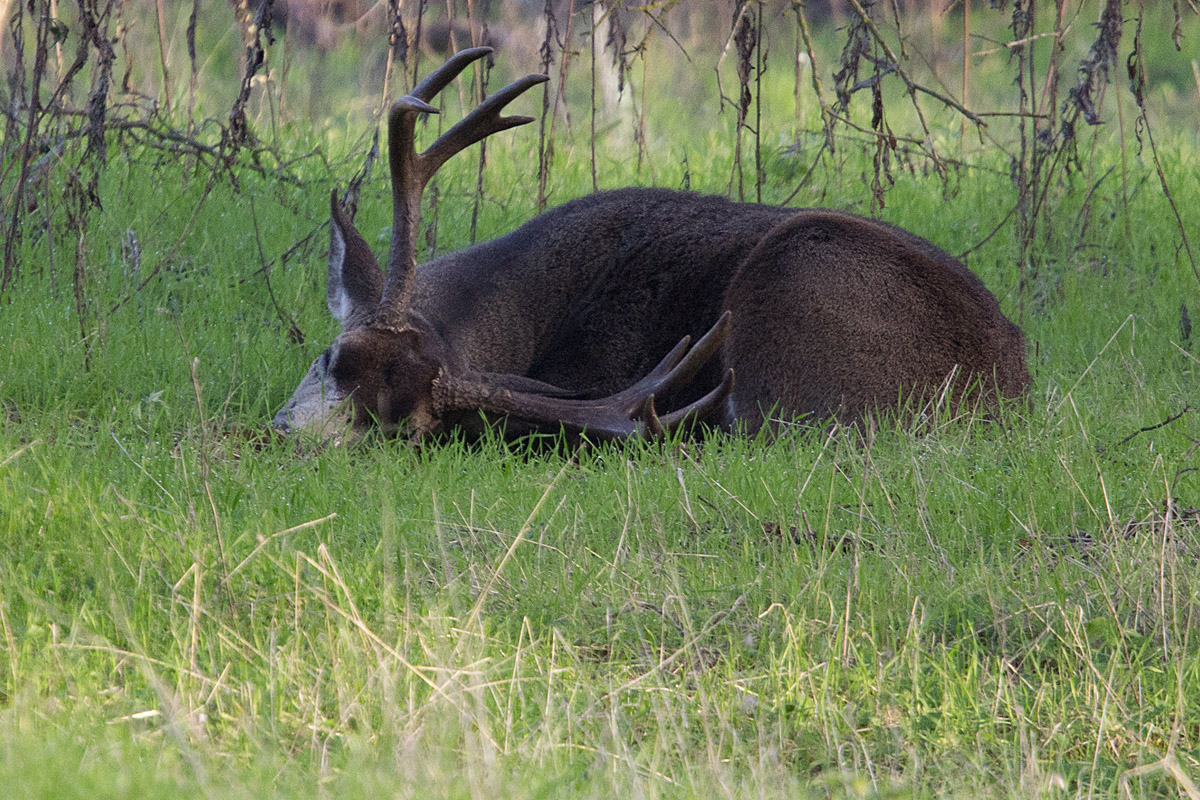
Earlier in the same morning I had encountered the buck I posted a photo of the other day. He was in the same spot and in essentially the same position. After I had taken a few shots and kind of exhausted the possibilities with him lying there, I moved on to another buck to photograph. After taking a few shots, I looked back at the first deer and this is what I saw. If I had come upon this at first I would have thought, "dead deer." But, no, he moved and sat upright again then put his head down several more times. And when I came back later he was nice, lively, and upright then as well. What was going on? My thought was he was just plain tired and exhausted from the rut and perhaps feeling the weight of that rack and jsut needed a rest. The larger version is cropped to show his head better and which seems to show the eye either closed or nearly so. I've seen does put their head down briefly but this is the first time with a buck. Has anyone else experienced this kind of event? Assusme deer have to sleep but can they sleep while holding their head up high?

Comments

6 comments
Comment posted by Marsel van Oosten on January 18, 2013 at 3:56 AM
I found this:

"While there has been very little research done on sleeping whitetails, the prevailing wisdom says that deer sleep with their heads in a variety of positions and with their eyes both opened and closed. Deer sleep anywhere they bed. Their head position changes many times during a sleep session, and they may lay with their front and back legs tucked under them, their back legs tucked and front legs extended and even on their side with all of their legs extended.

A typical sleeping session includes 30 seconds to a few minutes of dozing, followed by a brief alert period and then more dozing followed by an alert period. This cycle often lasts for about 30 minutes. Generally, once every 30 minutes or so deer will stand and stretch and they may urinate or defecate before laying back down. Also, deer spend the majority of their time bedded. The exact amount varies seasonally as deer spend less time bedded during the rut and more time bedded during winter, at least in northern environments."
Registered on March 9, 2004, 285 Posts, 2277 Comments
Comment posted by Peter Cross on January 18, 2013 at 12:49 PM
Marcel: Thanks for your insight on this. It appears to me this deer may have been doing just what you describe: Getting short periods of sleep between fully alert periods. He also displayed putting the head down with the chin on the ground which is more like I would expect. I'm hypothesising that these short periods are helpful for them whereas for humans that short a rest probably would not be of much value. Do African ungulates do the same? I seem to remember a few years ago that some researcher found that elephants may lie down to sleep but it had not been documented previously. Seems to be a rather open field for investigation.
Registered on April 3, 2010, 271 Posts, 1342 Comments
Comment posted by Lon Sharp on January 18, 2013 at 1:52 PM
It tells me you were not considered any kind of threat, or he would have remained a little more alert. I have seen this kind of posture before, but I suspect it is uncommon.
Registered on December 9, 2007, 258 Posts, 9892 Comments
Comment posted by Vincent Grafhorst on January 19, 2013 at 12:36 PM
Thanks for sharing this most interesting image Peter. I have seen ungulates rest, lying down, but never with their heads down like this. Perhaps this individual is sick?
Registered on February 24, 2006, 504 Posts, 7203 Comments
Comment posted by Peter Cross on January 19, 2013 at 3:19 PM
Sickness occurred to me as well, Marsel. I have no idea if it is. Certainly the stress of the rut could reduce it's strength and make it more suseptible to illness. Other than this, it displayed no other behavior that I would call unusual. I will be looking for this guy on coming visits and try to gauge his status.
Registered on April 3, 2010, 271 Posts, 1342 Comments
Comment posted by Richard Olsen on January 21, 2013 at 10:03 PM
Interesting photograph Peter. I've seen a couple of large bucks do this and believe it is because of the weight they are having to carry throughout the day. This is also very common with large elk.
Nice catch!
Registered on October 19, 2006, 306 Posts, 1571 Comments